Facebook
 Google
 GitHub
 Linkedin
It seems that whenever a circuit is presented for study, the ones that elicit the most disagreement are those that contain ideal circuit elements.
For example, consider this one:

If the voltage sources are ideal (zero internal impedance), the wiring is ideal (superconductor perhaps?), and the question is "what is the current in the 1 ohm resistor", beginning students are quite flummoxed. Eventually, after much discussion, it is agreed that the question can't be answered.
Note that if anything is less than ideal, if the batteries have any internal resistance (even one of them), or if the wiring has some resistance, however small, the question has a definite answer.
The student learns that you can't connect ideal voltage sources in parallel, and you can't connect ideal current sources in series
Another similar situation is the case where two ideal capacitors, one of which is charged to some voltage, are then connected in parallel with wiring having no resistance. Calculations show that energy is lost after the connection is made. But where did the energy go? If there is any resistance in the capacitors or wiring, there is no paradox. I am aware that in the ideal case where the method of making the connection is not ideal, energy will be lost in the spark, or in radiation from the loop of wire making the connection, but that's not the point here.
The circuit from the tutorial as shown:
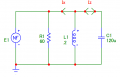
raises the question "Is there any interaction between L1 and C1?" Is the current Iz sloshing back and forth between L1 and C1? It would seem that if E1 is an ideal voltage source that the answer is no. Thus, it would seem that L1 and C1 are decoupled from each other, and there can be no resonance.
Yet, if we calculate and plot the impedance of the total LCR circuit, we see an definite peak in the impedance. If we analyze (or simulate) the current from the voltage source and plot it vs. frequency, it exhibits a pronounced dip in value at a frequency given by 1/(2*pi*(L1*C1)). This is the frequency we would normally associate with resonance, so apparently L1 and C1 are not decoupled from one another.
We have a paradox: L1 and C1 are decoupled, yet they are not decoupled.
The addition of the slightest non-ideality removes the paradox. Here's the ideal circuit with it's paradoxical bahavior, redrawn:

But with just a tiny non-ideality, the paradox is resolved:
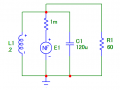
Now L1 and C1 are no longer decoupled. But, even now, the "voltage resonance" is extremely low q; probably not very useful.
I haven't seen the terms "voltage resonance" and "current resonance" before, but in discussing circuits where the presence of ideal components gives rise to a paradox, they can be useful. We see that such a circuit can have one kind of resonance but not the other, and apparently for one kind of excitation components can be decoupled, but for another kind of excitation, they are not decoupled.
Any resonant circuit with non-ideal components, voltage sources with non-zero internal impedance, and current sources with less than infinite internal impedance, will always have both "voltage resonance" and "current resonance"; there will be no paradox.
Edit: For people who read this thread without reading the other thread that spawned it, the Tutorial referenced is:
http://www.electronics-tutorials.ws/accircuits/parallel-resonance.html
The tutorial could be enhanced by pointing out this paradox, and pointing out that in practical applications, a parallel resonant circuit should probably be current driven, that is, driven from a high impedance.
For example, consider this one:
If the voltage sources are ideal (zero internal impedance), the wiring is ideal (superconductor perhaps?), and the question is "what is the current in the 1 ohm resistor", beginning students are quite flummoxed. Eventually, after much discussion, it is agreed that the question can't be answered.
Note that if anything is less than ideal, if the batteries have any internal resistance (even one of them), or if the wiring has some resistance, however small, the question has a definite answer.
The student learns that you can't connect ideal voltage sources in parallel, and you can't connect ideal current sources in series
Another similar situation is the case where two ideal capacitors, one of which is charged to some voltage, are then connected in parallel with wiring having no resistance. Calculations show that energy is lost after the connection is made. But where did the energy go? If there is any resistance in the capacitors or wiring, there is no paradox. I am aware that in the ideal case where the method of making the connection is not ideal, energy will be lost in the spark, or in radiation from the loop of wire making the connection, but that's not the point here.
The circuit from the tutorial as shown:
raises the question "Is there any interaction between L1 and C1?" Is the current Iz sloshing back and forth between L1 and C1? It would seem that if E1 is an ideal voltage source that the answer is no. Thus, it would seem that L1 and C1 are decoupled from each other, and there can be no resonance.
Yet, if we calculate and plot the impedance of the total LCR circuit, we see an definite peak in the impedance. If we analyze (or simulate) the current from the voltage source and plot it vs. frequency, it exhibits a pronounced dip in value at a frequency given by 1/(2*pi*(L1*C1)). This is the frequency we would normally associate with resonance, so apparently L1 and C1 are not decoupled from one another.
We have a paradox: L1 and C1 are decoupled, yet they are not decoupled.
The addition of the slightest non-ideality removes the paradox. Here's the ideal circuit with it's paradoxical bahavior, redrawn:
But with just a tiny non-ideality, the paradox is resolved:
Now L1 and C1 are no longer decoupled. But, even now, the "voltage resonance" is extremely low q; probably not very useful.
I haven't seen the terms "voltage resonance" and "current resonance" before, but in discussing circuits where the presence of ideal components gives rise to a paradox, they can be useful. We see that such a circuit can have one kind of resonance but not the other, and apparently for one kind of excitation components can be decoupled, but for another kind of excitation, they are not decoupled.
Any resonant circuit with non-ideal components, voltage sources with non-zero internal impedance, and current sources with less than infinite internal impedance, will always have both "voltage resonance" and "current resonance"; there will be no paradox.
Edit: For people who read this thread without reading the other thread that spawned it, the Tutorial referenced is:
http://www.electronics-tutorials.ws/accircuits/parallel-resonance.html
The tutorial could be enhanced by pointing out this paradox, and pointing out that in practical applications, a parallel resonant circuit should probably be current driven, that is, driven from a high impedance.
Last edited: