P-MOS control and capactive load

Irving

Joined Jan 30, 2016
5,128
i've opened some DC/DC 100V input / 12V 10-20A ouput, there are either 100uF or 220uF.
some people use 2 of them (so 440uF total max on my circuit) ;)
OK, fair enough.

I'd approach your problem with a current limiter... a small sense resistor in the drain circuit and a feedback loop shutting off the drive to the PMOS if it exceeds a certain value. You also need a 15v zener from gate to source to protect the PMOS gate.
 

Thread Starter

Koxx3

Joined Sep 29, 2022
17
OK, fair enough.

I'd approach your problem with a current limiter... a small sense resistor in the drain circuit and a feedback loop shutting off the drive to the PMOS if it exceeds a certain value. You also need a 15v zener from gate to source to protect the PMOS gate.
do you have an example of such circuit ?
for the zener diode between G&S, why is it usefull ?
 

Ian0

Joined Aug 7, 2020
13,132
OK, fair enough.

I'd approach your problem with a current limiter... a small sense resistor in the drain circuit and a feedback loop shutting off the drive to the PMOS if it exceeds a certain value. You also need a 15v zener from gate to source to protect the PMOS gate.
If the load is still attached, it may get into a situation where it is dissipating a lot of power.
Better still would be to add a resistor from the drain so it limits at a lower current for a higher Vds, like the classic audio amplifier SOA protection circuit.
 

Thread Starter

Koxx3

Joined Sep 29, 2022
17
If the load is still attached, it may get into a situation where it is dissipating a lot of power.
Better still would be to add a resistor from the drain so it limits at a lower current for a higher Vds, like the classic audio amplifier SOA protection circuit.
ok, understood, but it's bad simulation. as explained, the load is dc/dc converter with lights.
The main issue is the capacitive load of the dc/dc with 'large' input capacitors... it seems to me that it is the issue that must be handled during power on to prevent mosfet failure.
can those capacitors impact mosfet during latch power off discharge ?
 

LowQCab

Joined Nov 6, 2012
5,101
OK, so far .......
You have no control over the Power-Supply for the "Lights", ( what ever they actually are ),
You want a Circuit that can switch several hundred Amps of Inrush-Current,
and it has to fit on the head of a Straight-Pin ................

The answer is NO,
You can not do this.
You will need a substantial, Large-Package, FET, mounted to some sort of Heat-Sink,
or You will just continue to smoke FETs.
.
.
.
 

ronsimpson

Joined Oct 7, 2019
4,695
The irfr9120 is a 100 volt part. That is too close to the limit.
does anybody use NTC to limit inrush current ?
Inrush limiting is often used in 120/220 power supplies. (charging up the ele-caps in the supply)
When you first turn on the TV the resistor is cold and high resistance. While the caps charge up the resistor gets hot and gos to a low resistance.
 

crutschow

Joined Mar 14, 2008
38,513
Below is the LTspice simulation of a circuit that uses an added MOSFET to limit the surge current.
M2 initially turns on with a 10Ω resistor in series to limit the inrush load current to <10A (blue trace).
When the load capacitor is charged to about 90% of the final value, M1 turns on (red trace) after a delay due to R5 and C2 (about 70ms here), to directly connect the power to the output (yellow trace). and carry the load current.
M1 is slow to turn-on due to the RC gate delay, but that should not be a problem, since its peak current is <2A, and Vds is only about 10V at that point.
(I didn't have models for the MOSFETs you have, so I used some with similar parameters.)

R4 should probably have at least a 1W rating to handle the 3 watt-second initial power surge.

The MOSFETs should not need a heat-sink since there are only momentarily dissipating a high power, with the small steady-state dissipation equal to the M1 MOSFET on-resistance times the load current.

1664589239257.png
 
Last edited:

Thread Starter

Koxx3

Joined Sep 29, 2022
17
The irfr9120 is a 100 volt part. That is too close to the limit.

Inrush limiting is often used in 120/220 power supplies. (charging up the ele-caps in the supply)
When you first turn on the TV the resistor is cold and high resistance. While the caps charge up the resistor gets hot and gos to a low resistance.
ah !! very interesting answer for the inrush current limiter !
as you describe it, it seems to be an NTC.
any idea how to select the right NTC ?

for the 100v, as i wrote in the answers, the max input voltage is 92v (22s battery).
 

Thread Starter

Koxx3

Joined Sep 29, 2022
17
Below is the LTspice simulation of a circuit that uses an added MOSFET to limit the surge current.
M2 initially turns on with a 10Ω resistor in series to limit the inrush load current to <10A (blue trace).
When the load capacitor is charged to about 90% of the final value, M1 turns on (red trace) after a delay due to R5 and C2 (about 70ms here), to directly connect the power to the output (yellow trace). and carry the load current.
M1 is slow to turn-on due the RC gate delay, but that should not be a problem, since its peak current is <2A, and Vds is only about 10V at that point.
(I didn't have models for the MOSFETs you have, so I used some with similar parameters.)

R4 should probably have at least a 1W rating to handle the 3 watt-second initial power surge.

The MOSFETs should not need a heat-sink since there are only momentarily dissipating a high power, with the small steady-state dissipation equal to the M1 MOSFET on-resistance times the load current.

View attachment 277444
very interesting option too ! lt will be difficult to fit on the pcb, but i'll check. thanks.
 

crutschow

Joined Mar 14, 2008
38,513
any idea how to select the right NTC ?
Here's the data sheet for one brand of NTC surge limiters.
You would pick one rated for around 1A.
Note that they dissipate some power due to their resistance value when carrying their rated current (Approx R of Max Current) that varies with current, and which will somewhat reduce the efficiency of the circuit.
This resistance goes up at lower current levels, reaching the maximum at 0A.
 
Last edited:

Thread Starter

Koxx3

Joined Sep 29, 2022
17
yes.
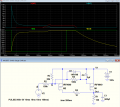
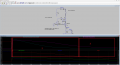
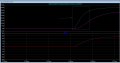
I am now simulating with LTSpice. It seems much more realisitic with models from manufacturers !

1665265931414.png

1665265910978.png
 

Thread Starter

Koxx3

Joined Sep 29, 2022
17
I use TDK spice models.
but I still struggle to see if the NTC 2.2ohm will support such power (~500W for a short period ... seems HUGE).
 

Papabravo

Joined Feb 24, 2006
22,082
I use TDK spice models.
but I still struggle to see if the NTC 2.2ohm will support such power (~500W for a short period ... seems HUGE).
It all depends on the thermal resistance of the package. This parameter is called \( T_{JA} \) or sometimes \( \theta_{JA} \) in the datasheets. The units are usually in °C/W, that's degrees Centigrade per watt. A SOT-23 package has the parameter at about 90-170 °C/W so a part like that could not handle it for very long is at all. Back of the envelope 500 W * 90 °C/W = 45,000 °C which exceeds the temperature of the sun by about an order of magnitude.
 
Top