Over/Undershoot issue 555/40106/4420

Thread Starter

cv43coeralsea

Joined Mar 17, 2021
22
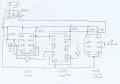
Having an issue with the circuit below:
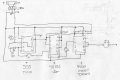
circuit2.jpg

The circuit generates a 50% duty cycle square wave at 500Khz. This is working. (The 555 is an ALD555 good up to 2Mhz).
The output of the Max4420 Mosfet driver has a big over/under shoot. There is no difference if the Mosfet is connected or not (J3 removed).
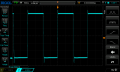
4420Out.png

The input to the MAX4420 from the 40106 inverter looks like this:
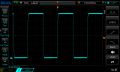
40601Out.png

Next I look at what is coming in to the 40106 from the 555: Their is a ground bounce or undershoot. If I remove J1 it is the same.
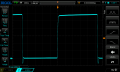
555Out.png

I tried a few different capacitors around the 555. I put a big low ESR cap at the regulator. I tried to keep the traces as short as possible.

I'm hoping someone has some insight on this flavor of pain. Thanks!
 

MrChips

Joined Oct 2, 2009
34,628
You have to determine if this is real or it is an artifact of the oscilloscope and probe.

Are you using a x1/x10 oscilloscope probe? Make sure it is in the x10 attenuation setting.

If this does not help try using the probe with a 470-1kΩ resistor in series with signal to be measured and the tip of the probe.
 

Thread Starter

cv43coeralsea

Joined Mar 17, 2021
22
You have to determine if this is real or it is an artifact of the oscilloscope and probe.

Are you using a x1/x10 oscilloscope probe? Make sure it is in the x10 attenuation setting.

If this does not help try using the probe with a 470-1kΩ resistor in series with signal to be measured and the tip of the probe.
I've tried both settings, 1x & 10x, same picture. I will try the resistor trick. Thanks
 

MrChips

Joined Oct 2, 2009
34,628
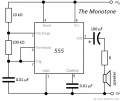
When drawing electric/electronics circuits schematics you must focus on drawing functional boxes. Do not feel compelled to draw the box with pin number as they appear on the IC package. That is for a wiring diagram and PCB.

For example, this is a better way of drawing a 555-timer circuit.
Notice that the pin numbers appear on the outside of the box while the pin function is on the inside of the box.
Signal flow is from left to right, i.e. inputs on the left and outputs on the right.
Components should be given parts designators such as C1, R2, U3, Q4, etc.

1654375269241.png
 

Thread Starter

cv43coeralsea

Joined Mar 17, 2021
22
When drawing electric/electronics circuits schematics you must focus on drawing functional boxes. Do not feel compelled to draw the box with pin number as they appear on the IC package. That is for a wiring diagram and PCB.

For example, this is a better way of drawing a 555-timer circuit.
Notice that the pin numbers appear on the outside of the box while the pin function is on the inside of the box.
Signal flow is from left to right, i.e. inputs on the left and outputs on the right.
Components should be given parts designators such as C1, R2, U3, Q4, etc.

View attachment 268740
Thanks. Wanted to sort of show actual routing. But good tips!
 

Thread Starter

cv43coeralsea

Joined Mar 17, 2021
22
I assume you forgot to draw the connection dot for power to the Schmitt inverters. What is the purpose of having a buffer on the timer output? The timer has more drive strength than the inverters.

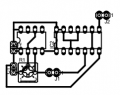
Routing diagrams are rarely useful for conveying circuit intent.
Yes forgot dot.

Ok. my brain is in routing mode.

Inverter was a place holder if I have to drive multiple branches/ Mosfets

Thanks!!
 

dl324

Joined Mar 30, 2015
18,220
Yes forgot dot.
See that you added it in the second schematic.

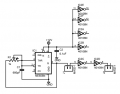
It's easier to discern circuit intent when you use proper symbols:
1654380255485.png

When you use connection dots, you don't need the humps. That style went out about 50 years ago. Now you use one or the other. I was able to avoid wire crossings by drawing a more conventional schematic.
 

Thread Starter

cv43coeralsea

Joined Mar 17, 2021
22
See that you added it in the second schematic.

It's easier to discern circuit intent when you use proper symbols:
View attachment 268746

When you use connection dots, you don't need the humps. That style went out about 50 years ago. Now you use one or the other. I was able to avoid wire crossings by drawing a more conventional schematic.
Very nice. Thanks, appreciate the pointers and help!
 

eetech00

Joined Jun 8, 2013
4,704
Having an issue with the circuit below:

View attachment 268730

The circuit generates a 50% duty cycle square wave at 500Khz. This is working. (The 555 is an ALD555 good up to 2Mhz).
The output of the Max4420 Mosfet driver has a big over/under shoot. There is no difference if the Mosfet is connected or not (J3 removed).

View attachment 268726

The input to the MAX4420 from the 40106 inverter looks like this:

View attachment 268728

Next I look at what is coming in to the 40106 from the 555: Their is a ground bounce or undershoot. If I remove J1 it is the same.

View attachment 268729

I tried a few different capacitors around the 555. I put a big low ESR cap at the regulator. I tried to keep the traces as short as possible.

I'm hoping someone has some insight on this flavor of pain. Thanks!
Doesn't look 50% duty cycle to me...but close.

Anyway, try pulling up the discharge pin and then use it to drive the 40106 so that the drive circuit is isolated from the 555 timing components. The discharge pin will have an inverted output so you may need to use a 40106 to invert it again.
 

LowQCab

Joined Nov 6, 2012
5,101
Aside from learning how to Communicate via Schematics ...............
Why do You think that the very minor "Over-Shoot" is a problem ?
.
.
.
 
Top