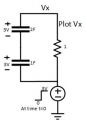
So are the voltages next to the capacitors the voltages on them at t=0?
That's an important point because whatever happens to to the 3 V source, the voltages across those capacitors will be changing, and so you need to know at what time they are the indicated values (though t=0 is the only reasonable assumption you can make in the absence of that information).
What is the final voltage across the 1 Ω resistor?
What is the final voltage across each of the capacitors?
What does the current through the resistor look like as a function of time for t > 0?
What effect does the voltage source have on the voltages, with respect to ground, anywhere in the circuit?
Well, as there is nothing SUPPLYING voltage to the capacitors, they will reach zero volts in time, therefore the final voltage at Vx will be 3 + 0 = 3 volts
Hi hoy,
The initial circuit shows a 3V potential across each capacitor, so 6V across the series pair, in parallel with the 1R.
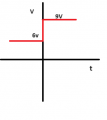
So from time=0 they will discharge through the 1R, the Pulsed 3V will have no effect on the capacitor discharge time.
But will set the final voltage to +3V.
What will the current in the resistor after a long time?
Let's assume, for the moment, that it is something other than zero. Doesn't that mean that energy is going to be being converted to heat by the resistor? But where is that energy coming from? The capacitors only store so much energy, so they can't deliver energy to the resistor forever. The source has no closed path for current to flow, so it can't provide any current, or energy, to anything.
If the current in the resistor is zero, what is the voltage across the resistor?
If you know the voltage across all of the components along some path between the point of interest and the reference point (i.e., 'ground'), can you find the voltage of the point of interest relative to the reference point.
Well, as there is nothing SUPPLYING voltage to the capacitors, they will reach zero volts in time, therefore the final voltage at Vx will be 3 + 0 = 3 volts
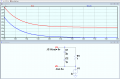
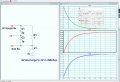
Although it won't change the results you plot, your circuit is not a faithful representation of the problem, in that you have performed part of the solution and then assumed it is correct and imposed it in the simulation.
You need to apply an initial condition that charges each cap to the voltage that is given across it.
It would also be good to then plot the voltage at the junction of the two capacitors to show that it does NOT go to the same voltage as Va or Vb.
This is a case where using the IC attribute of the capacitors would be the best way to go, since (as far as I know), the .IC direction only let's you set the voltage on a node. But this requires you to be sure that you get the part oriented correctly so that the polarity is correct.
Well, as there is nothing SUPPLYING voltage to the capacitors, they will reach zero volts in time, therefore the final voltage at Vx will be 3 + 0 = 3 volts
Ok, there is nothing supplying a voltage ACROSS the capacitors, therefore the voltage ACROSS the capacitors will discharge to zero through the resistor.
You have to have a complete circuit in order for current to flow. Start at the top of the voltage source and try to draw a line, passing through components as needed, from there back to the negative side of the source without touching any wire twice. If you can't do it, then there is no path for current to flow, and hence no means for the source to provide current to anything.
It's like connecting one terminal of a battery to a lightbulb and expecting it to light up.
Ok, there is nothing supplying a voltage ACROSS the capacitors, therefore the voltage ACROSS the capacitors will discharge to zero through the resistor.
It seems the initial condition specifies a voltage is present.
The voltage across EACH is irrelevant to the voltage at Vx.
This little interview quiz is intended to get at whether the person taking it understands fundamental, first semester EE concepts. It's a trivial little circuit that just happens to be slightly different than what most students have seen most of the time. The interviewer is looking to see if the interviewee can apply basic concepts to the circuit and discuss them. You can bet that expecting the interviewee to be able to describe what the final voltage at the junction is fair game, and anyone that can't answer the question, or says that it's 0 V, or that it's 3 V, has probably just failed the interview.

 Facebook
 Google
 GitHub
 Linkedin