Out ripple during mosfet off time

Thread Starter

muhzd

Joined May 25, 2009
34
Hi guys,

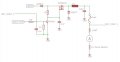
I got this circuit up:ripple 1.2Vs.jpg

Here is what the signals at the test points look like:
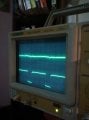
ripple 1.2V.jpg

The ripple peak to peak is 0.2V and this is during off time. 3 volt level PWM and period is 20us.
The question is can or would you get it any smoother. Maybe some components values are short or would you suggest snubbers but where?(aint that 470u enough?)

This is for a battery charging circuit. I'd like to check with you guys before substituting the load with the actual battery which is a li-ion 18650 battery. Just worried - maybe some signals are bad for them.
Thanks.
 
Last edited:

crutschow

Joined Mar 14, 2008
38,503
If you are charging a battery, 0.2V ripple is not a problem.

Warning--Charging a li-ion battery directly from that regulator will likely result in a blown battery, fire, or explosion. :eek:
Charging li-ion batteries requires a dedicated li-ion charging circuit to prevent such happenings.
 

Thread Starter

muhzd

Joined May 25, 2009
34
Hi crutcschow,
Thanks, what a relief.

...you really know what are my worries. Inexperienced, I am really have the slightest idea about any dangers. I'd loose to anybody if accused slanderous. But to defend myself I'd forward this application note. I contend myself to have the same understanding as you regarding electric and electronic at least in this to say everything else is the same.
Only the current is elevated to a max of 0.6A but this is just 18.75% whereas the datasheet recommends 50%.
:cool:

I must ask, what's wrong with it?
 
Last edited:

ian field

Joined Oct 27, 2012
6,536
Hi crutcschow,
Thanks, what a relief.

...you really know what are my worries. Inexperienced, I am really have the slightest idea about any dangers. I'd loose to anybody if accused slanderous. But to defend myself I'd forward this application note. I contend myself to have the same understanding as you regarding electric and electronic at least in this to say everything else is the same.
Only the current is elevated to a max of 0.6A but this is just 18.75% whereas the datasheet recommends 50%.
:cool:
Listen to him - the tolerance on lithium full charge terminal voltage is around +/-0.05V.

Type "lithium fire" into youtube for some pretty entertaining examples.

Boeing had to do some serious retrofitting on one of their lithium battery systems.

The weight advantage was key to their advertised fuel economy, so they couldn't abandon it - they ended up encasing the battery in a steel box with a vent tube going outside so the lithium fire didn't burn the aircraft to the ground.
 

crutschow

Joined Mar 14, 2008
38,503
I take it that I am warned that there are known risk associated with li-ion batteries.
Good.
That reference circuit should be fine as long as you build it completely and exactly as they show, including the MCU, with no shortcuts.
Otherwise the risk will turn into an undesired reality and we'll assume you are trying for a Darwin Award. :rolleyes:
 

Thread Starter

muhzd

Joined May 25, 2009
34
well..I replaced the load with the actual battery..

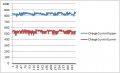
Battery voltage rise plot:
battery voltage.jpg
My ADC is 3 volts and 12 bits resolution.
According to the chart, peak to peak could reach a difference of about 40 ADC resolution unit. Battery voltage is by a voltage divider created using 47k and 20k resistor for a step down of 29.85%. So my ripple is of the magnitude 40/29.85*100/4095*3V=98mV.

Current sense plot:
ChargeCurrent.jpg
Charging current is maintained to 300mA. I'd cycle sampling current across a 0.1 ohm resistor and adjust duty cycle. For each 1000 cycle of this I'd record the highest and the lowest current reading.
Using an op amp the voltage across the sense resistor was amplified to 19x.
Ripple is in the magnitude of 300 ADC resolution unit. Thus current ripple estimated here is (300/19/4096)*3V/0.1=0.1156A.

Control duty cycle plot:
DCycle.jpg
For each 1000 cycle, I'd also record the highest and lowest values of a 10bit resolution duty cycle applied by the control system.
Previously, the voltage rise was from about 1480/4095/29.85*100*3=3.63V to 1545/4095/29.85*100*3=3.63V=3.79V.
Assume that voltage rise will be linear with increase of duty cycle and also as maintaining the current, change of 25 unit duty cycle would increase battery voltage by 0.16V.
This is control for 0.16V/25=6.4mV resolution for battery voltage; to conclude precise targeting of battery voltage in the 0.05V tolerance:D.


But I guess..with just 5 duty cycle unit steps difference, current ripple is quite large upto about 38% of what I'm trying to make constant..
 
Last edited:

Thread Starter

muhzd

Joined May 25, 2009
34
A view on the average for the current. For each cycle of the 1000 thousand time current levels is sampled.
average current.jpg
Measuring between the buffy lines, current ripple is now estimated at (75/19/4095)*3V/0.1=0.029A.

The large current deviation from before I thought it was the capacitor gaining voltage after a short break to measure battery voltage..its not. The microcontroller was able to pickup really delicate signals.

Since voltage ripple is just (75/19/4095)*3V=2.9mV which is little...then i guess everything is fine and case is closed..
 
Last edited:
Top