Oscillator Circuit

Thread Starter

Shilpa777

Joined Apr 24, 2023
20
Hello,
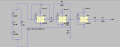
I have a gated oscillator circuit with crystal input frequency of 18kHz (See fig). I have four of this circuit in the same PCB and taking output from each circuit, I mean there are 4 output channels. In the initial stage the tendency is for the oscillator to start at 10.5 us period when the oscillator power is > 3.1V, but locks onto the crystal at lower supply voltages, so I reduce the drive level and reduce the resistance values R4 and R5. testing with R4=220k and R5=5.11k produce
Current: 0.71 mA
Drive level: 70 mV
Locks onto crystal after < .5 seconds at Vsupply = 3.6V
Jitter: 54 ns.

The problem is:
1) How can I eliminate this crosstalk/jitter noise between channels?
2) Reducing drive level helps, but reducing drive level affects gain or phase of the circuit?
3) Is there any additional capacitor (parallel) over R1 helps to avoid noise?
4) changing inverter IC , high speed CMOS type helps to avoid the noise and start up delay?
5) How to overcome the startup delay? Adding additional components to the circuit?

Too many questions...…Thank you for your time!
1682691424656.png
 

MrChips

Joined Oct 2, 2009
34,630
Why do you have multiple crystal oscillators at the same frequency running on the same board?
That is looking for trouble.


Thread Starter

Shilpa777

Joined Apr 24, 2023
20
Why do you have multiple crystal oscillators at the same frequency running on the same board?
That is looking for trouble.
Application is to drive different axis (X,Y,Z )..tested the same board with high frequency (35kHz) works fine. Lowering the frequency leads to cross talk.
 

Papabravo

Joined Feb 24, 2006
22,058
I am less than convinced that this is a suitable design procedure. In particular the very low frequency of the crystals would appear problematic. It might be a better idea to use a higher frequency and divide the output down and distribute it to where you need it. Crystals are not the most reliable components and four of them on the same board is begging for trouble in the field.
 

WBahn

Joined Mar 31, 2012
32,712
Application is to drive different axis (X,Y,Z )..tested the same board with high frequency (35kHz) works fine. Lowering the frequency leads to cross talk.
But why does each axis need a separate oscillator?

There might be a resonance phenomenon at play. There will ALWAYS be SOME level of cross talk between your different oscillators (that's true of any two circuits). The amount of crosstalk will be frequency dependent. Similarly, the susceptibility of a circuit to crosstalk will be frequency dependent. At 35 kHz the coupling isn't strong enough to rise about the susceptibility threshold, but at 18 kHz it is.

There are a number of EMC techniques you could employ to tackle the issue, keeping in mind that there are multiple channels of crosstalk. You could find that just reorienting your components, particularly your inductors, might be sufficient. Low hanging fruit would include stiffening up your power rails, using good bypassing at each chip, and using separate chips for each oscillator channel.
 

Ian0

Joined Aug 7, 2020
13,098
Is TC4429 really a suitable device for this?
Crystal oscillators need linear amplifiers, and TC4429 has a Schmitt-trigger front end.
The output is capable of 6A peak, which is asking for trouble with cross-coupling. U4 driving a 1uF capacitor is going to put some nice pulses of current through the protection diodes at some point in each cycle.

It makes me wonder whether a new thread was started to put all those people who recommended 74HCU04s and 4069Us off the scent, and only a few days ago the output waveform was meant to be a sinewave - a TC4429 is not going to output a sinewave no matter how hard you try.
CD4007 would also be a good device to use as current limiting resistances can be introduced to reduce the interference on the supply. Alternatively, nothing wrong with a simple JFET Pierce oscillator.
 

Thread Starter

Shilpa777

Joined Apr 24, 2023
20
Is TC4429 really a suitable device for this?
Crystal oscillators need linear amplifiers, and TC4429 has a Schmitt-trigger front end.
The output is capable of 6A peak, which is asking for trouble with cross-coupling. U4 driving a 1uF capacitor is going to put some nice pulses of current through the protection diodes at some point in each cycle.

It makes me wonder whether a new thread was started to put all those people who recommended 74HCU04s and 4069Us off the scent, and only a few days ago the output waveform was meant to be a sinewave - a TC4429 is not going to output a sinewave no matter how hard you try.
CD4007 would also be a good device to use as current limiting resistances can be introduced to reduce the interference on the supply. Alternatively, nothing wrong with a simple JFET Pierce oscillator.
I am trying out different oscillator circuits! of course, I am tried 74HCU04s , 4069U and new High speed ICs as well! yes, sine wave or square wave, output need to be clear with out jitter and input start up delay that's the objective ! :rolleyes:
 

Papabravo

Joined Feb 24, 2006
22,058
I am trying out different oscillator circuits! of course, I am tried 74HCU04s , 4069U and new High speed ICs as well! yes, sine wave or square wave, output need to be clear with out jitter and input start up delay that's the objective ! :rolleyes:
As the man in black would say: "get used to disappointment".
 

MrChips

Joined Oct 2, 2009
34,630
I am not sure what you are attempting to do.

You need to lay down the specifications.
Frequency
Frequency error, drift, temperature coefficient
Sine vs square wave

If you are trying to trigger an oscillator with minimum startup delay, have a look at 74S124.
I have used this in a waveform digitizer where sampling had to be synchronized to an input trigger.
 
Top