Question about an oscillator circuit in a classic textbook,

Thread Starter

drysore

Joined Jun 7, 2022
2
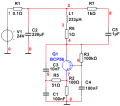
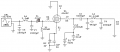
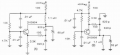
Hello all. I'm a student reading through Experimental Methods in RF Design, by Hartley and others. In chapter 4.3 - "The Colpitts and Other Oscillators", there's a figure of a schematic depicting a colpitts oscillator using bipolar transistors. I've attached it below, but in case anyone has the book, it's figure 4.10(A).

I get the circuit, except for a certain 100 ohm resistor connected from the NPN emitter to the tank's capacitive divider. I don't think its a degeneration resistor, since the 3.3k resistor is present at the emitter. The book has no commentary or mention related to this resistor. You can see it present in the PNP colpitts as well. Any ideas as to what its purpose is? I haven't seen it in any other colpitts design reference. Thanks. -J.A.Screenshot 2025-04-02 210722.png
 

Danko

Joined Nov 22, 2017
2,135
Any ideas as to what its purpose is?
See post #10:
=========
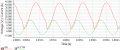
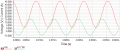
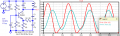
3. With R2 = 100 Ohm current through L1 is 150 mA (peak) under load,
but form of signal is distorted and frequency changed.
To eliminate distortion used R5 = 51 Ohm connected between C1, C3 and emitter Q1, R2.

1743658865734.png 1743658922979.png 1743658964409.png
 
Last edited:

LvW

Joined Jun 13, 2013
1,995
I mean, just to be clear - I do understand that the resistor is the feedback path, at the very least.
Each oscillator needs a closed feedback loop in order to fulfill Barkhausens oscillation criterion.
This must be positive feedback with a loop gain of (slighly larger than) unity at one single frequency only.
The shown circuit is in common base configuration (no phase invesion between collector and emitter) - and the frequency of the feedback loop is mainly determined by a LC-andpass (0.1uH and three capacitors: 820p, 820p, 50p ).
 

MisterBill2

Joined Jan 23, 2018
27,167
Certainly the resistor IS the feedback path. Some authors seek excessive feedback in the name of rapid starting of the oscillator. For other authors stable operation and less distortion (harmonic energy) is more important. There is also a consideration of where to take the output of the oscillator from. Some authors choose to hold the collector at RF ground by means of a large bypass capacitor, and connect an external load to the highest impedance part of the circuit. I never understood the logic of that.
The two versions shown in post #1 seem more reasonable.
 

0ri0n

Joined Jan 7, 2025
160
The 100 Ohm resistor introduces RF negative feedback and its purpose is to reduce the contribution of transistor flicker noise to the phase noise of the oscillator, in particular close to the carrier.
 

nsaspook

Joined Aug 27, 2009
16,250
The 100 Ohm resistor introduces RF negative feedback and its purpose is to reduce the contribution of transistor flicker noise to the phase noise of the oscillator, in particular close to the carrier.
Explain that to us in detail.
 

0ri0n

Joined Jan 7, 2025
160
Explain that to us in detail.
Transistor flicker (1/f) noise close to DC is upconverted to the carrier frequency as AM noise. Due to different AM-to-PM noise conversion processes, like the inherent gain compression/amplitude limiting in an oscillator or the modulation of the nonlinear, parasitic transistor capacitances, phase noise sidebands are created.

The (100 Ohm) negative feedback resistor enhances transistor linearity and isolates the nonlinear, parasitic capacitances form the actual tank circuit. Simply put, the feedback resistor decreases overall AM-to-PM conversion efficiency inside the oscillator, resulting in lower phase noise.


Is it what are you talked about?
Not directly. To see the improvement in phase noise caused by the use of a feedback resistor, you would have to do an oscillator phase noise analysis with a harmonic balance simulator.
 

nsaspook

Joined Aug 27, 2009
16,250
Transistor flicker (1/f) noise close to DC is upconverted to the carrier frequency as AM noise. Due to different AM-to-PM noise conversion processes, like the inherent gain compression/amplitude limiting in an oscillator or the modulation of the nonlinear, parasitic transistor capacitances, phase noise sidebands are created.

The (100 Ohm) negative feedback resistor enhances transistor linearity and isolates the nonlinear, parasitic capacitances form the actual tank circuit. Simply put, the feedback resistor decreases overall AM-to-PM conversion efficiency inside the oscillator, resulting in lower phase noise.


Not directly. To see the improvement in phase noise caused by the use of a feedback resistor, you would have to do an oscillator phase noise analysis with a harmonic balance simulator.
I'll take your for word for it but would like some actual engineering links with test data for a better look.
IMO It looks more like a damping resistance to limit positive feedback for better wave linearity. Those other 'improvements' are likely real improvements from that.
 
Last edited:

LvW

Joined Jun 13, 2013
1,995
I'll take for word for it but would like some actual engineering links with test data for a better look.
IMO It looks more like a damping resistance to limit positive feedback for better wave linearity. Those other 'improvements' are likely real improvements from that.
Without the 100 ohms resistor there is no signal feedback at all - no oscillation possible.
 

nsaspook

Joined Aug 27, 2009
16,250
Without the 100 ohms resistor there is no signal feedback at all - no oscillation possible.
Sure, it's positive feedback as most of us studied transistor (or tube common/grounded grid amplifiers) common base amplifiers long ago.
1743840060729.png

It was a comment directed at "The (100 Ohm) negative feedback resistor" by @0ri0n and @Danko excellent simulation for various resistor values.
 

MisterBill2

Joined Jan 23, 2018
27,167
Without the 100 ohms resistor there is no signal feedback at all - no oscillation possible.
That is true, the resistor is the feedback link. And, as has been mentioned, the resistance does improve the linearity. BUT there is a compromise relative to the oscillator starting up time.
SOME published authors choose the maximum feedback to provide the fastest possible starting, although it creates distortion in the form of harmonic content in the output, which then requires filtering to remove. So there is a compromise to be made relative to the purity of the waveform generated by the oscillator. It is seldom mentioned but always present. And often important.
 

Motanache

Joined Mar 2, 2015
652
Look for a "simple FM transmitter" and test it
The transistor is biased in direct current. And it has the base set to GND through a high value capacitor for high frequency

It works in the common base configuration.
In the collector of the transistor is the parallel LC oscillating circuit that mainly determines the emission frequency.

The oscillator is an amplifier with a negative feedback

Capacitive voltage divider 820p and 820p brings part of the output signal from the collector to the input at the emitter.

There are two conditions:
- The phase required for feedback
- feedback level and the amplification should not generate a lower output level
that's why 100R appears
Anyway, it works without it, I've never used it.

In practice, the feedback would be well done with variable capacitors. It establishes the start condition in the oscillation.

Anyway, in RF, practice differs from theory, because the characteristics of transistors differ a lot.
 
Last edited:

nsaspook

Joined Aug 27, 2009
16,250
Look for a "simple FM transmitter" and test it
The transistor is biased in direct current. And it has the base set to GND through a high value capacitor for high frequency

It works in the common base configuration.
In the collector of the transistor is the parallel LC oscillating circuit that mainly determines the emission frequency.

The oscillator is an amplifier with a negative feedback

Capacitive voltage divider 820p and 820p brings part of the output signal from the collector to the input at the emitter.

There are two conditions:
- The phase required for feedback
- feedback level and the amplification should not generate a higher output level
that's why 100R appears

Anyway, in RF, practice differs from theory, because the characteristics of transistors differ a lot.
Theory and practice are the same here. This is basic transistor circuits 101.

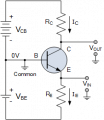
You can obviously make an oscillator with an amplifier with direct positive feedback if the amplifier in a non-inverting type of amplifier. A Common Base Amplifier doesn't invert the input signal voltage IRT the output signal voltage.

1743864246121.png
https://www.electronics-tutorials.ws/amplifier/common-base-amplifier.html
Common Base Amplifier Summary
We have seen here in this tutorial about the Common Base Amplifier that it has a current gain (alpha) of approximately one (unity), but also a voltage gain that can be very high with typical values ranging from 100 to over 2000 depending on the value of the collector load resistor RL used.

We have also seen that the input impedance of the amplifier circuit is very low, but the output impedance can be very high. We also said that the common base amplifier does not invert the input signal as it is a non-inverting amplifier configuration.

Due to its input-output impedance characteristics, the common base amplifier arrangement is extremely useful in audio and radio frequency applications as a current buffer to match a low-impedance source to a high-impedance load or as a single stage amplifier as part of a cascoded or multi-stage configuration where one amplifier stage is used to drive another.
https://www.allaboutcircuits.com/textbook/semiconductors/chpt-4/common-base-amplifier/
The Common-base Amplifier

1743864538044.png
1743864524777.png

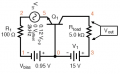
Common-base circuit for SPICE AC analysis.

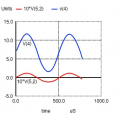
As you can see, the input and output waveforms in Figure below are in phase with each other. This tells us that the common-base amplifier is non-inverting.
 

LvW

Joined Jun 13, 2013
1,995
................
................
SOME published authors choose the maximum feedback to provide the fastest possible starting, although it creates distortion in the form of harmonic content in the output, which then requires filtering to remove. So there is a compromise to be made relative to the purity of the waveform generated by the oscillator. It is seldom mentioned but always present. And often important.
Ths so-called "linear" (or "harmonic") oscillator is a very interesting and contradictory device.
Of course, it should be as linear as possible and - at the same time - as non-linear as necessary.
Such a certain degree of non-linearity is necessary to ensure
(1) a safe start of oscillation (with a loop gain slightly larger than unity) and
(2) to allow a continuous oscillation with a loop gain that swings a bit around unity and which is controlled by the oscillation amplitude.
 

BobTPH

Joined Jun 5, 2013
11,463
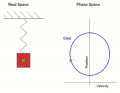
A perfectly linear harmonic oscillator, modeled as a mass hanging from a spring in a uniform gravitational field, oscillates in a perfect sine wave. The equation is:

F = -kx

Where F is the force and x is the displacement from the equilibrium position.

Notice that the equation is a simple linear relation. No non-linearity is needed to make it oscillate.

In the real world, it is always damped by friction and the oscillation always dies out.

In the electronic equivalent, the capacitor is the spring and the inductor is the mass. The voltage across the capacitor is the displacement and the current is the velocity.

The non-linearity comes from the fact that power is injected into each cycle, and, as @LvW says, is necessary to maintain oscillation. I believe this comes from a slightly higher than 1 gain, that reduces with amplitude, such that, at some amplitude, the power injected equals the power lost in each cycle. Electronic devices will naturally lose gain at some amplitude due to saturation. If this is slow and controlled, the oscillation remains close to a sine wave, it if is abrupt, it will be distorted, worst case becoming a square wave.

Edited to correct the analogy.
 
Last edited:

nsaspook

Joined Aug 27, 2009
16,250
Ths so-called "linear" (or "harmonic") oscillator is a very interesting and contradictory device.
Of course, it should be as linear as possible and - at the same time - as non-linear as necessary.
Such a certain degree of non-linearity is necessary to ensure
(1) a safe start of oscillation (with a loop gain slightly larger than unity) and
(2) to allow a continuous oscillation with a loop gain that swings a bit around unity and which is controlled by the oscillation amplitude.
It's needs AGC, gain control for linearity. In the classic tube oscillator , that was provided by a non-ohmic (positive temperature coefficient resistor) element called an incandescent light filament. Like most people that took electronics long ago, we had a few in the lab that we used and took apart to see inside.

https://www.hewlettpackardhistory.com/item/a-bright-idea/
Date: 1938
On July 27, 1938, while working as a researcher at Stanford, Bill Hewlett had an idea that would revolutionize oscillator technology and lead directly to the founding of Hewlett-Packard. Engineers had long sought a way to create a resistor whose resistance could vary to match a wide range of signals. Bill realized that when a light bulb converted electricity to heat and light proportionate to the power it received, it was basically acting as a variable resistor. He integrated a socket and a fifteen-watt bulb into his oscillator prototype, and wound up with an instrument comparable to the best oscillators on the market for a fraction of the production cost. The breakthrough would be applied to Hewlett-Packard’s first product, the 200A oscillator, and would continue to be key to Hewlett-Packard oscillators for decades. One historian recalled, “what Hewlett accomplished that July day remains one of the most clever bits of practical invention in technology history.”
https://en.wikipedia.org/wiki/HP_200A
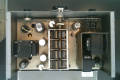
1743944076390.png
Insides of the Hewlett-Packard HP 200A. The light bulb repurposed as a positive temperature coefficient resistor is to the right of the upper section of the variable capacitor, which is the large structure in the center.

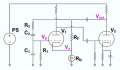
1743944221316.png
Simplified schematic of a Wien bridge oscillator from Hewlett's US patent 2,268,872. Unmarked capacitors have enough capacitance to be considered short circuits at signal frequency. Unmarked resistors are considered to be appropriate values for biasing and loading the vacuum tubes. Node labels and reference designators in this figure are not the same as used in the patent. The vacuum tubes indicated in Hewlett's patent were pentodes rather than the triodes shown here.

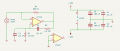
1743944803137.png
Feedback from a two stage non-inverting transistor amplifier section. It will work but needs some sort for gain control for the best linearity.

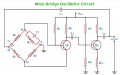
https://forum.digikey.com/t/wien-bridge-oscillator-construction-and-performance/37970

1743945039335.png1743945166929.png
The beauty and performance of classic circuits
The Wien Bridge oscillator is a classic circuit that everyone should build. It is an elegant circuit providing a remarkably low-distortion sinusoidal waveform. It provides valuable lessons in filtering, feedback, and automatic gain control. Surprisingly, the heart of the circuit is an incandescent light bulb that stabilizes the gain of the circuit.

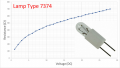
The type 7374 incandescent lamp can be seen in Figure 1 to the left of the LF412 operational amplifier. Use of a simple incandescent lamp is desirable as the lamp’s resistance changes with self-heating temperature. It is low when the bulb is cold and increases as the bulb heats up. This property is reflected in Figure 2. Here we see that the cold (1 VDC) resistance is about 125 Ω. When the lamp voltage reaches its rated 28 VDC, the filament resistance has increased to about 700 Ω. This is a non-linear resistance change with a positive temperature coefficient.
 
Last edited:

nsaspook

Joined Aug 27, 2009
16,250
A perfectly linear harmonic oscillator, modeled as a mass hanging from a spring in a uniform gravitational field, oscillates in a perfect sine wave. The equation is:

F = -kx

Where F is the force and x is the displacement from the equilibrium position.

Notice that the equation is a simple linear relation. No non-linearity is needed to make it oscillate.

In the real world, it is always damped by friction and the oscillation always dies out.

In the electronic equivalent, the capacitor is the spring and the inductor is the mass. The voltage across the capacitor is the displacement and the current is the velocity.

The non-linearity comes from the fact that power is injected into each cycle, and, as @LvW says, is necessary to maintain oscillation. I believe this comes from a slightly higher than 1 gain, that reduces with amplitude, such that, at some amplitude, the power injected equals the power lost in each cycle. Electronic devices will naturally lose gain at some amplitude due to saturation. If this is slow and controlled, the oscillation remains close to a sine wave, it if is abrupt, it will be distorted, worst case becoming a square wave.

Edited to correct the analogy.
Yes, my kid is just starting Physics 424. It's all about the harmonic oscillator in various physical and mathematical expressions in Newtonian physics.

PH 424, PARADIGMS IN PHYSICS: OSCILLATIONS AND WAVES, 3 Credits
Dynamics of mechanical and electrical oscillation using Fourier series and integrals; time and frequency representations for driven damped oscillators, resonance; one-dimensional waves in classical mechanics and electromagnetism; normal modes.

https://forum.allaboutcircuits.com/...on-of-nature-and-evolution.110424/post-862613

1743946114813.png

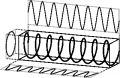
3d helix with the projection of sine and cosine.
1743946138205.png
 
Last edited:

sparky 1

Joined Nov 3, 2018
1,218
The ARRL publication 1977 These 3 authors are excellent as instructors in RF.
Wes Hayward, Rick Campbell, Bob Larkin
:)

Here is the context of what the book says in essence about fig. 4-10 comparing A and B
Why B is better and why Q matters shaping up a wide bandwidth.

... There is a subtlety that haunts some bipolar Colpitts
circuits referring to Fig 4 -10 in the form of ill-defined limiting.
(the resonant part of the circuit is ill affected by other parts of the circuit)
The circuit will nearly always oscillate. However, if the 3.3k
emitter bias resistor is reduced the transistor
will go into saturation at the negative
extreme of the collector voltage waveform.
This action extracts energy from the tank
and dissipates it in the transistor saturation
resistance. This can severely degrade the
loaded tank Q compromising phase noise
and thermal stability. The emitter degeneration
decreases the starting gain and leans toward wrongly
establish current limiting and this becomes the mechanism
determining operating level. Transistor
saturation is easily detected with a high speed
oscilloscope.

A simple Colpitts should be built with
high capacitance and low inductance by storing
the greatest energy in the resonator. But
there is a practical limit to this trend. Eventually
this will affect the inductance of the capacitors
and the wiring in the tank which includes the bypass
capacitors. They will all contribute to the
overall inductance in greater proportion. The stray
inductance generally has a considerably
lower Q and poorer stability than that of a
powdered iron toroid inductor.

The author explains that figure 4-10B The PNP is better because the tank is at ground state, noting the inductor to ground placement.
The resistor not remedying much of anything especially the effects of stray inductance, possibly an improper coil type of yester year.
The use of the tank's resonance which includes a high Q inductor where the reactance leans toward capacitive.
The chapter goes into noise saying a ferrite high Q inductor produces a tighter sideband where noise phase shifting
and attenuating can be accomplished in less trips around the loop. The impedance network has sufficient range and does not influence tank.

The book gives the short answers for radio experimenters which includes examining flawed radio circuits. They recommend building
a very noisy oscillator giving plans and dead bug, so you understand what is bad and they are not claiming these beauties deserve an award.
A radio club style presentation of projects. Common errors and what can go wrong, here is what it looks like on the spectrum analyzer
They show an ideal amplitude and phase vs frequency. Most experimenters that built RF oscillators could only estimate on field day 48 years ago.
 
Last edited:
Top