Question about an oscillator circuit in a classic textbook,

Motanache

Joined Mar 2, 2015
652
The author explains that figure 4-10B The PNP is better because the tank is at ground state, noting the inductor to ground placement.
I considered the tank , Parallel LC to GND anyway.

If it is NPN, we consider GND as the + terminal.
If PNP GND is - terminal.
I did not understand the statement why it would be better to be a PNP transistor?
 

nsaspook

Joined Aug 27, 2009
16,359
I considered the tank , Parallel LC to GND anyway.

If it is NPN, we consider GND as the + terminal.
If PNP GND is - terminal.
I did not understand the statement why it would be better to be a PNP transistor?
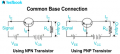
Normal NPN and PNP Common Base configurations.


1744043127504.png

If you have other circuitry that uses the negative potential as GND/COMMON it's better (in some ways for things like shielding, construction and others I'm missing here) for things like DC blocking (the coil has a low DC resistance) when your signal references are GND and the AC output signal with close to zero DC potential offset vs GND and the AC signal with a DC potential offset close to the positive supply potential.


Be careful when looking for and using random internet texts and pictures like this one from the same site.
1744043015918.png
https://testbook.com/electrical-engineering/transistor-configuration
 
Last edited:

sparky 1

Joined Nov 3, 2018
1,218
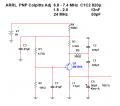
The Colpitts as shown in the ARRL book has sufficient tank energy for sustained oscillation.
By swapping out the two 820pF (7.2 MHz) with different values the circuit will cover HF bands.
For a single transistor the signal strength is relatively high. Hard to beat S reading. The frequency can be adjusted with an
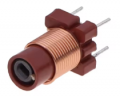
adjustable inductor shown below is .6 to 1.7uH This is what was referred to as having small inductive reactance
proportionally to the capacitive reactance. As the circuit adds selectivity the role of the resistor has more significance.
ARRL encourages students to build and get up and running, they select practical projects that address different levels of skill.
At some point a self-taught person might benefit more from an RF engineering textbook.

1744213860437.png

1744214787321.png


Some are using a parallel scheme combining an adjustable poly film capacitor with the fixed capacitors, they works ok.
The resonant part of a circuit can be found in an AM FM SW radio. While it is for reception it is also useful in an oscillator.
With RLC, the LC has the primary role in determining frequency but the R helps to define the frequency response without adding
inductance. This is found in more depth study with filters. 100R used in setting the time constant using R
in conjunction with the capacitors to improve performance and stability. The circuit with the adjustable inductor 6.8 - 7.4 MHz
The last picture shows a fixed inductor ferrite toroid 8mm dia, By using fixed inductor the trade off is higher Q narrower bandwidth.

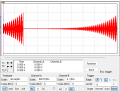
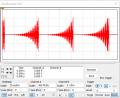
Here is the start up with and without the R100, the growing amplitude and number of iterations on the y axis,
the time constant or distance on the x axis. The adjustable 50pF capacitor kept at 100%

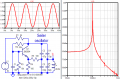
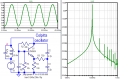
Colpitts start up with 100R.pngColpitts oscillator without 100R.pngColpitts ARRL PNP .png
 
Last edited:

0ri0n

Joined Jan 7, 2025
177
If it is NPN, we consider GND as the + terminal.
If PNP GND is - terminal.
I did not understand the statement why it would be better to be a PNP transistor?
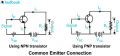
Wih a NPN transistor, the inductor is connected to Vcc and needs to be decoupled very well. Decoupling capacitor(s) have low-Q parasitic inductance. Besides other factors, the quality of the used decoupling capacitor(s) will influence the Q of the tank circuit, especially if you choose a low-L high-C configuration. With a PNP transistor the inductor is gounded, no need for decoupling.

Another advantage with the PNP oscillator version is when using back-to-back varactor diodes placed across the inductor for frequency tuning, where the anodes of both varactors would already be properly grounded.

I'll take your for word for it but would like some actual engineering links with test data for a better look.
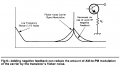
IMO It looks more like a damping resistance to limit positive feedback for better wave linearity. Those other 'improvements' are likely real improvements from that.
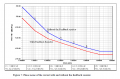
The main purpose of the feedback resistor is improving phase noise, a better looking waveform with lower harmonics is a highly appreciated bonus.

Colpitts_Phase_Noise_1.png

Colpitts_Phase_Noise_2.png
 

Attachments

nsaspook

Joined Aug 27, 2009
16,359
Wih a NPN transistor, the inductor is connected to Vcc and needs to be decoupled very well. Decoupling capacitor(s) have low-Q parasitic inductance. Besides other factors, the quality of the used decoupling capacitor(s) will influence the Q of the tank circuit, especially if you choose a low-L high-C configuration. With a PNP transistor the inductor is gounded, no need for decoupling.

Another advantage with the PNP oscillator version is when using back-to-back varactor diodes placed across the inductor for frequency tuning, where the anodes of both varactors would already be properly grounded.


The main purpose of the feedback resistor is improving phase noise, a better looking waveform with lower harmonics is a highly appreciated bonus.

View attachment 346516

View attachment 346517
Chicken or the egg for the root cause, the improvement is real.
 
Top