Facebook
 Google
 GitHub
 Linkedin

You need to calculate the output offset for the maximum input DC offset of the op amp you will use, which is the input offset times the closed-loop gain (here 10).
If that's too high for you purposes, then you need an op amp with lower offset (there are auto-zero amps with low microvolt offset if needed).
You can't depend upon the simulation to give an accurate worst-case offset.
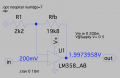
The sim below shows it works using a low offset, single-supply op amp:
I changed the values for R1 and Rfb to get the closest gain of 10 that standard 1% values can generate (within about 0.3% of the ideal, for zero resistor tolerance).
For a lower cost, low-offset amp, try looking at the OPAx197, for example, which I think is a low-cost op amp with low offset.
If that's too high for you purposes, then you need an op amp with lower offset (there are auto-zero amps with low microvolt offset if needed).
You can't depend upon the simulation to give an accurate worst-case offset.
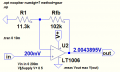
The sim below shows it works using a low offset, single-supply op amp:
I changed the values for R1 and Rfb to get the closest gain of 10 that standard 1% values can generate (within about 0.3% of the ideal, for zero resistor tolerance).
For a lower cost, low-offset amp, try looking at the OPAx197, for example, which I think is a low-cost op amp with low offset.
Last edited: