Noise analysis for non-inverting opamp with high pass filter at its output

Thread Starter

Deepesh Chari

Joined May 16, 2025
8
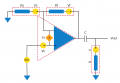
I want to calculate total noise at the output of the non-inverting amp with RC high-pass filter attached at its output.
1753764903266.png


  1. Va - thermal noise due to Ra
  2. Vf - thermal noise due to Rf
  3. Vn - Opamp Voltage referred noise
  4. In - Opamp Current referred noise
  5. V - thermal noise due to R
Can anyone explain me how to calculate total noise at the output of this circuit?

Additional doubts:

  1. How to calculate noise, if i add two more similar stages at its output?
  2. How to calculate noise, if i replace low pass RC filter in place of high-pass filter in the first stage.
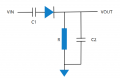
  3. If i place a capacitor and diode between the non-inverting opamp output and the LC filter, how to calculate noise in this case?
Correct me if i missed considering any additional noise source in this circuit.

Thankyou
 

Ian0

Joined Aug 7, 2020
13,097
The following contribute to the noise:
Va * gain
Vn * gain
Vf
In * gain * parallel combination of Ra and Rf.
Noise at input * gain

It's all uncorrelated noise so add the squares of all the above and take the square root.

To get the noise after the filter, you have to assume two things:
1. that the bandwidth is limited i.e. there IS a high frequency cutoff, although you have no low-pass filter.
Use 20kHz if it is audio, as that is as much as you can hear.
2. That the noise is white, which it almost is, but there is 1/f noise which your high-pass stage may remove.

Then add the √4ktRf from the Resistor in the filter (uncorrelated noise again)

If you have a low-pass filter, then it is easier - the bandwidth is limited by the low-pass filter, and the filter resistor noise adds in before you consider the bandwidth of the filter.

If you add another stage, the noise at the output of the second stage is the same as above with the addition of the noise from the first stage multiplied by the gain of the second stage. I've called this "noise at input", because the first stage will probably have some noise on its input signal.
You don't have an input resistor (between non-inverting input and ground) and that will contribute as well √4ktRf 8 gain, but the output resistance of the source will appear in parallel and reduce R accordingly.
 

MrChips

Joined Oct 2, 2009
34,626
C1 is a high pass filter or DC blocking capacitor.
The diode is a half-wave rectifier. This charges capacitor C2 to the peak voltage.
R is the load and also presents a discharge path for C2. You can calculate the time constant of R x C2.
 
Top