op amp understanding

Thread Starter

ntetlow

Joined Jul 12, 2019
71
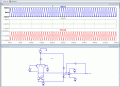
Enclosed is a simulation. I'm having trouble understanding how the volatge (vout) is generated from the input voltages (vin+ and vin-).
I do not see under which function the op amp is operating (comparator, integrator differential etc) , none of the formulas work for compting the output voltage from the inputs. Any help greatly appreciated.
 

Attachments

Thread Starter

ntetlow

Joined Jul 12, 2019
71
hi ntetlow,
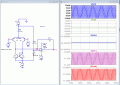
This is what I see in LTS, increased the .tran to 50mS.
What is your question.?
E
Added 2nd image, shows all 5 Vpoints, also tidied the layout.
Afternoon Eric,
nice to find you replying on a Sunday. My question is this:- Vin- and Vout are almost the same, so the difference must be accounted for by vin+. They are not added together aljebraically or subtracted aljebraically, however. Can you explain how vout is derived?
 

AlbertHall

Joined Jun 4, 2014
12,625
This circuit won't work with most 'real' opamps. The inverting input is at -14.3V which is 2.3V negative of the amplifier negative supply which would be outside the common mode range.
 

ericgibbs

Joined Jan 29, 2010
21,439
hi,
I measure the Vin+ as: -14.7V and you are using a -12V supply to the OPA.?

Vin- is close to 0V.!

Check the 741 d/s for the CMV and Voltage input limits when using +/-12V OPA supplies.
E
 

crutschow

Joined Mar 14, 2008
38,503
Vin- and Vout are almost the same
You have trouble understanding the circuit operation because the circuit is not a correct design, and the op amp is saturating at the negative rail so the circuit is not operating properly.
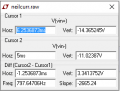
There's a 3.3V difference between Vin+ and Vin- (below) and that difference has to be very near zero for the op amp to not be saturated due to the high open loop gain of the op amp (over 10,000).

At a minimum, add a 1k resistor in series with the Vin- node and connect Vin+ to ground.

What is that odd circuit supposed to do?

1572192637482.png
 
Last edited:

danadak

Joined Mar 10, 2018
4,057
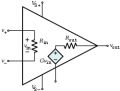
The basic OpAQmp model looks something like this -

1572196058640.png
So you can add feedback around it, do KVL and KCL analysis, and take the
limit of the equations when G becomes very large. This of course is the DC
model of a basic OpAmp.

Regards, Dana.
 
Top