Facebook
 Google
 GitHub
 Linkedin
I'm trying to understand how to determine stability of an op amp.
Upon studying op amp stability: I see finding the loop gain =(Aol* Betta) is essential for determining stability. Open Loop gain can be provided from datasheet from op amp. So then next step is to find Betta or feedback gain to calculate loop gain. .. In online examples with simple resistor dividers, it's easy to infer the feedback gain.
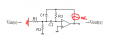
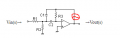
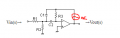
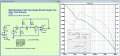
How do you do it for more complex examples like this band pass filter below?
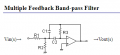
Assuming the open loop gain (Aol) is high, can you assume that the Betta = 1 / A_close_loop gain ? Then you just need to simulate the closed loop gain to find Betta.
Then to find loop gain: 20log(Aol*Betta) = 20log(Aol) - 20log(1/Betta) =
20log(Aol*Betta) = 20log(Aol) - 20log(Acl).
Phase Margin = Phase of 20*log(Aol*Betta) or (Phase 20log(Aol) - 20log(Acl))
Is this a correct method?
Upon studying op amp stability: I see finding the loop gain =(Aol* Betta) is essential for determining stability. Open Loop gain can be provided from datasheet from op amp. So then next step is to find Betta or feedback gain to calculate loop gain. .. In online examples with simple resistor dividers, it's easy to infer the feedback gain.
How do you do it for more complex examples like this band pass filter below?
Assuming the open loop gain (Aol) is high, can you assume that the Betta = 1 / A_close_loop gain ? Then you just need to simulate the closed loop gain to find Betta.
Then to find loop gain: 20log(Aol*Betta) = 20log(Aol) - 20log(1/Betta) =
20log(Aol*Betta) = 20log(Aol) - 20log(Acl).
Phase Margin = Phase of 20*log(Aol*Betta) or (Phase 20log(Aol) - 20log(Acl))
Is this a correct method?