What would you expect to happen if you connected a 1.5 V battery across the terminals of a 12 V car battery? And, no, that is not a suggestion for an actual experiment.
Also, please stop using all caps in your thread titles. That is considered shouting on the Internet and considered by many as being very rude. The same is true for all caps in the body of posts. Using it for a word/phrase here or there for emphasis is fine (it's the equivalent of using a bold font).
In general, there is no need to change font sizes or use bold or different colors. The kind of folks that haunt places like this find that distracting and would rather just see plain old sentences that convey your message.
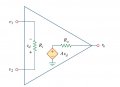
This is an equivalent circuit of op amp, is that because if Ro = 0 then a voltage source connect to Vo terminal will be short circuit????? View attachment 337714
In real life, the output resistance is generally low enough that if you connect a decent voltage source to it, bad things happen. Some opamps have internal protection circuitry to at least try to prevent damage, but many of them will just liberate their magic smoke.
A good working assumption in this case is that the output resistance of the op-amp is about zero. What is the voltage drop across 0 ohms when you drive it with 10 milliamps?
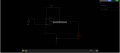
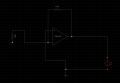
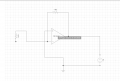
Here is the diagram cleaned up a little and with inverted colors so it is easier to read on a monitor.
If I understand your question, you want to know why we might short circuit the output of an op amp. The op amp has an equivalent very low output impedance and since we sometimes model it as a voltage controlled voltage source, we would be shorting out a voltage source. That may be why you first drew the 1v source on the output, but later you realized you don't have to do that.
The reason for shorting out the output of the op amp is the same as for any other voltage source. It helps to apply the principle of superposition when trying to analyze the circuit, for one. There could be other reasons too because when doing a circuit analysis we sometimes short out voltage sources even though we would never do that in real life.
Here is the diagram cleaned up a little and with inverted colors so it is easier to read on a monitor.
If I understand your question, you want to know why we might short circuit the output of an op amp. The op amp has an equivalent very low output impedance and since we sometimes model it as a voltage controlled voltage source, we would be shorting out a voltage source. That may be why you first drew the 1v source on the output, but later you realized you don't have to do that.
The reason for shorting out the output of the op amp is the same as for any other voltage source. It helps to apply the principle of superposition when trying to analyze the circuit, for one. There could be other reasons too because when doing a circuit analysis we sometimes short out voltage sources even though we would never do that in real life.
That won't let you check it. Just check the voltage at the output of the amplifier. Works best by giving the node connected to the output a name, such as Vout, and then adding the trace V(Vout) to your output plot.

 Facebook
 Google
 GitHub
 Linkedin