OP Amp Mosfet driver not working

LowQCab

Joined Nov 6, 2012
5,101
R-5 serves no useful purpose,
if this is supposed to represent the DC-Resistance of the Inductor,
then it should be in series with the Inductor, not in parallel,
and it would likely be a much lower value than 1K, probably closer to ~0.1-Ohms.
Adding some additional Resistance in series with the Inductor can help to reduce Oscillations,
but it will also reduce the efficiency of the Filter,
so it is a careful balancing act, and should be a "last-resort" strategy.

R-6, in the real-world, doesn't do very much.
It makes a big difference in some simulators because the Op-Amp may be considered to
have a "zero" Output-Impedance, which, in the real-world, it certainly does not.
The Op-Amp is not capable of Sourcing or Sinking much more than around ~50mA before
acting like the Output is virtually shorted to Ground.
To change the Voltage on the Gate of the MOSFET,
at High-Speeds, requires much more Current capability.
This is because of the "Gate-Capacitance" of the FET,
which is different for every FET, and must be properly modeled in the simulation.

Generally speaking, high-speed Switching of a FET should not be attempted using an Op-Amp,
instead, use a properly rated, dedicated, FET-Gate-Driver to get
a nice clean, sharp, and predictable Square-Wave, which should then
have the corners of the Square-Wave-Output slightly "rounded-off" by a "Gate-Resistor" that is
just barely large enough to prevent "ringing" oscillations in the FET from being created.
Or, of course,
You can simply buy a dedicated Chip specifically designed for the required performance.

Real Op-Amps seriously do NOT like driving Capacitive-Loads,
and an ~8-Ohm Load, ( like R-6 ), is SERIOUSLY lower than they are rated to drive.
An Op-Amp may do all kinds of strange things with an ~8-Ohm-Load attached to it's Output,
and this strange behavior will be directly transferred to the performance of the FET,
and then make it do screwy, unpredictable things.

Depending on the Output-Current-Requirements of the Regulator,
a properly sized FET-Gate-Driver can completely replace both the Op-Amp, and the FET,
and provide, not only superior performance, but much less design time, and fewer Components.
They can also be set up to "Self-Oscillate",
but a separate "Fixed-Frequency" Oscillator-Circuit is usually a better plan,with higher performance.

Using all Discrete-Components to create a Switching-Regulator can certainly be done,
and may even provide quite a bit of valuable-Education along the way,
but it's definitely the most difficult way to do it.
This is because no Electronic-Component is "perfect",
and You have to figure-out how to get them all to work with each other
and ultimately perform as You expect as a "real" Valuable-Final-Product.

Generally speaking,
using a N-Channel-FET for "High-Side-Switching" is not very practical.
That's why they invented P-Channel-FETs,
but P-Channel-FETs usually have
lower overall performance specifications, and are more expensive to purchase.
These drawbacks are sometimes outweighed by greatly simplifying the Circuit design.
.
.
.
 

Thread Starter

TheoryNeverWorkInPractice

Joined Feb 13, 2024
16
Alright so I removed R5. It had a use before, as it stabilized the output.
My logic was this: high frequency signals experience a higher impedance in the inductor than in the resistor and therefore choose to go through the resistor instead and gets damped. Yes this waste energy but it did stabilize the system. I don't need it anymore so now it's removed.

For R6 I'm not sure what to put there. I'm thinking I'll have a space to place smd resistors with values ranging from 1-100Ohms, and if I dont need it I'll just weld the two vias together giving 0Ohm resistance. Tbh, I havn't seen any ringing but I'm suspecting it will show up in the physical version. If so I can use this R6 to dampen it.

The LT1018 is a comparator, not an opamp.
I'm in the process of calculating wether it is capable of supplying gate voltage as fast as in the simulations or not.
The mosfet has a total charge of Qg: 116 nC (190 max)
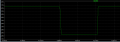
Juding by the simulation (see image below) switching speed of the mosfet, I should go from 0 to 7V in 300-800ns correct?
1708175301024.png

I = Q/dt = 116nC / 300nC = 386 mA
So I need to supply a current of about 400mA, is that the right conclusion?

The LT Comparator can supply around 70mA.
So the solution would be to add a mosfet driver inbetween the comparator and the mosfet?

And I agree, it would be much simpler to use a mosfet ic for all of this, but that's not allowed.
 

LowQCab

Joined Nov 6, 2012
5,101
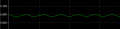
The waveform that You have made a Screen-Shot of "might" be "OK" at a very High-Switching-Frequency.
But, for maximum efficiency, it should have a much harder "edge".

All of this is likely to change when a Load is placed on the Output, or removed from the Output.
.
.
.
 

Thread Starter

TheoryNeverWorkInPractice

Joined Feb 13, 2024
16
I have now produced the circuit but the MOSFET keeps exploding whenever I plug in my 7.2V (7.8V measured) battery.

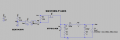
This is how the board layout looks with these components.
Untitled.png
R5 is the measured parasitic resistance of the coil.
R4 also parasitic (Estimated).

Some claim the reason it blows up is because of a short, I have measured every point on the board, there is no short.
I'm thinking maybe the C1 acts like a short when you plug in the battery? But how would that make my mosfet explode?

It's not even under any load btw, so I1 doesn't exist.
 
Last edited:
Top