Op-amp LM-741C - boosting a square signal (non uniform).

Thread Starter

Trailer

Joined Jan 22, 2023
85
I'm boosting a square signal (non uniform) 20240812_175908.jpgwith op-amp LM-741C. Supply voltage is variable up to 30 volts to control the amplitude of the output signal.
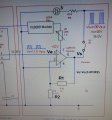
The circuit was working fine for many months now and I was getting the output signal up to 27 volts p-p. Suddenly the output dropped and I can only get a max amplitude of 16 volts from it?!
Any idea what could be the reason?
Is the op-amp damaged in any way?
Note that changing the supply voltage is still affecting the output but can't reach its previous top value of 27 volts.
Also note the input signal is around 11 volts p-p
 

WBahn

Joined Mar 31, 2012
32,703
Your schematic doesn't make a lot of sense.

You are showing the opamp being powered via a variable resistor. Why?

You are operating the opamp from a single-supply rail, so it can't output a negative voltage (relative to your ground). But you have this LED at the top with the anode connected to ground, which would require several volts of negative output from the opamp in order to illuminate.

What else is connected to the output node?
 

Ian0

Joined Aug 7, 2020
13,097
What frequency is the squarewave? If will take the output of a 741 64us to get from 0V to 32V, so the maximum frequency it could possibly manage would be 7.8kHz, and then it would look like a triangle wave not a square wave.
 

Thread Starter

Trailer

Joined Jan 22, 2023
85
Your schematic doesn't make a lot of sense.

You are showing the opamp being powered via a variable resistor. Why?

You are operating the opamp from a single-supply rail, so it can't output a negative voltage (relative to your ground). But you have this LED at the top with the anode connected to ground, which would require several volts of negative output from the opamp in order to illuminate.

What else is connected to the output node?
I'm using the potentiometer to control the supply voltage (~30 volts coming from the 6009 module) to the op-amp thus controling the magnitude of the output signal.
The led illuminate once I release the output through S1 and its getting a minimum 9 volts (in series with the 10k resistor) so it's working fine, no problem there.
The output node is connected to a sort of zapping grid.
 

Thread Starter

Trailer

Joined Jan 22, 2023
85
What frequency is the squarewave? If will take the output of a 741 64us to get from 0V to 32V, so the maximum frequency it could possibly manage would be 7.8kHz, and then it would look like a triangle wave not a square wave.
It's a low frequency wave, variable from 60Hz up to 1.5kHz..
And yes, there's a bit of distortion but that's no problem for my application.
My only problem is that the output max gain have dropped to almost 60% with no explanation (from 27 to 16 volts)!!
As I said in the original post, the circuit was working perfectly for several months and suddenly that happened?!
 

WBahn

Joined Mar 31, 2012
32,703
I'm using the potentiometer to control the supply voltage (~30 volts coming from the 6009 module) to the op-amp thus controling the magnitude of the output signal.
The led illuminate once I release the output through S1 and its getting a minimum 9 volts (in series with the 10k resistor) so it's working fine, no problem there.
The output node is connected to a sort of zapping grid.
That is a lousy way to control supply voltage. Why don't you control it properly using the recommended circuit for the XL6009 chip?

Also, controlling the supply voltage, even if done properly, is a lousy way to control the output signal of an opamp.

If your LED is illuminating, then your actual circuit is not wired according to the schematic, making the schematic worthless. According to your schematic, the anode of your LED is connected to 0 V. Depending on the type of LED, that means that the cathode will need to be several voltage (somewhere between 2 V to 4 V, probably) BELOW your ground. To get just 1 mA of current through the LED, via a 10 kΩ resistor, that means that your opamp output (once S1 is close) needs to be about -12 V, give or take. But the lowest it can get is going to be in the neighborhood of +2 V.
 

Thread Starter

Trailer

Joined Jan 22, 2023
85
That is a lousy way to control supply voltage. Why don't you control it properly using the recommended circuit for the XL6009 chip?

Also, controlling the supply voltage, even if done properly, is a lousy way to control the output signal of an opamp.

If your LED is illuminating, then your actual circuit is not wired according to the schematic, making the schematic worthless. According to your schematic, the anode of your LED is connected to 0 V. Depending on the type of LED, that means that the cathode will need to be several voltage (somewhere between 2 V to 4 V, probably) BELOW your ground. To get just 1 mA of current through the LED, via a 10 kΩ resistor, that means that your opamp output (once S1 is close) needs to be about -12 V, give or take. But the lowest it can get is going to be in the neighborhood of +2 V.
The potentiometer is connected in series with the 6009 internal variable resistor (reduced to minimum) so its actually replacing it to have an external control on the box. Yes, the supply voltage control maybe lousy, but it was working. And No, the circuit is 100% matching the schematic. And point is the entire circuit was working perfectly, and for several months as i mentioned before, and I was getting an output signal of 27v p-p.
Just suddenly it dropped to a max of 16v. That's why I'm doubting that the op-amp got damaged in some way? Or maybe something else?
 
Last edited:

WBahn

Joined Mar 31, 2012
32,703
I would ask how you expect the LED to work when there is no way to forward bias it, but I don't see the point. I would also ask why you are exposing the LED to reverse voltages that are almost certainly well in excess of its reverse breakdown voltage, but again, I don't see the point.

What is comes down to is that you have several ways in which you are operating components out of spec, so it shouldn't come as a surprise that, at some point, their behavior changes as a result of the repeated abuse.

You say that the output of the opamp is connected to some king of "zapping grid" -- well, "zapping" things usually entails voltages that many things don't like being exposed to.
 

crutschow

Joined Mar 14, 2008
38,321
An easy way to control the output voltage of a PWM signal, would be to apply the PWM signal to a comparator with an open-collector output (such as the LM339/LM393) connected to a resistor.
Varying the resistor voltage will then vary the output PWM voltage.
(This will generate a multiplication of that voltage with the average PWM voltage. Is that what you are doing?)
 

Thread Starter

Trailer

Joined Jan 22, 2023
85
I would ask how you expect the LED to work when there is no way to forward bias it, but I don't see the point. I would also ask why you are exposing the LED to reverse voltages that are almost certainly well in excess of its reverse breakdown voltage, but again, I don't see the point.

What is comes down to is that you have several ways in which you are operating components out of spec, so it shouldn't come as a surprise that, at some point, their behavior changes as a result of the repeated abuse.

You say that the output of the opamp is connected to some king of "zapping grid" -- well, "zapping" things usually entails voltages that many things don't like being exposed to.
I would ask how you expect the LED to work when there is no way to forward bias it, but I don't see the point. I would also ask why you are exposing the LED to reverse voltages that are almost certainly well in excess of its reverse breakdown voltage, but again, I don't see the point.

What is comes down to is that you have several ways in which you are operating components out of spec, so it shouldn't come as a surprise that, at some point, their behavior changes as a result of the repeated abuse.

You say that the output of the opamp is connected to some king of "zapping grid" -- well, "zapping" things usually entails voltages that many things don't like being exposed to.
I'm zapping bees, the withdrawn current is well below safe limit and the voltage doesn't fluctuate much, I measured it while in use.
So, back to square one, why the output can't reach its previous height?
 
Last edited:

Thread Starter

Trailer

Joined Jan 22, 2023
85
I would ask how you expect the LED to work when there is no way to forward bias it, but I don't see the point. I would also ask why you are exposing the LED to reverse voltages that are almost certainly well in excess of its reverse breakdown voltage, but again, I don't see the point.

What is comes down to is that you have several ways in which you are operating components out of spec, so it shouldn't come as a surprise that, at some point, their behavior changes as a result of the repeated abuse.

You say that the output of the opamp is connected to some king of "zapping grid" -- well, "zapping" things usually entails voltages that many things don't like being exposed to.
 

Thread Starter

Trailer

Joined Jan 22, 2023
85
An easy way to control the output voltage of a PWM signal, would be to apply the PWM signal to a comparator with an open-collector output (such as the LM339/LM393) connected to a resistor.
Varying the resistor voltage will then vary the output PWM voltage.
(This will generate a multiplication of that voltage with the average PWM voltage. Is that what you are doing?)
Yep, that what I'm doing, and thanks I'll try this approach in the next design. But I need to ask:
1. Does it maintain the signal shape?
2. How much amplification can I get, I need to at least triple the input signal.
3. Also keep in mind that the frequency is also controllable so what about their response time? I'm operating between 60Hz up to 1.5kHz
Thanks
 
Last edited:

Alec_t

Joined Sep 17, 2013
15,103
why the output can't reach its previous height?
If the 'zapping screen' is contaminated it could be presenting a low impedance. The 741 has an output impedance of about 25 Ohms, which forms a potential divider with the load impedance, reducing the output voltage across the load.
 

Thread Starter

Trailer

Joined Jan 22, 2023
85
If the 'zapping screen' is contaminated it could be presenting a low impedance. The 741 has an output impedance of about 25 Ohms, which forms a potential divider with the load impedance, reducing the output voltage across the load.
I don't think so, the voltage is measured at no load (without the screen) and still low.
 

Alec_t

Joined Sep 17, 2013
15,103
The maximum continuous output current of the 741 is rated as 25mA and the maximum dissipation is rated as 500mW. If you are supplying 32V to the chip and on some occasion its output was inadvertently short-circuited, the chip would have been dissipating 32V x 25mA = 800mW and could have been damaged.
 
Top