OP Amp Inputs Sourcing Current?

Thread Starter

imzack

Joined Nov 3, 2010
73
I have a circuit that is puzzling me.

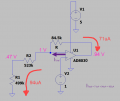
I am using a AD8030 Op Amp, in the following config.
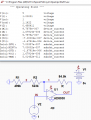
upload_2019-2-5_21-34-19.png

Does anyone know what could be going wrong? I don't expect the output to be a lower value than the input. (1v vs .94v)

I am using external voltage supplies (benchtop) to power this. I can vary the 1V input, and the feedback always tracks... but the output voltage is always lower than the input.

(I also have replaced the part multiple times, with the same results)

Any suggestions would be appreciated.

Thanks,

Zack
 

wayneh

Joined Sep 9, 2010
18,104
So the simulation is showing this and you have a build showing the same thing?

Are the voltage sources sharing a good ground connection? (This wouldn’t explain the simulation.)
 

WBahn

Joined Mar 31, 2012
32,823
Where are these numbers coming from?

How are you measuring them?

With what?

The AD8030 is spec'ed to have input bias currents on the order of a microamp, so if you are measuring 165 uA then something is wrong.

But, assuming that the measurements are good, then the explanation is pretty simple. You are expecting the opamp to behave like an ideal opamp and that means that the inputs require no current or, in practice, that the other currents in the input part of the circuit are sufficiently larger that the input currents of the amp itself are negligible by comparison. That clearly is NOT the case here. The output of the amp seeks a value that satisfies the biasing needs of the amp, so if those biasing needs are a significant portion of the total current, they can't be ignored.
 

crutschow

Joined Mar 14, 2008
38,503
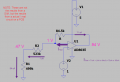
Below is the LTspice simulation which shows voltages and currents as expected:
I suspect there is some sort of wiring error in the real circuit.

upload_2019-2-6_0-43-59.png
 

Thread Starter

imzack

Joined Nov 3, 2010
73
Thanks for the feedback.

For clarification, my sim works the way I want it to. (not included)

The picture I included is what I am seeing Voltage-Wise at each node (On a Real Board) (I tried to calculate the current in each path, but the drops across the resistors seem to be inconsistant (Maybe its my probe loading things?)

Either way, the general idea that I don't understand, is why is my PHYSICAL / REAL circuit sourcing current from the INVERTING pin, and the OUTPUT is sinking current.

Hope this helps
 

Thread Starter

imzack

Joined Nov 3, 2010
73
The Prove is connected from my Ground, and each node I am measuring.
The input Impedance is set to 1M, I do believe. (I think the R&S scope I have has 3 options, 50 ohm, 1M, or AC)


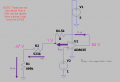
Below is the updated Diagram, to take into account the differences in current calculated (Induced by Oscope Probes?)

upload_2019-2-6_11-31-6.png
 
Put a resistor in series with the voltage source before the non-invering input. Ideal value: R || (R1+R2).

If you use the scope without a x10 probe the Input Z will be 1 M as selected. If you use a x10 probe, then it increases to 10 M.
Compensate the probe.
 

Thread Starter

imzack

Joined Nov 3, 2010
73
You're right, damn decimal places.

Thanks for mentioning that.

Things look much more consistent now.

upload_2019-2-6_11-53-33.png


Does this look like the expected behavior?
I have more of the midset of what I would think a normal/ideal device would look like, and would think that the output would still be a higher voltage than the inputs
 

Thread Starter

imzack

Joined Nov 3, 2010
73
Okay, I'll give that a shot. Is there any documentation to better understand the reason to have a resistor there? I understand it is to somehow control a bias current, but I would like to better understand it, so I don't run into this issue in the future... if this is indeed the cause ofmy issue I am seeing

Thanks
 

crutschow

Joined Mar 14, 2008
38,503
Is there any documentation to better understand the reason to have a resistor there?
The reason for the added resistor is to cancel some of the input bias current effects.
With no resistor the input voltage offset is proportional to the input bias current times the equivalent resistance at the inverting junction.
With the resistor, a voltage is now generated at the non-inverting junction that tends to cancel the input offset voltage so that it is now proportional to the input offset current, not the bias current.
The offset current is normally less than the bias current.
This current difference can be seen below from the AD8030 data sheet:

upload_2019-2-6_11-47-2.png
-upload_2019-2-6_11-45-9.png
 

Thread Starter

imzack

Joined Nov 3, 2010
73
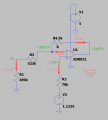
So I added a resistor to the Non-Inverting Pin (Between the Supply and the Op Amp)

Below are my results.


upload_2019-2-6_20-27-58.png

I am getting the same current being sourced by both inputs of the Op Amp, where the Output is now sinking current. This is still acting in a opposite way that I would expect.

Any thoughts?
 
The sum of the currents into a node have to be zero.

Set up the equations correctly. e.g. I1+I2+I3=0 with the positive or negative direction pointing toward the node so you don't get confused.
 

AlbertHall

Joined Jun 4, 2014
12,625
So I added a resistor to the Non-Inverting Pin (Between the Supply and the Op Amp)

Below are my results.


View attachment 169632

I am getting the same current being sourced by both inputs of the Op Amp, where the Output is now sinking current. This is still acting in a opposite way that I would expect.

Any thoughts?
There is something wrong with this too. You have a 40mV difference between the opamp inputs. This should drive the output to 0V or as near as it can get. So maybe still a measurement error caused by the loading of the voltmeter.
 

AlbertHall

Joined Jun 4, 2014
12,625
Do you have two separate means of measuring voltage? Two meters, a meter and an oscilloscope?
Connect the lowest resistance meter to the output (the output will be only very marginally affected by the meter).
Connect the other meter also to the output to compare the readings from the two meters.
Now move the other meter to each of the opamp inputs and note the effect on the meter on the opamp output.
 
Top