Op amp excessively heats up

Thread Starter

Shane47

Joined Jul 22, 2023
12
Hi,

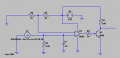
I am using an op amp LM358 as a comparator. The inverting input is connected to some reference voltage and the non-inverting is connected to a sensor output. The 12V supply is from a 12V,5A SMPS. The op amp really heats up to ~60 degree C. Any helps/suggestions would be greatly appreciated.

1690337449830.png
 

LowQCab

Joined Nov 6, 2012
5,101
Do You have Bypass-Capacitors mounted near the Chip ? ( none are shown ).

What is the character of the Input ? ( a pulse??? is shown ).

What is the purpose of R1 ?

You could add Positive-Feedback to eliminate Oscillations.
Oscillation is most likely the problem.
.
.
.
 

Thread Starter

Shane47

Joined Jul 22, 2023
12
Do You have Bypass-Capacitors mounted near the Chip ? ( none are shown ).

What is the character of the Input ? ( a pulse??? is shown ).

What is the purpose of R1 ?

You could add Positive-Feedback to eliminate Oscillations.
Oscillation is most likely the problem.
.
.
.
I donot have the bypass capacitor near the chip. The output type is pulse type, R1 is to tap the voltage by allowing current to pass through it.
 

Thread Starter

Shane47

Joined Jul 22, 2023
12
Do You have Bypass-Capacitors mounted near the Chip ? ( none are shown ).

What is the character of the Input ? ( a pulse??? is shown ).

What is the purpose of R1 ?

You could add Positive-Feedback to eliminate Oscillations.
Oscillation is most likely the problem.
.
.
.
What causes the oscillation?
 

BobTPH

Joined Jun 5, 2013
11,524
Has anyone actually seen an opamp overheat due to an oscillation? How does that work when nearly all of them are short circuit protected and can only source or sink 20mA or so?

Now, a voltage regulator can understand, but a run of the mill opamp like LM358, I can’t see it.
 

schmitt trigger

Joined Jul 12, 2010
2,091
As others have mentioned, the circuit, if assembled exactly as shown, should not cause the opamp overheating.
I would start with AG’s suggestion: on the unused opamp, tie directly the output to the inverting input, then the noninverting input to ground.
Then double check all your wiring. I can’t emphasize this too much. Everyone makes mistakes.
For instance… Last week I incorrectly wired the + and - supplies in a circuit. Damaged a couple of devices. Cow dung happens!
 
Last edited:

Thread Starter

Shane47

Joined Jul 22, 2023
12
Do You have Bypass-Capacitors mounted near the Chip ? ( none are shown ).

What is the character of the Input ? ( a pulse??? is shown ).

What is the purpose of R1 ?

You could add Positive-Feedback to eliminate Oscillations.
Oscillation is most likely the problem.
.
.
.
Something I noticed which I am not sure would or wouldn't be the cause of this problem: when I measure the voltage at the inverting and non inverting input, the voltage seems to fluctuate by around +/- 10mV.
 

Thread Starter

Shane47

Joined Jul 22, 2023
12
Has anyone actually seen an opamp overheat due to an oscillation? How does that work when nearly all of them are short circuit protected and can only source or sink 20mA or so?

Now, a voltage regulator can understand, but a run of the mill opamp like LM358, I can’t see it.
Maybe the second opamp on the LM358 dual is oscillating or is overloaded. It must be properly disabled.
Something I noticed which I am not sure would or wouldn't be the cause of this problem: when I measure the voltage at the inverting and non inverting input, the voltage seems to fluctuate by around +/- 10mV.
 

Audioguru again

Joined Oct 21, 2019
6,826
The unshielded leads of your multimeter are antennas that are picking up electrical and radio noise and injecting them into the inputs of the opamp.
The lousy (high noise level) old LM358 dual opamp has a second opamp that might be oscillating if it is not properly disabled.
 
Top