Great, thanks again !
I think you mixed up the signs in the Acl of the noninv. equation, it should be "+" all the way i think..
So for coclution:
Acl (noninv.) = Aol/1+Aol*beta
Acl (inv.) = K*Aol/1+Aol*beta
Is it correct ?
I didn't understand the example, why are you doing Acl-Aol, isn't it suppose to be LG=Aol[db]-Acl[dB] ?
In the wxample in the file attched you can see that they did the same as you but i still don't understand why ?
BTW - ROC also stand for Region of Convergence which is more common so be aware when using it.
I think you mixed up the signs in the Acl of the noninv. equation, it should be "+" all the way i think..
So for coclution:
Acl (noninv.) = Aol/1+Aol*beta
Acl (inv.) = K*Aol/1+Aol*beta
Is it correct ?
No, I didn`t mix up anything. Please note that in the case mentioned the LG carries a negative sign. Explanation: In most cases, we have negative feedback only. However, sometimes we have positive feedback also (e.g. together with negative feedback).
For this reason, we have the GENERAL formula (applicable for both kinds) Acl=Aol/1-Aol*beta
This general formula (developed by H. Black) considers a summing junction at the input of the feedback model (without any sign inversion).
For negative feedback we have LG=Aol*beta with beta<0, thus LG<0
and for pos. feedback LG>0.
I know that some books and papers show a positive sign in the denominator.
But - in this case - it must be mentioned that the formula applies to NEGATIVE feedback only!
For similar reasons also the factor K=-R2/(R1+R2) in case of inverting operation carries a negative sign. Simple rule: Signals feeding the inv. input carry a negative sign.
I didn't understand the example, why are you doing Acl-Aol, isn't it suppose to be LG=Aol[db]-Acl[dB] ?
BTW - ROC also stand for Region of Convergence which is more common so be aware when using it.
No - when you look carefully, you see that I did (1/beta-Aol).
Explanation:
To check stability we have to investigate the rate of closure for Loop gain magnitude LG=1 (0 dB). This results from the stability criterion (Nyquist).
With LG=beta*Aol=1 we have at the crossing frequency Aol=1/beta.
Thus, we have to find the slopes of both function 1/beta(dB) and Aol(dB) at this critical point. OK?
(Of course, for simple non-inv. operation we have Acl=1/beta as you have indicated. However, there are some other feedback schemes for non-inv. operation with 1/beta NOT equal to Acl. Therefore, it is important to distinguish between
1/beta and Acl - even if they are identical in some cases).
No - when you look carefully, you see that I did (1/beta-Aol).
Explanation:
To check stability we have to investigate the rate of closure for Loop gain magnitude LG=1 (0 dB). This results from the stability criterion (Nyquist).
With LG=beta*Aol=1 we have at the crossing frequency Aol=1/beta.
Thus, we have to find the slopes of both function 1/beta(dB) and Aol(dB) at this critical point. OK?
(Of course, for simple non-inv. operation we have Acl=1/beta as you have indicated. However, there are some other feedback schemes for non-inv. operation with 1/beta NOT equal to Acl. Therefore, it is important to distinguish between
1/beta and Acl - even if they are identical in some cases).
I agree with everything you are saying, we need to find the slopes of 1/beta(dB) and Aol(dB) at the 0dB point, but why subtracting them (1/beta-Aol) as you did ?
No, I didn`t mix up anything. Please note that in the case mentioned the LG carries a negative sign. Explanation: In most cases, we have negative feedback only. However, sometimes we have positive feedback also (e.g. together with negative feedback).
For this reason, we have the GENERAL formula (applicable for both kinds) Acl=Aol/1-Aol*beta
This general formula (developed by H. Black) considers a summing junction at the input of the feedback model (without any sign inversion).
For negative feedback we have LG=Aol*beta with beta<0, thus LG<0
and for pos. feedback LG>0.
I know that some books and papers show a positive sign in the denominator.
But - in this case - it must be mentioned that the formula applies to NEGATIVE feedback only!
For similar reasons also the factor K=-R2/(R1+R2) in case of inverting operation carries a negative sign. Simple rule: Signals feeding the inv. input carry a negative sign.
You are saying that the GENERAL formula is: Acl=Aol/1-Aol*beta, for both configurations. But you also said we need to add K factor for an inv. configuration. so what is the complete formula for the inv. AMP (K factor included) ?
I agree with everything you are saying, we need to find the slopes of 1/beta(dB) and Aol(dB) at the 0dB point, but why subtracting them (1/beta-Aol) as you did ?
Because we need to find the "angle" (more correct: rate of closure) BETWEEN both lines (asymptotes) which define the loop gain (and the loop gain is zero dB at the crossing point). Of course, for 1/beta=constant the corresponding slope is 0dB/dec and we must care about the slope of Aol only.
However - in general, as indicated in my differentiator example, when 1/beta has a certain slope we must find the difference.
By the way: Such a case is the only reason for using the term "rate of closure" .
Otherwise, if 1/beta would be always a horizontal line with 0dB/dec it would suffice to say simply "slope of Aol".
You are saying that the GENERAL formula is: Acl=Aol/1-Aol*beta, for both configurations. But you also said we need to add K factor for an inv. configuration. so what is the complete formula for the inv. AMP (K factor included) ?
EDIT: Perhaps the following hint helps:
* the feedback factor beta is found by calculating the part of the output signal that is fed back to the inv. input (setting signal input to zero!).
* accordingly, the "feedforward factor" K is found by calculating the part of the input voltage that arrives at the inv. input (setting the output node to zero).
This is in full accordance with the superposition theorem (setting signal sources successively to zero and superimpose the results).
Because we need to find the "angle" (more correct: rate of closure) BETWEEN both lines (asymptotes) which define the loop gain (and the loop gain is zero dB at the crossing point). Of course, for 1/beta=constant the corresponding slope is 0dB/dec and we must care about the slope of Aol only.
However - in general, as indicated in my differentiator example, when 1/beta has a certain slope we must find the difference.
By the way: Such a case is the only reason for using the term "rate of closure" .
Otherwise, if 1/beta would be always a horizontal line with 0dB/dec it would suffice to say simply "slope of Aol".
I understand all your saying but you still didn't answer my question (or i didn't get your answer totally). Why a subtract of the magnitude between the lines (1/beta-Aol) gives you the "angle" (rate of closure) ?
I understand all your saying but you still didn't answer my question (or i didn't get your answer totally). Why a subtract of the magnitude between the lines (1/beta-Aol) gives you the "angle" (rate of closure) ?
OK - here comes a detailed explantion:
1.) It is the slope of the LOOP GAIN magnitude that matters only.
Now assume that 1/beta rises with +20dB/dec and Aol decreases with -20dB/dec. As derived earlier, the loop gain is Aol/(1/beta) or in dB: Aol(dB)-1/beta(dB)
For our example, that means: At the crossing frequency the loop gain decreases with -40dB/dec.
(You could now draw the loop gain response in an extra diagram - however, this is not necessary because you can use the 1/beta line in the original diagram as a new x-axis. Then - related to this new axis, the Aol curve gives you the loop gain response).
2.) As another view:
Loop gain LG=Aol/(1/beta).
That means: The phase response of the loop gain is the difference Phi(Aol)-Phi(1/beta).
Because the individual phase shifts are connected with the corresponding SLOPES of the magnitude functions, the information about the combined phase shift (the difference as given above) is also contained in the difference of both magnitude slopes. Thus, we can apply the knowledge, that the loop gain magnitude drop must not be 40dB/dec but should exhibit 30dB/dec or even less. OK?
This is what i said straight from top, the equation should be Aol-1/beta, and not the other way around.
In your differentiator example u did 1/beta-Aol !
This is what i said straight from top, the equation should be Aol-1/beta, and not the other way around.
In your differentiator example u did 1/beta-Aol !
Was this really your problem? Don`t care about it - as far as magnitudes are concerned.
I think, from the drawing (Aol and 1/beta, respectively) it is clear what the difference means.
More than that - as far as the SIGN of a slope is concerned - you have distinguish between "slope" and "roll-off".
Example: A slope of -20 dB/dec is identical to a roll-off of +20 dB/dec (and vice versa). I think, this explains the sign difference.
(May be, I have confused roll-off with slope in one of my answers. Sorry, if this was a problem for you).
Was this really your problem? Don`t care about it - as far as magnitudes are concerned.
I think, from the drawing (Aol and 1/beta, respectively) it is clear what the difference means.
More than that - as far as the SIGN of a slope is concerned - you have distinguish between "slope" and "roll-off".
Example: A slope of -20 dB/dec is identical to a roll-off of +20 dB/dec (and vice versa). I think, this explains the sign difference.
(May be, I have confused roll-off with slope in one of my answers. Sorry, if this was a problem for you).
But the differnce between 1/beta-Aol and Aol-1/beta is crucial, if we have
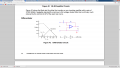
In the diff. example one slop of +20dB\dec and the other -20dB\dec. So 1/beta-Aol comes to 0dB (instead of 40) !! from the attached drawing i can't understand why the ROC is 40 dB/dec. after the crossing point the curves merged and the slope remain the same as it was.
But the differnce between 1/beta-Aol and Aol-1/beta is crucial, if we have in the diff. example one slop of +20dB\dec and the other -20dB\dec. So 1/beta-Aol comes to 0dB (instead of 40) !!
0 dB? Yes- if you ADD both slopes. However, you must use the DIFFERENCE!
In one case you get +40 dB/dec (roll-off) and in the other case -40 dB/dec (slope).
From the attached drawing i can't understand why the ROC is 40 dB/dec. after the crossing point the curves merged and the slope remain the same as it was.
No - 1/beta and Aol do not merge.
The drawing shows THREE different curves.
1.) Aol
2.) 1/beta=(1+jwRC), which crosses the Aol curve and continues in growing!
3a) Acl=1/beta (as long as Aol can be regarded as 1/Aol<<beta (see the denominator of the complete transfer function for Acl)
3b) Acl=Aol for 1/Aol>>beta.
Of course, the drawing shows the asymptotic lines only. You must interpolate to get the real response.
From the Acl response you can derive that this circuit cannot be applied for differentiating purposes (instability).
That is one of the reasons that integrators play a major role in analog signal processing - if compared with diff. circuits.
(filters, oscillators).

 Facebook
 Google
 GitHub
 Linkedin