Op amp and a push pull configuration with offset

Thread Starter

Mozee

Joined Jul 23, 2016
87
Hello there

I am trying to built an amplifier which it's output can be offseted when needed. I will be using Double power supply to get -Ve and +Ve swinging.
My idea is to feed the Op Amp with the weak signal using the Non-Inverting input and the output should be fed to the two NPN and PNP transistors in push-pull configuration. Problem is the Op Amp output voltage connected to the bases is not enough to turn on the transistors (Vbe= 0.7V) and I want my output signal to be swinging about 0 Volts not offsetted, Alse I would like to control the amount of offset using a potentiometer and biasing principal. I know the basics but I can't seem to understand the connections and how is should be made, I believe it is possible to be done so any help or explanation would be appreciated.

First of all, sorry for the bad hand drawing,

-Input signal is 200mV max , very weak therefore an op amp is used for it's high impedance
-Where should I place the POT to control the final offset form Zero to +Ve and -Ve and is it actually possible?
-How can I turn on the transistors, what is the required voltage V=? and how to get it from the Op amp output?
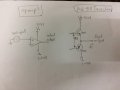
IMG_1605.JPG

Explanations would be so very welcomed so I can learn and not just memorise :)
 

ci139

Joined Jul 11, 2016
1,989
I want my output signal to be swinging about 0 Volts not offsetted

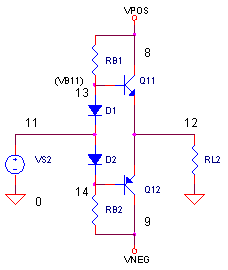
(Fig. - clk4src)

if you add neg FB ? it likely should do that -- however such likely has both those transistors open for OUT-put "0" at least for 1A×(Vee-Vcc)=30W for ±15V supply (a lot of heat to conduct off from your output transistors !!!) -- depending on your exact application there may be better solutions . . .
 
Last edited:

Thread Starter

Mozee

Joined Jul 23, 2016
87
What is the maximum peak output voltage you need?
I would need a max Vp=10V , this is going to be a reasonable value!
The amplifier is then going to act as a waveform generator by feeding from an android app called "Function Generator". My problem is that I need the output to be swinging about Zero volts and then I would like to be able to offset the entire signal towards +Ve and -Ve using potentiometer.
Now I know that the Q-point (Biasing) is what I should play with but I can't find how to calculate that.

Also, Isn't adding biasing diodes going to change the wave shape? I think I read that somewhere?!
 

Thread Starter

Mozee

Joined Jul 23, 2016
87
however such likely has both those transistors open for OUT-put "0"
Hmmm, Not sure I understand what you mean here! If possible, could you explain further more?
BTW, thanks for the circuit you provided, I am just afraid of the diode being a source of distortion to the signal, I don't know how but i read this sometime ago, perhaps you can explain this too :)
 

ci139

Joined Jul 11, 2016
1,989
afraid of the diode
:p
diode - in principle - acts as zener (or as something that has a constant voltage drop on it - independent what the the current value passing through it is - ((to better compensate the 2N3904 PN junction for small signal actually takes 1N4148+1N5817+a small value resistance - but since the production parameters for these things vary by items - it's not a rule)) )
diode also acts as voltage and current dependent capacitor and a low ohmic(name value) resistor
. . . same for the appropriate PN NP junctions for NPN and PNP switches (from where it actually hints -- as we use the transistors in emitter follower cfg. here -- that they have a negative (for switch) (forward (in time)) biasing for the emitter ... but actually/eventually a varying capasitive positive feedback from emitter - that in turn may cause instabilities - - at higher frequencies ((! i guess)) )
if you follow the
article the negative (from push pull output) feedback effect gets covered

what you also may attempt is (component exhaustive) drive the Hi and Low Switches independently from Hi/Lo drives with
appropriate dynamic offsets - relative to you I or O signal - these offsets depend on the output power and voltage (and the dynamic stage/state of your voltage output at higher frequencies - I/O phase shift of your bipolar output switches "induced" by their appropriate "transition times" and desired output amplitude at time"."x as to climb higher faster you need to overdrive the B to reach there ((High)) at required time . . . a lot of head ace )

we can always interpret this and differently - for power amplifiers - we imagine the high and low side switches being the appropriate POS and NEG power supplies with "very low" (sufficient) OUTP impedance (and "excellent" (sufficient) supply/load rejection) and OUTP.sink capability . . . e.g. the complexity of a design is the same
 
Last edited:

Thread Starter

Mozee

Joined Jul 23, 2016
87
:p
diode - in principle - acts as zener (or as something that has a constant voltage drop on it - independent what the the current value passing through it is - ((to better compensate the 2N3904 PN junction for small signal actually takes 1N4148+1N5817+a small value resistance - but since the production parameters for these things vary by items - it's not a rule)) )
diode also acts as voltage and current dependent capacitor and a low ohmic(name value) resistor
. . . same for the appropriate PN NP junctions for NPN and PNP switches (from where it actually hints -- as we use the transistors in emitter follower cfg. here -- that they have a negative (for switch) (forward (in time)) biasing for the emitter ... but actually/eventually a varying capasitive positive feedback from emitter - that in turn may cause instabilities - - at higher frequencies ((! i guess)) )
if you follow the

article the negative (from push pull output) feedback effect gets covered

what you also may attempt is (component exhaustive) drive the Hi and Low Switches independently from Hi/Lo drives with
appropriate dynamic offsets - relative to you I or O signal - these offsets depend on the output power and voltage (and the dynamic stage/state of your voltage output at higher frequencies - I/O phase shift of your bipolar output switches "induced" by their appropriate "transition times" and desired output amplitude at time"."x as to climb higher faster you need to overdrive the B to reach there ((High)) at required time . . . a lot of head ace )

we can always interpret this and differently - for power amplifiers - we imagine the high and low side switches being the appropriate POS and NEG power supplies with "very low" (sufficient) OUTP impedance (and "excellent" (sufficient) supply/load rejection) and OUTP.sink capability . . . e.g. the complexity of a design is the same
Thanks bro.. Will have a look at the provided link.
You see, my problem is that I didn't and I'm not studying electronics academically therefore I am not fameliar with the termonologies so an extended explanation with simple understandable words will help me a lot. Trying my best to learn the electronics terms thou but it's vast as you guys know :)
 
Top