Old School Clock - How to get it to work without a Master? ..#3

Thread Starter

frannypoo

Joined Jun 4, 2026
12
The info on the clock label indicates 6W @ 24VDC, so 0.25A.

Only driving one clock.

The transformer is a standalone transformer purchased when the existing circuit was built back in 1989 or so. It is an Archer (RadioShack) Model 273-1366: 120VAC primary, center-tapped 12-0-12VAC 0.45A secondary.
 

AnalogKid

Joined Aug 1, 2013
12,147
The circuit has run for years without regulated power supplies, so there is no immediate reason to add them to the design. Still, it would be good to see what the actual operating voltages are.

With a DC meter, measure the voltage across each diode bridge's outputs. There is no common ground between the 12 V and 24 V circuits, so a valid reading is possible only with both meter leads at the bridge terminals.

After that, to see the effect of the separate supplies, put the - meter lead on the 12 V bridge - terminal (or any other ground point in the timing circuit, such as pin 8 of either timer chip), and put the meter + lead on the OUT+ connection point.

ak
 

Thread Starter

frannypoo

Joined Jun 4, 2026
12
With a DC meter, measure the voltage across each diode bridge's outputs.
12V bridge output: 17.6VDC (input from xfmr is 13.4VAC)
24V bridge output: 37.7VDC (input from xfmr is 26.8VAC), drops to 28.8VDC-ish (DVM reading) for the 1s pulse

After that, to see the effect of the separate supplies, put the - meter lead on the 12 V bridge - terminal (or any other ground point in the timing circuit, such as pin 8 of either timer chip), and put the meter + lead on the OUT+ connection point.
12V bridge (-)-to-OUT (+): 20.6VDC, drops to 19.8VDC-ish for the 1s pulse

OUT (+)-to-OUT(-): 0.0VDC until 1s pulse where it jumps to 28.8VDC-ish (again, DVM reading)

By the way, I first took these measurements before I disconnected the plug's earth ground from the 12V bridge (-). It didn't seem to make any difference after I did.

To my eye it seems the bridge DC outputs are way higher than expected/desired. But there might be some other things going on that I'm not qualified to evaluate. Let me know if you want me to make any more measurements. Thanks.
 

crutschow

Joined Mar 14, 2008
38,536
Fortunately there are many ways to do this with contemporary parts, while eliminating diode bridge D3 and optocoupler U4.
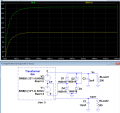
Sidebar -- Although there's no apparent reason to modify the already built circuit, for your interest, below is the sim of a rectifier circuit that generates full-wave voltage from a single bridge, and 1/2 voltage from the transformer center-tap output (the center-tap acts as a full-wave rectifier using the two grounded bridge rectifiers).

As an added bonus, both voltages are referenced to a common ground, thus the opto isolator is not needed.
Also the output experiences equal current in both winding halves from both the full voltage and the 1/2 voltage loads.

Perhaps that was what your were alluding to. :)

1780968223839.png
 
Last edited:

AnalogKid

Joined Aug 1, 2013
12,147
To my eye it seems the bridge DC outputs are way higher than expected/desired.
One of the very first things you learn in EE school is how to quantify the energy in something that is changing constantly - a sine wave. Skipping the very long derivation (I'll leave that for the boys on Stackex) the answer is the RMS value. Root - Mean - Square. Unlike the peak value or peak-to-peak value, the RMS value is voltage equivalent of a DC voltage that produces the same power. 10 V DC across a 20 ohm resistor produces 5 watts of heat. A 10 Vrms sinewave produces the same 5 W. Using the peak value or peak-to-peak value would yield the wrong result. This is why transformer voltages are given in RMS values. Your meter probably is not a true RMS meter, so it has an internal circuit that approximates the RMS value assuming the AC input signal is a sine wave.

When a sinewave goes through a rectifier and filter circuit, the voltage across the filter cap (with no load current) is not the RMS value, it is the peak value. The conversion factor between RMS and peak is 1.414, the square root of two. Thus, the peak value of a 12 V sinewave is 16.97 V. Next, we take into account the forward voltage drop across the bridge rectifier diodes, Vf. A common approximation is that all silicon diodes have a Vf of 0.6 V, but power rectifiers run high, so I estimate low power rectifiers and bridges at around 0.8 V per diode. In a bridge circuit there are two diodes conducting at all times, so that 1.6 V is subtracted from the transformer secondary's peak voltage.

Almost done. Next is something difficult to approximate. Power transformer outputs are not perfectly constant from no load to full load, and the rated output voltage usually is at full load (or full load -10%) so the AC voltage you measured in the gap between pulses is going to be higher that the rated value. This should sag downward during a pulse, and your readings indicate that it does. What is informative is that if you start with the supply's DC output voltage during a pulse and work backwards through the math, you come up with a secondary AC voltage of 21.5 Vrms, not 24. This could indicate that the transformer is being overloaded briefly, or (more likely), the transformer core is made of relatively cheap steel. We don't know what Radio Shack's standards for power transformers are, but if you increase that 21.5 V calculation by 10% you get 23.65 V. Close enough for RS.

ACrms value x root2, + 10%, - diodes = unloaded peak output voltage -ish

ak
 
Last edited:
I couldn't see a hint to the most likely culprit: I'd expect the 10 uF cap to be an Al electrolytic one. Over the years (decades) this might have dried out and thus lost capacitance, leading to voltage dips resulting in erratic circuit operation.
For circuits expected to work "forever" I'd recommend film capacitors (available mainly in THT). These could be somewhat bulky and costly but rarely lose capacitance. (e.g. MKS 4 10 uF/63 V, RM15)

As for tying unused Inputs to either GND or the supply: you can tie some such inputs together, then connecting them to the rail through a 1k resistor (to prevent fancy latchup events under "not so favorable circumstances").
 

Thread Starter

frannypoo

Joined Jun 4, 2026
12
I'd expect the 10 uF cap to be an Al electrolytic one.
Both capacitors in the circuit are electrolytic. Seems it might be a good idea to replace them both with film types to better ensure the longevity of the circuit's operation when I upgrade the overall circuit. Thanks for the tip.
 
Both logically and electrically, all unused inputs can be hard-tied to GND, so there shouldn't be any latch-up issues.

ak
Under "friendly circumstances" a series resistor is not necessary. But when it comes to EMI/ESD, the resistor comes really handy - do not underestimate the wisdom of our ancestors.
(BTW: the series resistor pull-up/pill-down recommendation has even been published by e.g. TI in some paper that might date back to the last millennium.);)
 
Top