Ok I’m addicted... another meter

rsjsouza

Joined Apr 21, 2014
425
@Wolframore, congratulations on your purchase!

The ultra low cost meters are quite bad in terms of CAT ratings, but the midrange Chinese ones seem to be at least marginally well made.

Since the standards aim the survivability and safety of the operator and not the equipment, @joeqsmith's tests certainly fill this gap up to a certain extent.

That said, I don't really see how Gossen could get away with such susceptible meter - maybe the standards do not evaluate for magnetic interference? I know that electromagnetic fields are tested. Well, that or they are cutting costs during production (after the unit passes certification) - their silence after @joeqsmith's messages really gives a lot of margin for speculation. Despite Gossen is a household name, it may have been under the influence of the bean counters (nobody is immune to them, really). Even Fluke has been taking measures to cut costs, but it seems they are years ahead in well designed products.
 

BobaMosfet

Joined Jul 1, 2009
2,211
If I were required to buy a Fluke handheld meter, the only choice would be the 289. Lucky for me, that's not a requirement as the slow boot times, poor display, short battery life and show graphing are much to be desired. It's too bad they don't offer any modern meters for electronics use but I doubt there was much of a market for meters like the 87IV and 189 or they would continue to offer them.
I have a 289, it's amazing. If you have slow boot times, poor display, and short battery life you need to get it looked at. I bought this meter in 2014, and have yet to change a battery. Display is excellent and has a backlight.
 

Ya’akov

Joined Jan 27, 2019
10,235
I have a 289, it's amazing. If you have slow boot times, poor display, and short battery life you need to get it looked at. I bought this meter in 2014, and have yet to change a battery. Display is excellent and has a backlight.
In comparison to "modern" meters, the 287/289 is slow, and it doesn't have the high contrast display of newer options. It also has famously short battery life if used for logging though I haven't had any problems with the 287 in non-logging applications.

I really like and trust my 287, but it would be nice to have the modern equivalent made by fluke.
 

joeqsmith

Joined Oct 15, 2016
63
I have a 289, it's amazing. If you have slow boot times, poor display, and short battery life you need to get it looked at. I bought this meter in 2014, and have yet to change a battery. Display is excellent and has a backlight.
True, if the meter just sits on the shelf, I bet the battery life is as good as the lowest powered meters out there. ;) A few of us were looking at battery life of handhelds. That data is available on the EEVBLOG site. Battery life, boot times, display and back light are all relative. Start comparing the 289 with other meters and you will find it's not very impressive. It's an old design.
 
Last edited:

joeqsmith

Joined Oct 15, 2016
63
That said, I don't really see how Gossen could get away with such susceptible meter - maybe the standards do not evaluate for magnetic interference? I know that electromagnetic fields are tested. Well, that or they are cutting costs during production (after the unit passes certification) - their silence after @joeqsmith's messages really gives a lot of margin for speculation. Despite Gossen is a household name, it may have been under the influence of the bean counters (nobody is immune to them, really). Even Fluke has been taking measures to cut costs, but it seems they are years ahead in well designed products.
There is something in the standards for magnetic interference but nothing like a magnetic hanger. That's really a miss IMO. After a few people had written them and they came up with the stories about what was said, then I called them out for it, nothing else had come out of them. A shame really. That Ultra could be a one of the best meters I have looked with a few changes. Talk about poor battery life. So bad they have that external battery pack option.
 

joeqsmith

Joined Oct 15, 2016
63
I can't imagine it would add more than $5-10 per unit for the Chinese to build similar units.
...
But I am truly amazed at the range and precision of these hobby meters from China.
I am not sure what the costs to have a product certified are. It's not free and they will need to spread that cost over the number of units they plan to sell. UNI-T offers a certified version of the UT61E but the price difference is more like $30. And my guess is a direct hit with a small ESD event would still take it out. ESD is not part of 61000. It's called out in 61326.
 

rsjsouza

Joined Apr 21, 2014
425
True, if the meter just sits on the shelf, I bet the battery life is as good as the lowest powered meters out there. ;)
The battery may last that long under these conditions alright, but there is always a risk the supercap spews its guts all around the PCB. :rolleyes:

I am not sure what the costs to have a product certified are.
I know that at least a couple of 10s of dollars go for certification costs of a very basic product with minimal unintentional irradiator and non-LVD compliance. Take that to an instrumentation equipment with an annually renewed compliance mark and the cost will quickly explode.
 

joeqsmith

Joined Oct 15, 2016
63
The battery may last that long under these conditions alright, but there is always a risk the supercap spews its guts all around the PCB. :rolleyes:

I know that at least a couple of 10s of dollars go for certification costs of a very basic product with minimal unintentional irradiator and non-LVD compliance. Take that to an instrumentation equipment with an annually renewed compliance mark and the cost will quickly explode.
The one Fluke 189 that my friend gave me still has the original cap in it. That's a pretty long life. The one that failed in my tablet only lasted a couple of years. I didn't look to see how hard they were driving it.

I wouldn't be surprised of the cost to for cert is not in the 10s of thousands. It's been a while since I have had to rent time but the hourly rates are not cheap and the time to run the full set of tests for a product, I would guess is days if not weeks. It would be interesting to know the costs around the world.
 

Thread Starter

Wolframore

Joined Jan 21, 2019
2,619
If it’s anything like the FCC intentional and unintentional EMI $20k min if there are no issues. Cost little to nothing to add protective circuitry without the certs
 

joeqsmith

Joined Oct 15, 2016
63
If it’s anything like the FCC intentional and unintentional EMI $20k min if there are no issues. Cost little to nothing to add protective circuitry without the certs
I've said before that I believe that when it comes to safety, that the mechanics of the meter may be more important than any protective circuitry. I've said that I've contacted a few large, well known companies who make meters and one company interpreted that the meter had to survive the testing while the other did not. I later in a video stated the company who told me they design the meters to survive was Fluke.

If the companies who design the meters are not clear about the goals and the companies who certify them are open to different pass/fail criteria, how do we as consumers ever know?

To be clear, I can't tell you that a meter that is certified for safety would make it more electrically robust. I think it's two separate topics. What I can tell you is that if you are interested in seeing meters survive some basic transients, finding a meter that has been certified for the 61326 standard may be more what you are looking for.
 
Last edited:
Some things I don't mind going cheap on. A meter is not one of them. The DVM is your most used piece of test equipment. I paid $100 for my fluke. It is 10 years old now and lived through several times of being dropped form ladders, and being thrown around my tool bag. You get what you pay for when you buy a meter.
 

Thread Starter

Wolframore

Joined Jan 21, 2019
2,619
Hey Joe I have an AW Sperry that's about 30 years old now... I wanted a Fluke but it's difficult on military salary at the time... I'm curious to open it up an take a look, have you by any chance done tests on any of them? I don't have the model number handy but looks similar to this with manual ranges
upload_2019-5-10_8-46-50.png
 

joeqsmith

Joined Oct 15, 2016
63
If the concern is safety, many old meters, including ones made by Fluke are not going to be certified.

Again, the data I have collected is free to view. I have only looked at the meters listed.

https://docs.google.com/spreadsheet...KXqM22CEQZP3_xwWvDyeVwxTy4/edit#gid=400910915

The following slide show made by Fluke may be helpful. Again, to be clear, I really have little interest in the safety side of things. I am most interested in a meter's ability to survive some basic transients. Fluke has shown to do very well in these tests, along with Brymen, HIOKI and Gossen.

https://www.slideshare.net/Transcat/fluke-electrical-safety-seminar-slides
 
I wish the smaller ones used 9V for diode testing because they’re handy for testing LEDs. Otherwise the smd LEDs all look the same. I need to light em up.

I have a few specific uses for something like this. I’m doing a series of very low power led stuff for hobby use. I need to easily check my smd components might check current draw on a few LEDs maybe 100mA max. Eyesight getting bad don’t want to strain, small size is great for workspace and may be used on my automotive and motorcycle once in a while. I have other meters for tube circuitry and higher voltage stuff. Might also come in handy to just keep it in my car.
Have you looked at the BT39C? Looks like a decent performer as long as you stay on the low V you're fine. Fits all your reqs.
 

rsjsouza

Joined Apr 21, 2014
425
Congratulations with your purchase!

I had a Surpeer AV4 that was the same form factor, size and specifications, but a different design. It would have been a great meter if it weren't an unfinished product full of bugs. I think Aneng has a finished product with the AN870.
 

Thread Starter

Wolframore

Joined Jan 21, 2019
2,619
Well from the reviews The AN870 looks ok for what it is. The input protection for all of these meters are for when you screw up and have it in the wrong setting and plug. I’ve tested tube plate voltage with my $12 thsinde just fine. It measured 380V thereabouts. Even the Flukes are only rated for so many seconds with high current readings. But using a shunt is a better way to measure current. The Supeer looks like a decent meter as well. As with all these meters I wish they would speed up the sample and settle they’re very useful nonetheless even with their faults. Even the Fluke 87 sample rate is 4/sec so I guess it’s not bad.
 
Last edited:

Thread Starter

Wolframore

Joined Jan 21, 2019
2,619
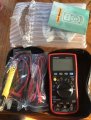
Just got package yesterday. It took 10 days so that’s record time. Just tested against my other meters. Showing 9.998k on 10k resistor(1%). The others show 9.99k. The temp sensor looks useful but may get some different thermocouples for checking components.

Are all these guys using the same case/enclosure? They’re getting a lot of mileage out of this mold.

Probes were a little loose but adjusting plug end works fine.

871F1F24-517D-4026-B603-969706A9A536.jpeg
 

rsjsouza

Joined Apr 21, 2014
425
Are all these guys using the same case/enclosure? They’re getting a lot of mileage out of this mold.
Molds are expensive, thus it makes sense - these are shared among several OEMs (Aneng, Zoyi, Zeast and others). Even between them and the "A-brand" meters there is an incredible degree of similarity (pick a Fluke 15B or a Fluke 17B, for example).
 
Top