offgrid, modern household. usecase for 204+VDC battery packs

MrSalts

Joined Apr 2, 2020
2,767
Can anyone please help shedding some light on this question?
MCB = miniature circuit breaker. Two pole means both wires are connected to a breaker and both breakers are connected to each other - if one trips, they both trip. That way, one live wired will not zap you if you are grounded both will be cut off when the circuit breaker trips. 230v is typically a live-live two wire connection - where as 120 is live to neutral connection.
 
Last edited:

Thread Starter

quitenoob

Joined Mar 27, 2022
262
But why is the third phase red? Shouldn’t it be grey.
Are two-pole MCBs required in NL?
No not required, but given the amount of stuff going on in this cabinet it helps to reduce the footprint of components.

I dare not post an image of my breaker cabinet before the update. it was total chaos!!
 

Ian0

Joined Aug 7, 2020
13,171
Can anyone please help shedding some light on this question?
At the top of your photo is a line of MCBs all of which are single unit width but have 4 terminals. I thought they must be 2-pole MCBs, but I assume that the must be MCBOs.
 

Thread Starter

quitenoob

Joined Mar 27, 2022
262
At the top of your photo is a line of MCBs all of which are single unit width but have 4 terminals. I thought they must be 2-pole MCBs, but I assume that the must be MCBOs.
I am not fully confident I understand where you are going but i'll try to respond anyway;

These "units" have 2 terminals going in and 2 going out. So 4 in total. If I recall correctly is should not even matter the direction the flow goes. Did not fact chack that and just kept the same wiring concept as original
 

Lo_volt

Joined Apr 3, 2014
373
You mentioned that you want to install a wind turbine to this system. Evidently it's more complex than a home brewed transformer and a 204 volt lithium battery bank. Can you offer a description of the final system that you want for your home? What do you have installed already and what do you have planned? How much power do you normally use? How much storage to you expect to get out of your battery bank in kilo-watthours? How much power do you expect to get from your renewable sources, solar or wind, etc?
 

Thread Starter

quitenoob

Joined Mar 27, 2022
262
The wind turbine (and alternator) I am DIY'n will have 3 phases.
And then through a MPPT wind turbine charge controller via a BMS to a battery pack the voltage of which is yet to be determined.
What inverter(s) to use to be able to hook battery packs up to wiring in the home I will figure out much later down the road I am afraid ;(
 

Lo_volt

Joined Apr 3, 2014
373
How many kWH do you use in a day on average? What is your peak usage? You'll need to know this to determine your battery size. You will have to size the battery bank such that you have enough power for several days if the wind doesn't blow. Voltage of the battery bank is agnostic to your storage needs. As you've learned in this thread, higher voltages mean smaller wire sizes but you still need to think in terms of kWH stored.

What is the wind like in your location? Windspeeds below 7 miles/hr (11kph) won't generate any significant amount of energy and windspeeds above 25 miles/hr (40 kph) are too strong such that your turbine will need to furl. Constant wind is always preferred.

You will also need a significant diameter turbine to generate enough power for your needs. A 1 meter diameter turbine might be able to generate 100 watts at 25 miles/hr. That's not much. A 3 meter turbine will generate a lot more, but think about the logistics of installing it. Conventional wisdom suggests that 30 meters above any surrounding trees is optimal for a turbine. This is to avoid the turbulence close to the ground. Have you thought about how you are going to mount a large turbine 30 meters high?

For some great info on renewable energy I suggest you go to https://www.fieldlines.com . They have some very experienced wind turbine builders that can offer great answers to questions you may have.
 

Thread Starter

quitenoob

Joined Mar 27, 2022
262
I am getting a bit nervous though playing with high voltages so perhaps it is better to have multiple 12 volt packs rather than one large one
 

Ian0

Joined Aug 7, 2020
13,171
I am getting a bit nervous though playing with high voltages so perhaps it is better to have multiple 12 volt packs rather than one large one
That's what I thought! - see post #9. Though the larger currents would be more likely to cause a fire. It depends on how you want to die!
 

Lo_volt

Joined Apr 3, 2014
373
I think you need to lay out your needs for your whole system before you decide what components you want to use. You are looking at wind generation, battery storage and an inverter.

To start, you have to confirm that the wind in your vicinity will be strong enough and constant enough to generate the power that you need. There is very little energy in a breeze. You'll need 25 miles/hr (40 kph) wind to get sufficient output and you'll need that to be constant. Wind gusts don't count.

Looking at your turbine design, I'm not sure it will generate enough energy for you.
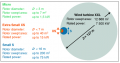
1649872225980.png
(Credit: https://ebookreading.net/view/book/EB9781118361153_52.html , Small Wind Turbines by Paul Kühn)
Guessing at your dimensions from the fieldlines post, it looks like about 2 meters wide by 4 meters high. This gives you a swept area of 8 m^2. Looking at the illustration you'll generate a maximum of just over 1.5 kW at the best wind speed. If the wind speed is constant, if your turbine and its associated generator are efficient enough, then over 24 hours you'll see 36 kWH. Those are giant "ifs".

As for your battery bank. As I've noted before, find out how much energy storage you need and work your calculations from that. Remember that your battery will need to supply enough to get you through any periods of time when the wind doesn't blow .

The inverter is something I think you'll need to pay close attention to. With your lack of experience in power electronics design, I would really suggest that you buy an off-the-shelf device. As I've said before, they are designed and tested to rigid safety standards. That is really valuable when it comes to keeping your family safe.

I'm not trying to be a downer. I'm a big fan of renewable energy. I just think you need to fully understand your needs before you jump into designing a system.

Now that I've totally discouraged you from going with wind, I'll suggest that you look at solar. I looked at both wind and solar a few years ago and I realized quite quickly that I don't have enough wind to make that work. I have the room available on my property to install a 100 foot high tower, but that's a lot of effort for minimal output. Very quickly I came to the conclusion that solar was best for me. I have an 8460 watt grid tied solar array and have not paid a cent to the utility since I commissioned it. I installed the major portions of it myself. In my locality, a licensed electrician was needed to finalize installation.

The other thing that you should take seriously is reducing your usage. Take advantage of LEDs and other energy efficient devices in your house. I have seen water heaters that take the heat from air conditioning the house and use it to heat hot water. There are all kinds of cool tricks to be played to increase energy efficiency.
 

Thread Starter

quitenoob

Joined Mar 27, 2022
262
Power semiconductors are another factor.
The world is well supplied with low Rds(on) MOSFETs at 100V Vds(max), which you would use for a 48V inverter.
The next common voltage would be 72V, which would boost charge at 90V (for Lead Acid), which is rather close for comfort on a 100V transistor.
The next common battery voltage is 108V, which would require 200V transistors, and the choice is not so good.
Higher battery voltages may require IGBTs, or SiC devices.

If the project is in any way experimental in nature, then choosing a battery voltage that you can experiment with, without having to take extreme safety precautions is an advantage.

If you are using a commercial product, someone else has taken all those risks, and you are free to choose any voltage for which there are products available.
OK so a reason NOT to go higher is the availability of components yes?
If one can confirm then I'll update the TL DR on the OP
 

Thread Starter

quitenoob

Joined Mar 27, 2022
262
As they are finished products EV's comply with those conditions to reduce the risk to the consumer and the liability of the manufacturer. That's also the reason I suggested an off-the-shelf product vs. DIY.
I have heard too many stories of EV blowing up so I am far better persuaded with other data.
Also what I have probably neglecting to tell is that I favor DIY over store bought.
That is not to say I am against the concept.
 

Thread Starter

quitenoob

Joined Mar 27, 2022
262
To start, you have to confirm that the wind in your vicinity will be strong enough and constant enough to generate the power that you need.
Wind here is favorable. More over my land has several places where I can place large (on the roof 2m w x3m h, elsewhere on my land I can stack turbines as long as they not go above 12m above "ground" level) turbines that will not interfere with my solar array.
 

Thread Starter

quitenoob

Joined Mar 27, 2022
262
Guessing at your dimensions from the fieldlines post, it looks like about 2 meters wide by 4 meters high. This gives you a swept area of 8 m^2. Looking at the illustration you'll generate a maximum of just over 1.5 kW at the best wind speed. If the wind speed is constant, if your turbine and its associated generator are efficient enough, then over 24 hours you'll see 36 kWH. Those are giant "ifs".
Yes!! and I will place more of them around my land.
 

Thread Starter

quitenoob

Joined Mar 27, 2022
262
The inverter is something I think you'll need to pay close attention to. With your lack of experience in power electronics design, I would really suggest that you buy an off-the-shelf device. As I've said before, they are designed and tested to rigid safety standards. That is really valuable when it comes to keeping your family safe.
The problem I have is that I am only considering cheap knockoffs from our friends in the east as long as I do not know what I am doing. I intend to learn how quality stuff works and be able to fix it when it breaks
 
Top