NTC thermistor

Thread Starter

Missio2468

Joined Mar 18, 2022
74
The transfer function will be very close to linear if you keep the temperature range small enough.

How have you determined that your setup is not accurate enough for your purposes?

I can only assume that you are comparing your results against a known reference, e.g. a digital thermometer?
Hence you only need two pairs of calibration points, one at a low temperature and another at a higher temperature.
Post your calibration data, i.e. known reference temperature and ADC counts (not the temperature your unit is indicating).
I have determined According to the datasheet provided and also theoretical(in excel) and practically checked using 5 different thermistor in my circuit. I can do that with method you have shown but the problem is I have to calibrate everytime I use new thermistor and i do not want that.
 

ag-123

Joined Apr 28, 2017
294
there are alternatives though, I bought some semiconductor temperature sensors e.g.
https://www.ti.com/product/LMT86
these 'brand name' products are quality controlled and I find them pretty accurate and they have detailed specs and app notes.
there are 'highly accurate' ones which TI sells for a premium.
I used these to calibrate thermistors up to the boiling point of water. They normally can't work at temperatures too much higher than 100 deg C.

Then of course there are the even more convenient ones like DS18B20 from Maxim
https://datasheets.maximintegrated.com/en/ds/DS18B20.pdf
these gives you direct digital outputs, saving even the ADC.
and for all it is worth, in the online 'flea' markets
https://www.aliexpress.com/wholesale?catId=0&SearchText=ds18b20
you would find ready made probes some of which includes the metal thermal well, nicely wrapped cables etc.
these could be used to calibrate the thermistors or that they could be simply used on their own.
 

Thread Starter

Missio2468

Joined Mar 18, 2022
74
Wil
there are alternatives though, I bought some semiconductor temperature sensors e.g.
https://www.ti.com/product/LMT86
these 'brand name' products are quality controlled and I find them pretty accurate and they have detailed specs and app notes.
there are 'highly accurate' ones which TI sells for a premium.
I used these to calibrate thermistors up to the boiling point of water. They normally can't work at temperatures too much higher than 100 deg C.

Then of course there are the even more convenient ones like DS18B20 from Maxim
https://datasheets.maximintegrated.com/en/ds/DS18B20.pdf
these gives you direct digital outputs, saving even the ADC.
and for all it is worth, in the online 'flea' markets
https://www.aliexpress.com/wholesale?catId=0SearchText=ds18b20
you would find ready made probes some of which includes the metal thermal well, nicely wrapped cables etc.
these could be used to calibrate the thermistors or that they could be simply used on their own.
Will look into it. for calibration purpose, LMT86 is okay and use of DS18B20 is out of question beacuse it is very big with respect to where I am going to measure.
 

ericgibbs

Joined Jan 29, 2010
21,460
hi Missio,
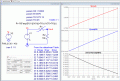
This LTspice plot shows the NTC Table values for the datasheet you posted.
E
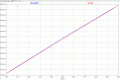
Edit: 2nd image shows the non-linearity of the NTC signal, over 30C thru 40C

EG 1699.gif
 

Attachments

Last edited:

Ian0

Joined Aug 7, 2020
13,158
I wonder what the purpose of this exercise is.
If it is a high precision application what is the problem with using a better sensor?
Otherwise, why is 0.3°C accuracy required?
33°C to 44°C suggests a water heating application which is generally done with a mechanical thermostat,for which 0.3°C accuracy would be ambitious.

Most importantly, what is the tolerance on B?
if it is also unacceptably high, then calibration is going to be required at two different temperatures, and the labour cost to do that will far outweigh the cost of a curve-matched thermistor, or even a platinum resistance sensor.
 

ag-123

Joined Apr 28, 2017
294
Most importantly, what is the tolerance on B?
if it is also unacceptably high, then calibration is going to be required at two different temperatures, and the labour cost to do that will far outweigh the cost of a curve-matched thermistor, or even a platinum resistance sensor.
calibration is tedious and it takes pretty much a full day experiment to do it, from setting up, possibly making a little app for data recording, running the experiments, it would likely take like bring water to boil and letting it cool and recording the temperature curves and thermistor readings as it happens. and after that is the analysis and calibration.

For the online 'flea' market thermistors, this is the hassle which I'd think is unavoidable. Nearly all of them mentioned 3950 and one order only the resistance preferences 100k (popular on 3d printers), 10k etc.

Use of thermistors or at least thermocouple is unavoidable for 3d printers as the hot end temperatures are typically around 200-250 deg C. A hassle with a thermocouple is that you need to measure the temperature of the cold end. which makes it the thermocouple itself and a separate temperature sensor (commonly a thermistor or a prebuilt semiconductor sensor).
In the end for costs and other reasons (convenience), it seemed, 3d printers all simply used 100k NTC thermistors.
I'd guess many of the "flea" market ones. I think it is in part responsible for failed prints as a thermistor that is even slightly inaccurate say by 10 deg C off 200 deg C would make a big difference if the thermoplastic e.g. PLA melts properly.

I think digikey, farnell (element14.com), mouser etc and all carry the 'better' thermistors, and I'd think a next round I'd prefer to get one that has proper and detailed specs and QCed by the manufacturer. They normally come at a premium and is even more for small quantities say like a few pieces. But it'd save one day of experiments. I think in terms of tests, the better manufacturers knows their sample variances and for certain geometries and properties of the semiconductors they can estimate the B values and give tolerances. Then for the premium ones they would bin them e.g. 1% or more accurate and hence the prices.

"flea" market ones a problem is the lack of spec or assurance even if they are the same semiconductors as well spec ones, one ends up with a gamble on what that "thing" is after all. and a "usual" thing after receiving the mail is just measure the resistances with a multimeter if it claims 100K and 3950, one should get something on the curve and assume it is after all correct.
 
Last edited:

Thread Starter

Missio2468

Joined Mar 18, 2022
74
I wonder what the purpose of this exercise is.
If it is a high precision application what is the problem with using a better sensor?
Otherwise, why is 0.3°C accuracy required?
33°C to 44°C suggests a water heating application which is generally done with a mechanical thermostat,for which 0.3°C accuracy would be ambitious.

Most importantly, what is the tolerance on B?
if it is also unacceptably high, then calibration is going to be required at two different temperatures, and the labour cost to do that will far outweigh the cost of a curve-matched thermistor, or even a platinum resistance sensor.
I am developing a prototype to measure the temperature of human body That's why I need precision. Also the problem with better sensor is its cost. I need to develop accurate with less cost. that's why i am asking for methods that can accuarately measure temperature. Also if nothing is there, then I would probably search for better accurate thermsitor sensor.
 

Thread Starter

Missio2468

Joined Mar 18, 2022
74
I am developing a prototype to measure the temperature of human body That's why I need precision. Also the problem with better sensor is its cost. I need to develop accurate with less cost. that's why i am asking for methods that can accuarately measure temperature. Also if nothing is there, then I would probably search for better accurate thermsitor sensor.
[/QUOTE
hi Missio,
This LTspice plot shows the NTC Table values for the datasheet you posted.
E
Edit: 2nd image shows the non-linearity of the NTC signal, over 30C thru 40C

View attachment 270480
I know that the data would be linear but if I calibrate my instrument according to Rnor.and what if thermistor is changed which has Rmax for that temperature. Now the reading will be different. And that will show 1 degree inaccurate
 

ag-123

Joined Apr 28, 2017
294
off-topic, the "mystery" behind "flea" markets NTC thermistors is that they are most likely sintered oxides of maganese, iron, and nickel powders.
this is an article which discuss it
https://iopscience.iop.org/article/10.1088/2053-1591/aba146
The interesting chart is figure 8, which shows a sintering temperature vs the B value of the resulting ceramic it is just below 4000.
but a higher sintering temperature changes the B value. I'd think the proportion of those oxide mixtures would make a difference as well.

This could mean that "flea" market thermistors could vary quite a bit if the manufacturing process is not well controlled.
so those (beta) 3950 claims are probably a "material property" claim and the resistances e.g. 100k, 50k etc are probably a (rough) function of the geometry of the sintered ceramic chip. if the geometry is off, u'd likely get a different resistance value.
so the "flea" market ones, they probably "bin" it according to the resistance values.
There is even less assurance about that 3950 beta and it is simply assumed to be a "material" property when in fact that is determined by the sintering manufacturing process, the mixing, proportions, temperature, etc.
 

Ian0

Joined Aug 7, 2020
13,158
I suggest that you check that the thermistor you have is approved for medical use.
(There’s nothing like bureaucarcy to thwart a good idea, or a cheap solution)
 

MrChips

Joined Oct 2, 2009
34,870
I have determined According to the datasheet provided and also theoretical(in excel) and practically checked using 5 different thermistor in my circuit. I can do that with method you have shown but the problem is I have to calibrate everytime I use new thermistor and i do not want that.
If you need to change the thermistor then you have to use a 1% or better device. In any case you still have to perform calibration at least once.
 

AnalogKid

Joined Aug 1, 2013
12,158
Late to the party, but ...

The only way to get tight tolerance interchangeability without calibration is to throw money at the sensor. Basically, you are paying someone else to calibrate it for you. For over 30 years, this has been my go-to part:

https://www.amphenol-sensors.com/hu...273H-Thermometrics-NTC-Type-95-091819-web.pdf

The old Thermometrics catalog had a full page table of the resistance-vs-temperature, in one degree steps from -55C to +105C, with the resistance specified to ***six*** digits. For example, the specified resistance at +35C is 6531.31 ohms. Love at first sight.

For a certain accuracy and/or precision, every individual component in the system or signal path has to be better than the desired outcome. To get the kind of precision you want, you will need 0.1% tolerance resistors, a 12-bit A/D, and a very stable voltage reference. The reference will have to be adjusted, but you can do that with a 5-1/2 digit voltmeter. A pain, but way less pain than calibrating a temperature sensor.

ak
 

Ian0

Joined Aug 7, 2020
13,158
Late to the party, but ...

The only way to get tight tolerance interchangeability without calibration is to throw money at the sensor. Basically, you are paying someone else to calibrate it for you. For over 30 years, this has been my go-to part:

https://www.amphenol-sensors.com/hu...273H-Thermometrics-NTC-Type-95-091819-web.pdf

The old Thermometrics catalog had a full page table of the resistance-vs-temperature, in one degree steps from -55C to +105C, with the resistance specified to ***six*** digits. For example, the specified resistance at +35C is 6531.31 ohms. Love at first sight.

For a certain accuracy and/or precision, every individual component in the system or signal path has to be better than the desired outcome. To get the kind of precision you want, you will need 0.1% tolerance resistors, a 12-bit A/D, and a very stable voltage reference. The reference will have to be adjusted, but you can do that with a 5-1/2 digit voltmeter. A pain, but way less pain than calibrating a temperature sensor.

ak
No real need for an accurate reference, because it’s a potential divider, between 3.3V and 0V, and the A/D’s reference will be the same 3.3V and 0V, but a high-spec pull-up resistor with tight tolerance AND low or zero tempco will be required.
 

Thread Starter

Missio2468

Joined Mar 18, 2022
74
Late to the party, but ...

The only way to get tight tolerance interchangeability without calibration is to throw money at the sensor. Basically, you are paying someone else to calibrate it for you. For over 30 years, this has been my go-to part:

https://www.amphenol-sensors.com/hu...273H-Thermometrics-NTC-Type-95-091819-web.pdf

The old Thermometrics catalog had a full page table of the resistance-vs-temperature, in one degree steps from -55C to +105C, with the resistance specified to ***six*** digits. For example, the specified resistance at +35C is 6531.31 ohms. Love at first sight.

For a certain accuracy and/or precision, every individual component in the system or signal path has to be better than the desired outcome. To get the kind of precision you want, you will need 0.1% tolerance resistors, a 12-bit A/D, and a very stable voltage reference. The reference will have to be adjusted, but you can do that with a 5-1/2 digit voltmeter. A pain, but way less pain than calibrating a temperature sensor.

ak
Thank you will try and update
 
OP you will not get high accuracy due to thermistor self-heating. You'll find the mW dissipated in it warms it much more that 0.1°C and readings will be sensitive to airflow across the thermistor. Drove me nuts trying to figure that out error, but switching power on only when taking a reading, and off otherwise fixed that. Also need high res A/D and switch in different resistors to get best sensitivity. 5.62k is not good at very low or very high temperatures away from base 25°C .
 

ag-123

Joined Apr 28, 2017
294
I think how some manufacturers achieve that .1 degree precision or accuracy, is that the parameters are after all programmable, or that the algorithm could be built into the firmware. they still nevertheless worked that labor intensive calibration, possibly in batch, automated etc. if say the range to be calibrated is 30 - 45 deg C, it is quite possible to maintain different bath temperatures for the calibration purposes.
As it goes in the 'simplified' case, it could be simply 3 equations and 3 unknowns.
https://en.wikipedia.org/wiki/Steinhart–Hart_equation#Steinhart–Hart_coefficients
 
Top