NPN transistor Base resistance calculation.

Thread Starter

KranthiKumarR

Joined Aug 27, 2017
18
Dear all,

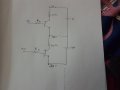
I have a 36V Li-ion battery pack and I'm designing a Discharge circuit for cell balancing. Please find the attached picture of my circuit where I'm using a BJT and 20ohms Dicharging resistor. Please let me know how to calculate base resistor value. I've seen calculation of base resistors but those calculations are when emitter is connected to the ground. But here in this case emitter is connected to the next cell but not ground.BJT-min.jpg
 

wayneh

Joined Sep 9, 2010
18,085
All voltages are relative. If you want the top transistor to conduct, it needs a base voltage of at least 32.7V relative to ground or 0.7V relative to its emitter.

If you want a current of X amps to flow, the base current needs to be 0.1X. So you calculate the resistor using ohms law: (5 - 0.7) x R = 0.1X.

This is for using the transistor as a switch, full on or off. I’m not sure that’s your case?
 

MrChips

Joined Oct 2, 2009
34,626
As @wayneh says, voltages are relative.
5V on the base is never going to turn on an NPN transistor if the emitter is at 28V or 32V.

If you want to use 5V control signals, you need to look into using opto-couplers.
 

OBW0549

Joined Mar 2, 2015
3,566
What @wayneh and @MrChips said: your transistors are never going to turn on when driven by 5 volt signals, no matter what base resistor you use.

Here's a general, universal rule that applies here and everywhere else, in ALL circuits: electronic components-- BJTs, JFETs, MOSFETs, op amps, regulators, resistors, capacitors, inductors, diodes, or anything else-- do not care one bit what the voltages on their terminals are relative to other parts of a circuit. They ONLY care what their terminal voltages are relative to one another.

For example, an NPN BJT whose emitter is at 32 volts, base at 32.7 volts and collector at 36 volts will conduct exactly the same collector current as a BJT whose emitter is at 0 volts, base at 0.7 volts and collector at 4 volts. Or an NPN BJT whose emitter is at -763 volts, base at -762.3 volts, and collector at -759 volts. And so forth.

But an NPN transistor whose emitter is at +32 volts, collector at +36 volts and base connected through a resistor to +5 volts isn't going to do a darned thing (except perhaps fail due to excessive reverse base bias).
 

Thread Starter

KranthiKumarR

Joined Aug 27, 2017
18
Thank you all for kindly explaining me.
1. All voltages are relative
2. Cannot turn on BJT with 5V base voltage and 32V emitter voltage

As all voltages are relative, I'll limit my voltage ranges. I've found a schematic which uses darlington pairs for this purpose(schematic attached which I have simulated on mobile in every circuit app). But I'm unable to understand the calculations. Can anyone please help me understand the circuit. I'm trying to understand this from a long time.
 

Attachments

danadak

Joined Mar 10, 2018
4,057
In case Base at 5, Emitter at 32, transistor probably destroyed due to
base-emitter breakdown V exceeded.

Regards, Dana.
 
Top