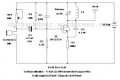
That's very interesting for me , because the 2 answers seem different (may be there not, or both correct)
and this is what I am trying to figure out.
1)So at 100mhz the base is effectively tied to the positive rail by 1 ohm (is that grounded through the supply(battery) effectively, I don't really understand that)?
And or
2)The 100mhz ripple on the supply rail is being coupled to the base as positive feed back?
in the book I'm reading Newton C Braga, Pirate Radio and Video page 47
it says Quote "the feed back that keeps the circuits in oscillation is C3" but no explanation for C2 presence
Thanks Again everyone
So if C2 was missing what kind of problems are likely to occur?
C3 creates some positive feedback (needed to keep oscillating)
which will manifest itself at the base due to the base emitter follower action?(back in phase hence +)
The base is held at a fixed voltage at RF by C2, the feedback feeds signal to the emitter, which causes a current to flow through the BE junction.
Without C2, the current through the BE junction would be too low to produce enough amplification.
By making the base a low impedance point, (via C2) any change in emitter voltage causes a large base current to flow.
Hi
Ok so the DC quiescent bias voltage is fixed (does not fluctuate) thanks to C2.(regardless of any HF that tries to get to base)
(except for low freq mic audio signal)
The positive feedback amplification curtesy of C3 occurs because of the HF on the emitter which will cause some increased base emitter current and hence amplification through the collector load (the LC circuit)
The configuration of the transistor amplifier used in the oscillator is common base. The base is held at a fixed voltage by the resistor divider and C2. The output of a common base is the collector and the input is the emitter. C3 couples the output to the input.
Without C2 holding the base voltage steady, the feedback would be reduced, and it might or might not oscillate. I have used a similar circuit without C2 for lower frequencies.
C2 in that circuit also cuts high audio frequencies from the microphone. Then the very muffled sounds are even worse than if the circuit had pre-emphasis (high frequency boost) that all FM radio stations have.