Normal noise for a cheap DSO?

Thread Starter

spinnaker

Joined Oct 29, 2009
7,830
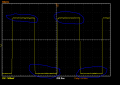
Not sure if I noticed it before or not but I have been noticing what looks like the traces on my scope sparkling.

So I decieded to take a close look. The shot below is with tip grounded to the probes ground wire.

Whatever this is, it looks like it is way up there around 100 MHZ so it is likely not a power supply issue. Is this type of noise normal for these cheap DSos? Coincidence that it is the Rigol 1102E 100mhz?


Not sure if this is the source of the "sparkling" or not.
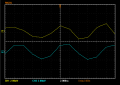

upload_2017-11-10_23-44-57.png

It might be probe related.

Here is a shot of the probes disconnected.
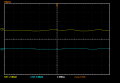
upload_2017-11-10_23-49-31.png

Probes have been calibrated.

I swapped out two other probes with the same results

I would like to sell this scope. I want full disclosure but don't want to mention an issue that is native to the product either.
 

Attachments

Thread Starter

spinnaker

Joined Oct 29, 2009
7,830
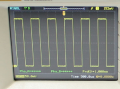
Here is the sparkling I mentioned. This is from the scopes calibration port. Those pixels circled sort of dance or sparkle. What is odd is they don't see to increase / division along with the rest of the waveform when volts per div is changed.


upload_2017-11-11_0-11-17.png
 

DickCappels

Joined Aug 21, 2008
10,661
When I got my first digital scope I worried about that too, but it is normal. What you are seeing is the in the first photo is the temporal resolution of the A-to-D converter, which is not adequate for the scan rate. In the photos in posts #2 and #3 you see the voltage resolution or granularity of the measurement.
 

OBW0549

Joined Mar 2, 2015
3,566
Here is the sparkling I mentioned. This is from the scopes calibration port. Those pixels circled sort of dance or sparkle. What is odd is they don't see to increase / division along with the rest of the waveform when volts per div is changed.
This is normal for a DSO, especially one that uses an 8-bit A/D converter which digitizes the analog input voltage into 256 discrete levels. With digitization that coarse, the levels are quite visible on the display and any input voltage that lies at or near the boundary between one level and the next will tend to jitter back and forth between them.

The A/D converter is downstream from the variable-gain analog amplifier that determines your volts/division, which is why these jiggles don't scale up and down when you change the vertical scale.
 

Thread Starter

spinnaker

Joined Oct 29, 2009
7,830
Thanks everyone. Now I can sell at a good conscience I can't believe I haven't noticed that behavior before. I have used that scope dozens of times too. Hard to believe I have owned this thing for 5 years now.

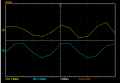
So what is this? Is it just cheap probes that is th eissue?


upload_2017-11-11_7-19-55.png
 

OBW0549

Joined Mar 2, 2015
3,566
So what is this? Is it just cheap probes that is the issue?
Dunno. Could be. I get something similar with the 1202X-E, though at about 1/2 the amplitude your screenshot is showing. Also, the noise on both yours and mine appears periodic, suggesting interference of some sort. Keep in mind that at those high frequencies, the small loop of wire created when you short the probe's ground lead to the probe tip acts as a very nice antenna, and it will pick up all kinds of crap. When I disconnect the scope probe and replace it with a BNC shorting plug, the display shows random noise at about 500 μVp-p. Activating the 20 MHz Bandwidth Limit cuts that by a factor of 10.

(Just found another software bug: every now and then the 1202X-E decides to stop showing the on-screen trigger level indicator. Who the heck knows why, but once its gone it's gone for good, and only resetting the scope by hitting the DEFAULT button will bring it back.)
 
Top