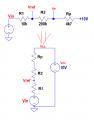
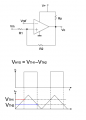
Very good, this will be the equation for Vth1 = Vin = Vref (1+(R1/R2)) . When the comparator changes state from Low to High due to turning off the internal transistor, so now the output can be pulled up to the High level by Rp resistor.
And the situation will now look like this:
And your job for this new circuit is again to write the equation for Vref and next solve it for Vin.
Can you do it?
To "help" TS quickly find the equation for the threshold voltage. It seems like TS more or less understands how this circuit work.
But he seems to struggle with the understanding of how to find the threshold voltage. So, it's hard to help him because TS do not want to describe what exactly part he doesn't understand.
The supply voltage to the amplifier and open collector supply voltage should be considered different values. In this case, also, Should I use the same (above) formulas derived for V_TH1 and V_TH2 ?.
I have positive 5V supply to compactor and negative terminal of compactor is connected to GND. And open collector supply voltage is 2.5V. So, in this case, Shall use the same formulas which are derived in post #70?.
If I use the above formulas (from Post # 70), and I have a two different voltage supplies (as I said in post # 71). In this case, Should I use VCC (from VTH2 formula) value as either voltage value of the comparator supply voltage or voltage value of open collector supply voltage?.
The whole idea of analysis for these types of circuits is to first try to visualize what will happen when voltage levels change.
The first point is that the output of the comparator is open collector so the voltage is either zero, or when open the voltage is found from the three resistors connected to the output.
When the output is zero there are mainly two resistors in the circuit so call that circuit #1.
When open, there are three resistors in the circuit call that circuit #2.
Now analyze the voltage at the non inverting terminal for both circuits, using the voltage divider formula.
After that you know all the conditions needed to determine when the comparator changes state. You thus know what voltages it will change state at.
There is one caveat, and that is sometimes we dont take the output to be zero when the comparator output is said to be in the low state. Sometimes we might take it to be 0.1v or 0.2v or something like that, but most of the time you can get away with calling it just zero volts and that makes the analysis a little simpler.
The voltage divider formula can be found in different places around the web. However, when there are two voltages connected to the two resistors we need the dual voltage, voltage divider formula:
Vout=(VH-VL)*R2/(R1+R2)+VL
where
Vout is the output of the divider,
VH is the highest voltage applied to one of the two resistors R1,
VL is the lower voltage applied to the other resistor R2 (often this voltage is just zero).
R1 is the resistor connected to VH,
R2 is the resistor connected to VL.
So for example if you have the high voltage VH=10v and the low voltage VL=2v and R1=10k and R2=30k, then:
Vout=(10-2)*30k/(10k+30k)
Vout=(8)*30k/(40k)
Vout=8*3/4
Vout=6 volts
So you see it is not that difficult you just have to keep track of what voltages change (VH and VL) as the comparator changes state and when there are more than two resistors you have to lump some of them into just one resistors (R1 or R2). If you have two resistors in series, then the total is of course Ra+Rb and that becomes thought of as just one resistor.
Try using the dual voltage voltage divider formula with a few resistors and voltages and see how easy it can be. Then, apply what you know to the circuit for each state circuit #1 and circuit #2. Finding the voltages of the non inverting input is the first step to solving this.

 Facebook
 Google
 GitHub
 Linkedin