Non-Inverting Open Collector Comparator

ericgibbs

Joined Jan 29, 2010
21,444
hi pp.
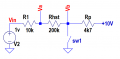
I have reduced the circuit to showing only the Rhst resistor connections.
Note: Vin =+1v
What two voltage, levels will be at Va when sw1 is Open and Closed.
E
EG 1181.png
 

Thread Starter

pinkyponky

Joined Nov 28, 2019
373
hi pp,
What part does the 200k Rhst play in the calcultions. it seems to have been missed out.?
E
That's why I have been asking you guys to check my derivations. I'm not understanding where I did the mistake. Please, can you do the corrections in the derivation?.
 

ericgibbs

Joined Jan 29, 2010
21,444
That's why I have been asking you guys to check my derivations. I'm not understanding where I did the mistake. Please, can you do the corrections in the derivation?.
hi pp,
I have checked your equations as you have requested, they are wrong.
I was trying to help understand what the circuit is actually doing, that's the only way you can possibly derive the correct equations.

At the moment, you don't appear to understand the circuits' operation.:(

As this is Homework, I cannot give you the final answer.!

E
 

ericgibbs

Joined Jan 29, 2010
21,444
hi pp,
Please don't be offended, but are you studying an electronics subject, if yes, at what grade are you.?

You don't appear to understand Ohms Law.?

E
 

Thread Starter

pinkyponky

Joined Nov 28, 2019
373
hi pp,
Please don't be offended, but are you studying an electronics subject, if yes, at what grade are you.?

You don't appear to understand Ohms Law.?

E
I know ohm's law. But, I'm not sure how to apply here.

Now, I will say. When the switch is close, Va= 0.95V and when the switch is open, I'm not sure how to calculate.
 

ericgibbs

Joined Jan 29, 2010
21,444
hi pp,
I have come to the conclusion that you are playing games and are wasting the valuable time of your fellow members.

It can also be classified as Trolling

E
 

Thread Starter

pinkyponky

Joined Nov 28, 2019
373
hi pp,
I have come to the conclusion that you are playing games and are wasting the valuable time of your fellow members.

It can also be classified as Trolling

E
Dear Ericgibbs,

I'm not that kind of person, to play the games with professionals.

Please understand me, I'm struggling to solve the equation. May be I have lack of basic, so that I couldn't solve the problem which you gave me. But, please don't think that I'm playing the games with you guys such as who are brilliants in this forum.

Please don't conclude me like that. Moreover, if the person not solve the small thinks/problem please please don't consider like that, in my case especially. I'm requesting you.
 

ericgibbs

Joined Jan 29, 2010
21,444
hi pp,
These two Va2 values you have for when Vsuppy is 10V and 0V give an indication of the hysteresis voltage levels.
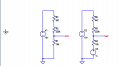
Look at post #19 circuit, also note the Inverting input of the Comparator is at +1v

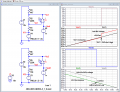
Try to think out what will happen at the Comp output, if the Vin is slowly increased from 0v to say +2v, then decreased back down to 0v.
Work out the switching point voltage of Vin, going up and down
E
 

Thread Starter

pinkyponky

Joined Nov 28, 2019
373
hi pp,
These two Va2 values you have for when Vsuppy is 10V and 0V give an indication of the hysteresis voltage levels.
Look at post #19 circuit, also note the Inverting input of the Comparator is at +1v

Try to think out what will happen at the Comp output, if the Vin is slowly increased from 0v to say +2v, then decreased back down to 0v.
Work out the switching point voltage of Vin, going up and down
E
Vin > Vref -> Vout is High (10V, as per the circuit in post #19)
Vin < Vref -> Vout is Low (0V)
 

ericgibbs

Joined Jan 29, 2010
21,444
hi,
So when Vin is < +1V , the Comp Vout is Low at approx 0v, due to the +1V on the Inverting input of the Comp.

As Vin increases to just over +1v, the Comparator Vout changes over to approx +10v, this 10V drives current onto the 200k and the 10K in series. [remember the 4.7k is also in series with 200k]

This current raises the junction of the 10K and 200k to +1v+0.48v =1.48v, this means as the Vin falls, it has to go down to 1v- 0.48v= ~+0.5v before the +1v on the INV input exceeds the voltage and the Comp Vout switches to 0v, the initial condition.
See post #19.
Do you follow that, OK.?
E
 
Last edited:

Thread Starter

pinkyponky

Joined Nov 28, 2019
373
hi,
So when Vin is < +1V , the Comp Vout is Low at approx 0v, due to the +1V on the Inverting input of the Comp.

As Vin increases to just over +1v, the Comparator Vout changes over to approx +10v, this 10V drives current onto the 200k and the 10K in series. [remember the 4.7k is also in series with 200k]

This current raises the junction of the 10K and 200k to +1v+0.48v =1.48v, this means as the Vin falls, it has to go down to 1v- 0.48v= ~+0.5v before the +1v on the INV input exceeds the voltage and the Comp Vout switches to 0v, the initial condition.
See post #19.
Do you follow that, OK.?
E
As I follow from post #19, I have analysis these voltages, please have a look.

when Vin increases to just over +1V, the junction of 10k and 200k will be 1.419V (not 1.48v). And, when Vin falls to 0V, then, the junction of 10k and 200k will be 0.465V (yes it is aprox. 0.5V).
 

ericgibbs

Joined Jan 29, 2010
21,444
hi pp,

when Va increases to just over +1V, the junction of 10k and 220k will increase to 1.419V due to Vout switching from ~0v to +10v and so driving current back to Va via the 200k

And, when Vin falls towards 0V, the junction of 10k and 220k, ie: Va will decrease to just less than Vref then Va will drop to 0.465V , due to Vout switching from +10V to ~0v and removing the 200k positive feedback current


Note: without positive hysteresis feedback, Vout could, due to electrical noise on Vin cause Vout to switch rapidly Hi/Lo, due to the noise.
Hysteresis effectively adds or subtracts from the Vin voltage so that Va is 'biassed' away from the critical threshold voltage, ie: Vref

E
 
Last edited:
Top