I have to measure the AC voltage (220 V, 60 Hz) non-intrusively using capacitive sensor. Does anyone have some expertise in this era who can help me.
Regards
I have seen Capacitive AC Detection but never seen an accurate non intrusive sensor to actually measure an AC voltage. Current yes but not voltage. I would be curious as to what is out there.
I have seen Capacitive AC Detection but never seen an accurate non intrusive sensor to actually measure an AC voltage. Current yes but not voltage. I would be curious as to what is out there.
I have seen some papers in which they explained the method to measure voltage non-intrusively. But some are very difficult to manufacture and accuracy of some are very low. Links of those paper are below
A field mill is fine for DC fields, but would produce beats when measuring AC fields, which really messes up the RMS reading.
I once designed an instrument to measure time-varying electric fields in terms of volts per meter. Your receiving antenna is a plate of copper coated PCB material, with an optional grounded guard ring around the circumference. The plate is connected to the input of a low noise JFET amplifier (not really an oxymoron that is connected as an integrator which is actually a low pass filter with the low pass corner frequency being a couple of orders of magnitude below the frequency of interest. High impedance current sources are utilized for DC feedback to stabilize the amplfier's operating point.
The RMS value of the amplifier's output can be easily calibrated in terms of volts/meter. The volts/meter can be correlated with the voltage in the conductor being observed and the geometry of the setup (observed area of the conductor, presence of dialectrics and conductors that can affect the field strength and measuring distance).
One basic setup is described in more detail in SWEDAC's MPR II standard.
I did not design that pickup plate - its design was part of the original MPR II specification and had to be used in order to claim compliance with the standard.
The grounded ring probably helped the sensor ignore electric fields in the same plane as the antenna, which would improve the accuracy of measurements in the plane of interest.
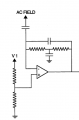
I was unable to locate a public domain schematic of the MPR II measurement circuit but do have this schematic from U.S. Patent 5396151.
This circuit is the first stage, which converts displacement current through the capacitance between the pickup plate and the circuit being measured. This displacement current is cancelled at the opamp's inverting input bu feedback current through the feedback capacitor. Since the input is differentiated and the output signal is taken from the output of an integrator there is (ideally) no waveform distortion.
The "T" network establishes DC feedback for the integrator and sets the low frequency response.
I couldn't find any information on the "MPR II" specification you're referencing.
That circuit looks like an integrating amplifier, or "charge amplifier."
I get the overall idea of the free-body field meter; (1) There's a conducting body, (2) When immersed in an electric field, the electrostatics causes charge redistribution in the conductor so that the electric field inside the conductor is zero, (3) you cut the conducting body in half, and short the two conducting pieces together & the charge re-distribution is forced to occur through the short (4) you implement a circuit to measure the very very small current (can be in the pA range) to calculate the electric field.
I'm just trying to learn how to optimize the pickup plate and charge amplifier circuit for highest sensitivity while reducing size.
I found a great reference that talks about the overall theory of operation of a "free body" field sensor, but doesn't go into enough detail on how to calculate the expected short-circuit charge flow of differing conducting bodies (ie. two parallel traces on a PCB... circular pad with guard ring... two pads top-and-bottom ).
reference: http://nvlpubs.nist.gov/nistpubs/Legacy/IR/nbsir77-1311.pdf
I would really like to know; given an area A (say 10mm^2), and for a 2 dimensional field antenna, which "pickup plate" design would yield the highest peak-to-peak charge oscillation?
Also, how is the analog circuit optimized to achieve the highest gain to amplify this very very small current measurement?
I'm thinking that the secret to getting the largest displacement current out of an antenna (for a given field strength E and antenna area A) is probably directly proportional to the two conducting bodies' capacitance?
Yes. It is the capacitance.You are making a air dielectric capacitor and measuring the displacement current. The displacement current is proportional to the change in electric field times the capacitance. Shape is not particularly important provided the field is uniform over the surface of the plate and you know the area.
Yes. It is the capacitance.You are making a air dielectric capacitor and measuring the displacement current. The displacement current is proportional to the change in electric field times the capacitance. Shape is not particularly important provided the field is uniform over the surface of the plate and you know the area.
If the copper plate is connected to ground the current that will flow through the path from it to ground will be equal to the capacitance between the changing E field and plate multiplied by the strength of the E field at the plate?
You may notice that my earlier statement simplified things a lot, mentioning the output of the displacement current sensor rather than the actual current.
Yes, you are correct, a grounded copper plate will have a current that is a direct function of dv/dt as stated for the scalar value of the displacement current.
You may notice that my earlier statement simplified things a lot, mentioning the output of the displacement current sensor rather than the actual current.
Yes, you are correct, a grounded copper plate will have a current that is a direct function of dv/dt as stated for the scalar value of the displacement current.
When you did this yourself did you find there was any coupling or interference you had to account for with regards to the copper plates. I want to make an array but am not sure how to take B field effects into account or how to stop the various copper plates interacting when they're closely spaced (eg 1mm spacing).
The following is a rather ignorant question but I'm absolutely new to this... a lot of equations, for example in the wikilink, require the use of a dielectric constant but most of our dielectrics are metal with an infinite constant, are we to suppose the current coming out of the copper plates is infinite? That's not possible so what gives here? Are we to substitute the permittivity value with an approximated capacitance between the plate and the field?
What's key here is that the electric flux produces the current in the capacitively coupled plate that it applies also for a stand alone dielectric surface, eg just a copper plate, and not only inside a capacitor.
Also it's more or less irrelevant what the exact dielectric constant is because you can calibrate the field strength changes with the current that results when building your sensor.

 Facebook
 Google
 GitHub
 Linkedin



 that is connected as an integrator which is actually a low pass filter with the low pass corner frequency being a couple of orders of magnitude below the frequency of interest. High impedance current sources are utilized for DC feedback to stabilize the amplfier's operating point.