Non Contact AC voltage Detector Circuit

Thread Starter

Jan Luthe

Joined Jan 10, 2015
89
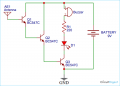
All I know about electronics is about LEDs and required resistor to limit amps. I would like to have a very simple schematic where the change in the strength of the field can be seen. May be using an ammeter or multiple LEDs. I would order what I would need from Digi-key and would appreciate specifics on what I would require.
 

Attachments

Thread Starter

Jan Luthe

Joined Jan 10, 2015
89
It looks like you've already found a viable Circuit.
I don't understand what your question is.
.
.
.
AS my tester gets closer to the field, the strength of the field will increase. I want to see when the field strength is increasing so that I know I am getting closer to the field.
 

Audioguru again

Joined Oct 21, 2019
6,826
If your simple circuit is in a modern city then it will be triggered all the time by all the radio and TV stations and other communications that are transmitted.
Circuitdigest.com is made by students in India who make many errors like this simple circuit.
 

Reloadron

Joined Jan 15, 2015
7,869
Looks like you want what is commonly called a "field strength meter circuit". These can be crude and simple like the one you linked to or rather posted or more complex and tuned circuits for specific bands of frequencies. Start with a simple Google of "field strength meter circuit" or "field strength meter ham radio" to get an idea of what you want.
AS my tester gets closer to the field, the strength of the field will increase. I want to see when the field strength is increasing so that I know I am getting closer to the field.
Then you may want to add a directional antenna. I also assume RF field strength?

Ron
 

Reloadron

Joined Jan 15, 2015
7,869
Electricity I think it is 60Hz. Want to try to trace electrical wires behind walls (covered with drywall/plaster).
I agree with IAN in that it's easier to buy than build. Yes, US and most of North America is 60 Hz while most of Europe and South America is 50 Hz. A good stud detector will also detect AC power behind walls. Trying to roll your own is just more headaches than it's worth.

Ron
 

Audioguru again

Joined Oct 21, 2019
6,826
That circuit will not detect electricity wires through a wall because each of the two first transistors need an input of 0.6V to begin turning on totaling 1.2V. My oscilloscope picks up only 0.3V peak-to-peak with a 5" antenna wire in my workshop which does not increase when the wire is very close to a power bar.
Then your transistors circuit will have an input of only 0.15V (because the transistors rectify the AC signal) which is much too low for any indication of electricity nearby.

An opamp could easily pickup an electricity signal through a wall.
 

Thread Starter

Jan Luthe

Joined Jan 10, 2015
89
If your home-made cable detector indicates that there is no cable, would you drill?
I am just starting off in electronics so I am 'playing' around. All I want to do is possibly improve the original schematic by being able to see how the signal strength changes with distance from the electrical wire. I was thinking of possibly putting in an ammeter in the circuit some where if this is reasonably possible or something else. Looking for ideas/suggestions.
 

MisterBill2

Joined Jan 23, 2018
27,283
I have built a proximity sensor based on exactly that principle, of sensing an increase in the field intensity radiated by a person functioning as an antenna, increasing the electrical field as they approached the sensor lead from my device.
The principle is identical to the hum pickup of an amplifier with a high impedance input as somebody reaches toward an open input connection. .
Some digital multimeters will display o the AC volts scale if the user holds the common input lead in their hand and probes the field with an insulated wire connected to the input jack on the meter. That might be adequate for what the TS is seeking. Not really accurate, but certainly an interesting thing.
Otherwise, using a string of two J-fet opamps configured for a gain of a few hundred, feeding a diode bridge and a milliameter, battery powered, should provide a similar function in a dedicated package.
 

Thread Starter

Jan Luthe

Joined Jan 10, 2015
89
I have built a proximity sensor based on exactly that principle, of sensing an increase in the field intensity radiated by a person functioning as an antenna, increasing the electrical field as they approached the sensor lead from my device.
The principle is identical to the hum pickup of an amplifier with a high impedance input as somebody reaches toward an open input connection. .
Some digital multimeters will display o the AC volts scale if the user holds the common input lead in their hand and probes the field with an insulated wire connected to the input jack on the meter. That might be adequate for what the TS is seeking. Not really accurate, but certainly an interesting thing.
Otherwise, using a string of two J-fet opamps configured for a gain of a few hundred, feeding a diode bridge and a milliameter, battery powered, should provide a similar function in a dedicated package.
thanks MisterBill2. Can provide a schematic with the specific parts required. (remember I am a newbie) I order from digi-key.
 

MisterBill2

Joined Jan 23, 2018
27,283
thanks MisterBill2. Can provide a schematic with the specific parts required. (remember I am a newbie) I order from digi-key.
If you have a digital meter that can read AC voltage that is what I recommend using. The device I mentioned was an ON/OFF control for a light that sensed when somebody sat in an easy chair. It used a type 2050 gas filled thyratron tube. The circuit is simple and possibly could be modernized.
The scheme was to set the DC grid bias just below the switch on thereshold, feeding the grid through a high value resistor. Then the added voltage picked up by the antenna connected to the grids put the 2050 tube into conduction. It worked well.
 

MisterBill2

Joined Jan 23, 2018
27,283
Digikey was recommended as a source for the remote trip breaker, not the 2050. For that you go to the antique industrial parts store, and bring LOTS of money.
 

MisterBill2

Joined Jan 23, 2018
27,283
Digikey DOES sell digital multimeters and so that could work fairly well. And if they wanted to build an e-field sensor, DK sells all of those parts as well. he FET input op-amps, that is.
 

Reloadron

Joined Jan 15, 2015
7,869
Back in post #5 I suggested a Google of Field Strength Meter Circuits. You will find several using the now ancient 1N34 Germanium Diode as a detector and a few transistors or single transistor as amplifiers driving a typical 50 uA full scale analog meter movements. A further Google of 1n34 diode field strength meters will get you more schematics. The 1N34a diodes are still around today and I was playing with them in the 50s. There isn't much to these circuits.

Ron
 
Top