New Method for Parallel Resistor Calculation ..#2

Thread Starter

John Grizz

Joined Sep 23, 2025
1
Hello. I'm really new to all this, in trade school for hvac. Electrical fundamentals right now. What if you have more than two numbers? (I haven't learned anything NOT the hard way in a long time, and just getting back into learning, and any level of math)

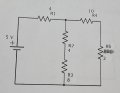
I finally solved this, but with your formula, how would this be solved
 

Attachments

WBahn

Joined Mar 31, 2012
32,703
Hello. I'm really new to all this, in trade school for hvac. Electrical fundamentals right now. What if you have more than two numbers? (I haven't learned anything NOT the hard way in a long time, and just getting back into learning, and any level of math)

I finally solved this, but with your formula, how would this be solved
Given the title of your thread, I assume that by "two numbers" you are referring to more than two resistors in parallel. Although I have no idea what the "..#2" in your title is referring to.

You don't say what "your formula" is, so I'm again left at guessing that you are referring to the classic formula for the effective resistance, R_eff, of two resistors, R_1 and R_2 in parallel, namely

\(
R_{eff} \; = \; \frac{R_1 R_2}{R_1+R_2}
\)

Did your course just give you this equation to use, or did they walk you through were it comes from?

You say that you finally solved it, so what did you do and what did you get?

We do not work homework problems for you, we expect you to show your work. The more work you show, more in depth our responses can be.

I can certainly walk you through where the above equation comes from and how it is a simplification of the general formula for N resistors in parallel, but that would be of no real help for this particular problem since you don't have more than two resistors in parallel in that circuit. What you have are two parallel branches, but each branch can be treated as single effective resistors replacing the two series-connected resistors in that branch.

If you show your work, we can help you see how to better identify these situations and how they can be used to better organize your work.
 

WBahn

Joined Mar 31, 2012
32,703
Very possible. If that's the case, the mod should have put an annotation and link to the original thread. But that's something that's easy to overlook when dealing with a necrohijacking. They also could have seen it as being such a clean break that a back reference wasn't useful.

EDIT: I just looked at the logs and it appears that this is the case.
 

MrChips

Joined Oct 2, 2009
34,628
When a member posts to an old thread, it is called necroposting. The moderator chose a new title by appending ..#2 to the original title.

Here we answer the question from the TS (thread starter), how does one calculate the effective resistance of more than two resistors in parallel?

For two resistors in parallel, the “product over sum” formula is commonly used:

Reff = (R1 x R2) / (R1 + R2)

How would one remember “product over sum” and not “sum over product”?

This is why we don’t teach such methods.

For any number of resistors in parallel, the correct mathematical answer as provided in the original thread is “the reciprocal of the sum of reciprocals”.

That is as clear as mud for the mathematically challenged.

Instead, we prefer to teach the physics and then apply the math. We teach the concepts of conductance AND resistance.

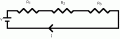
Resistors connected in series pass the same current while the total voltage is the sum of each individual voltage across each resistor.
Resistances are added.

1758688346621.gif

V = V1 + V2 + V3 = I x (R1 + R2 + R3)

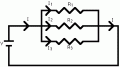
Resistors connected in parallel are subjected to the same voltage. Each resistor conducts current. The total current is the sum of each individual current.
Conductances are added.

1758688260295.gif

I = I1 + I2 + I3 = (G1 + G2 + G3) x V

Conductance G is the reciprocal of resistance R.

Ohm’s law stated mathematically is:
I = V / R

The conductance law is:
I = V x G

The unit of resistance is volts per amp or ohm.
The unit of conductance is amps per volt or mho.
 

MrChips

Joined Oct 2, 2009
34,628
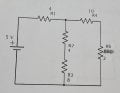
1758689975957.jpeg

There are 5 resistors drawn in this question. Rather than attempting to find one formula to solve this, you need to break it down to simpler situations with which you are already familiar.

R2 and R3 are in series. Find R23eff.
R4 and R5 are in series. Find R45eff.
R23eff and R45eff are in parallel… etc.

As a complete exercise for you, calculate the voltage across each resistor, the current through each resistor, and the power dissipated by each resistor.

What is the total power dissipated by the circuit?
(There are two ways to do this.)
 

WBahn

Joined Mar 31, 2012
32,703
For two resistors in parallel, the “product over sum” formula is commonly used:

Reff = (R1 x R2) / (R1 + R2)

How would one remember “product over sum” and not “sum over product”?

This is why we don’t teach such methods.
Remembering which it is and which it is not is easy. Product over sum yields the correct units, while sum over product does not.

A somewhat different approach that I personally prefer doesn't require the concept of conductance at all, which minimizes the number of new concepts that the student has to contend with at once.

By the time we are ready to introduce resistors, we have already progressed from individual charges and the forces they exert on each other to the concept of an electric field to the definition of voltage that follows from it. We've also established the path independence of voltage (we don't talk about non-conservative electric fields until later, when electromagnetic induction is introduced) and how this requires that the voltage drops along a path have to add up in order to conserve energy. We've also established the concept of the conservation of charge and the implications that has for currents. In doing so, we've set the stage for Kirchhoff's Laws, but we don't introduce them explicitly until after we have a couple of components, namely batteries and resistors, with which we can actually construct circuits to anchor them to.

Now we introduce a resistor as being a component whose behavior is such that the current flowing through it is proportional to the voltage across it and define the constant of proportionality as the component's resistance. Hence

V = I·R

We call this Ohm's Law.
At this point we have everything that we need to derive the equations for series and parallel resistor combinations.

I'm not going to draw any figures (don't have time to even track some down), but hopefully a word description is sufficient.

Series Resistors

Imagine a box containing N resistors connected in series where the two ends of the string of resistors are accessible outside the box (i.e., pokes through the box). Now imagine another box containing a single resistor whose two terminals are also accessible outside the box. The goal is to determine, given the values of all of the resistors in the first box, what value resistor needs to be placed in the second box such that an outside observer can't tell a difference between the two boxes.

The box with the single resistor simply obeys Ohm's Law and we'll use a subscript t for that case.

\(
V_t \; = I_t \cdot R_t
\)

For a given resistor, R_i, in the string of resistors, Ohm's Law requires

\(
V_i \; = I_i \cdot R_i
\)

The series connection requires that the voltage across the outside terminals, V_t, equals the sum of the individual voltages in order to satisfy the conservation of energy.

\(
V_t \; =\; \sum\limits_{i=1}^{N} V_i \\
V_t \; = \; \sum\limits_{i=1}^{N} I_i \cdot R_i
\)

The series connection also requires that the current through each resistor in the string be the same as the current current entering the box in order to satisfy the conservation of charge, which must also be the same as the current entering the box with the single resistor if the two boxes are to be indistinguishable.

\(
I_i \; = \; I_t \;\;\;\; \text{For any i}
\)

Thus

\(
V_t \; = \; \sum\limits_{i=1}^{N} I_t \cdot R_i \\
V_t \; = \; I_t \cdot \sum\limits_{i=1}^{N} \cdot R_i
\)

This therefore requires that

\(
R_t \; = \; \frac{V_t}{I_t} \\
R_t \; = \; \sum\limits_{i=1}^{N} \cdot R_i
\)

Parallel Resistors

The development for parallel resistors is very similar.

Imagine a box containing N resistors connected in parallel where the two wires that connect the resistors together are accessible outside the box (i.e., pokes through the box). Now imagine another box containing a single resistor whose two terminals are also accessible outside the box. The goal is to determine, given the values of all of the resistors in the first box, what value resistor needs to be placed in the second box such that an outside observer can't tell a difference between the two boxes.

The box with the single resistor simply obeys Ohm's Law and we'll use a subscript t for that case.

\(
V_t \; = I_t \cdot R_t
\)

For a given resistor, R_i, in the string of resistors, Ohm's Law requires

\(
V_i \; = I_i \cdot R_i
\)

The parallel connection requires that the current entering the first box be the sum of the currents in the individual resistors in order to satisfy the conservation of charge. To be indistinguishable, this must also be the current entering the second box.

\(
I_t \; =\; \sum\limits_{i=1}^{N} I_i \\
I_t \; = \; \sum\limits_{i=1}^{N} \frac{V_i}{R_i}
\)

The parallel connection also requires that the voltage across each resistor in the first box must be the same as the voltage applies across the single resistor in the second box.

\(
V_i \; = \; V_t \;\;\;\; \text{For any i}
\)

Thus

\(
I_t \; = \; \sum\limits_{i=1}^{N} \frac{V_t}{R_i} \\
I_t \; = \; V_t \cdot \sum\limits_{i=1}^{N} \frac{1}{R_i}
\)

This therefore requires that

\(
\frac{1}{R_t} \; = \; \frac{I_t}{V_t} \\
\frac{1}{R_t} \; = \; \sum\limits_{i=1}^{N} \frac{1}{R_i}
\)

This is a good point at which to introduce conductance because it makes it clear that it is not some separate property or concept, but rather a definitional convenience (akin to syntactic sugar in a programming language).

While an old name for conductance was the mho (ohm spelled backwards) and the symbol was an upside down uppercase Greek omega, and this is a useful unit to be familiar with because you can expect to run across it from time to time, the proper unit of conductance is the siemen, whose symbol is S.

Personally, I find this unfortunate, because it results in a lot of improper use and occasionally confusion because too many people are sloppy with proper capitalization of units symbols and this is a case where 's' means seconds while 'S' means siemens. I think this is the only instance where case makes the difference as to which unit is meant.
 

MrChips

Joined Oct 2, 2009
34,628
Another example where case makes a difference is with m and M.
This is a common error seen here on AAC forums with sloppy notation.

The difference between m and M is 9 orders. of magnitude.
 

MrAl

Joined Jun 17, 2014
13,667
Hi,

[1] Using real world measurements:
Another useful method sometimes would be to open circuit R1, then apply a current 'i' through the circuit formed by the other four resistors. Then, measure the voltage across them 'v'. The total series/parallel resistance is then R=v/i using Ohm's Law.

[2] A little easier in some cases:
Another idea when we have more than two resistors in parallel without measuring anything, say with R1, R2, R3 in parallel, is to first find R1 and R2 in parallel call it R12, then calculate that in parallel with R3, so that would be R12 in parallel with R3:
R12=R1||R2
Rtotal=R12||R3
using the double bars to indicate the parallel operation Ra*Rb/(Ra+Rb).

[3] Elaborate, probably only good for educational purposes:
Another rather complex idea is to assign nodes to each of the 4 nodes associated with the four resistors, then using Ohm's Law, write the equations knowing the voltage across each resistor is VT-TB (top and bottom nodes schematically) and the current is iR2 for example. We also know that way that iR2=iR3, and iR4=iR5, so we can probably set up a set of equations to solve this. I doubt anyone would want to go through that trouble though.
To add to that, we can also make it an iterative method. This would require a concerted iterative modification of variables until we meet the constraints of Ohm's Law for all resistors. Similar to how a numerical solution to a partial differential equation could be solved, similar to solving the Laplace Equation numerically. In that realm of things, we would have choices for the iterative solver methods. Kind of elaborate, but hey, you asked :) It might be good practice for more complicated problems though.
 

MrChips

Joined Oct 2, 2009
34,628
Another practical tip is to use minimum and maximum limits to check your calculations.

Resistors in series
Take the lowest resistance. The effective resistance of resistors in series must be higher than the lowest resistance. This is the minimum limit.

Resistors in parallel
Take the highest resistance. The effective resistance of resistors in parallel must be lower than the highest resistance. This is the maximum limit.
 

WBahn

Joined Mar 31, 2012
32,703
Another practical tip is to use minimum and maximum limits to check your calculations.

Resistors in series
Take the lowest resistance. The effective resistance of resistors in series must be higher than the lowest resistance. This is the minimum limit.

Resistors in parallel
Take the highest resistance. The effective resistance of resistors in parallel must be lower than the highest resistance. This is the maximum limit.
The bounds are even better than that -- for series resistors, the effective resistance is higher than the HIGHEST resistance, and for parallel resistors, the effective resistance is lower than the LOWEST resistance.

Any you can bound things on both ends.

For resistors in series, the effective resistance must also be less than twice the highest resistance.

So for R1 ≥ R2

R1 ≤ Rseries ≤ 2·R1

For resistors in parallel, the effective resistance must also be higher than half the lowest resistance.

R2/2 ≤ Rparallel ≤ R2

These are easy rules to remember -- you shouldn't have to memorize them at all, but should be able to construct them on the fly by reasoning them out at need almost instantly. Applying them systematically to a circuit should let you put min and max limits on the total resistance of most resistor combination problems that will let you have high confidence that your final answer is correct and will often give you tight enough bounds by themselves that there is no need to do the detailed analysis.

Even tighter bounds can be had when R1 is no more than twice R2, but the following is a bit less obvious and not something that is as easy to reason out on the fly.

While it is true that Rseries must be at least R1, regardless of the value of R2, it is also true that, since we know that R1 is more than R2, that the effective resistance also must be at least twice that of R2.

max(R1, 2·R2) ≤ Rseries ≤ 2·R1

Similarly, while it is true that Rparallel must be less than R2, regardless of the value of R1, it is also true that, since we know that R2 is less than R1, that the effective resistance also cannot be more than half of R1.

R2/2 ≤ Rparallel ≤ min(R2, R1/2)
 

WBahn

Joined Mar 31, 2012
32,703
That only works for two resistors.
It does not work with 3 or more resistors.
Since it's used for doing estimates, it can be chained fairly easily by simply rounding the numbers in the safe direction to keep the math easy to do in your head.

But it can also be generalized quite easily.

Given N resistors, let's call R1 the largest and Rn the smallest.

For N resistors in series, the total resistance can be no less than R1. But it also can't be any less than N times Rn.

At the other end, the largest it could possibly be is N times R1.

We therefore have

max(R1, N·Rn) ≤ Rseries ≤ N·R1

For N resistors in parallel, the total resistance can't be any more than the smallest. But it also can't be more than 1/N times the largest.

At the other end, the smallest it could be is the smallest resistor divided by N.

We therefore have

Rn/N ≤ parallel ≤ min(Rn, R1/N)

Set N=2, and you have the equations in my prior post.
 

MrAl

Joined Jun 17, 2014
13,667
Hi,

Yes I think most of these can be chained if they are not too far off.

Here's another interesting example...

Rp=sqrt(R1*R2)/2

Surprisingly good for R1/2<=R2<=R1*2
within about 5 percent I think.
To get within 1 percent:
R1*2/3<=R2<=R1*3/2

It's just half the geometric mean of R1 and R2.

For wildly different values of R1 and R2 I think we can take the ratio R2/R1 (R2>R1) and invert it, then Rp=R1-R1/R2 as an approximation (R1 the lower value of the two). This gets incredibly good when R2>>R1, but then again when we have to do that it usually means we are after a super accurate value for Rp not really an approximation.
 
Last edited:

WBahn

Joined Mar 31, 2012
32,703
Hi,

Yes I think most of these can be chained if they are not too far off.

Here's another interesting example...

Rp=sqrt(R1*R2)/2

Surprisingly good for R1/2<=R2<=R1*2
within about 5 percent I think.
To get within 1 percent:
R1*2/3<=R2<=R1*3/2

It's just half the geometric mean of R1 and R2.

For wildly different values of R1 and R2 I think we can take the ratio R2/R1 (R2>R1) and invert it, then Rp=R1-R1/R2 as an approximation (R1 the lower value of the two). This gets incredibly good when R2>>R1, but then again when we have to do that it usually means we are after a super accurate value for Rp not really an approximation.
Something to keep in mind is not making the cure worse than the disease.

Let's compare

Rp ≈ sqrt(R1*R2)/2

and

Rp = (R1*R2)/(R1+R2)

In both cases, you have to multiply R1 and R2 together. In both cases you need to divide one thing by something else, though in the approximation you are dividing by two, which is something that is easily done on paper. The only other differences is in the approximation you have to take a square root, not something that most people can do accurately or quickly by hand, while in the actual formula you merely have to add two values together. So while evaluating the actual result is quite doable, even by hand, for most people, evaluating the approximation is something that most people wouldn't do unless they have a calculator hand and, if they do, why would the settle for an approximation instead of just finding the actual value.

In the case that one resistor is within a factor of two of the other, we already know that

Rmin/2 ≤ Rp ≤ Rmax/2

Where Rmin is the smaller of the two and Rmax is the larger.

What if we just use the arithmetic mean as our approximation:

Rp ≈ [(R1+R2)/2]/2 = (R1+R2)/4

Now you have something that most people should be able to do readily on paper and be able to get a close answer in their head. The error using the arithmetic mean over this range is almost exactly twice the error of using the geometric mean, peaking at 12.5% when one resistor is twice the other, compared to 6.1% for the geometric case.

An approximation is only useful if it involves sufficiently less effort to achieve than doing the full-blown evaluation, so while using the geometric mean might result in a closer approximation, why would anyone ever actually use it?

If we want a better approximation, while keeping in mind the need to keep it reasonably simple to calculate, we can leverage the known behavior of the error. In this case, if the larger resistor is half-again as large as the smaller, we have an error of just over 4% at that point, growing to just over 12% when it is twice. So, what if we simply reduce the estimate by 5% (i.e., one-half of 10%) when we cross that threshold?

Example: R1 = 470 Ω, R2 = 750 Ω.

Without the adjustment,

Rp ≈ (470 Ω + 750 Ω) / 4 = 1220 Ω / 4 = 305 Ω

The difference between them is 280 Ω, which is more than half of 470 Ω, so we have to apply our adjustment.

10% of 305 Ω is 30.5 Ω and half of that is 15.25 Ω, so our adjusted estimate is

Rp ≈ 305 Ω - 15.25 Ω = 289.75 Ω

The actual value is 288.93 Ω, so our estimate, which was arrived at without using a calculator or even writing anything down beyond what I typed above, is off by 0.28%.

Using the geometric mean estimate

Rp ≈ sqrt(470 Ω · 750 Ω) / 2

I can simplify this some by pulling a factor of 100 out of the sqrt

Rp ≈ 5 · sqrt(47 Ω · 75 Ω)

While multiplying 47 by 75 is not terribly difficult to do on paper, it's not something that I'm going to do in my head. If I had to, I would probably estimate it as roughly 50*70 = 3500, which would allow me to pull another factor of 100 out, giving me

Rp ≈ 50 · sqrt(35) Ω

Now, I know that sqrt(35) is very close to 6 and slightly less, but I don't have a good feel for how much, particularly in my head, so I might call it 5.9, or a reduction of 1/6 of 10%. With that, I would get

Rp ≈ 300 Ω - 30/6 Ω = 295 Ω

A lot of work, if I don't have a calculator, to get an estimate that is 2.1% off.

If I have a calculator, I get an estimate of 296.86 Ω, which is actually worse (but that's by coincidence) and is off by 2.7%, which is right at an order of magnitude off from the estimate obtained using the arithmetic mean, with adjustment, that was obtained doing all the math in my head. Note that, without adjustment, the arithmetic mean estimate of 305 Ω is, as expected, about twice as far off as the geometric mean with an error of 5.7%.

Remembering the rule of reducing the arithmetic mean estimate by 5% if the larger resistor is more than 1.5x the smaller is easy (and easy to do), it still results in a max error of about 6.8% (comparable to the geometric mean estimate). It isn't too difficult to improve this by adding more break points to the adjustment. How many and were would be a balance between computability and accuracy, always keeping in mind that the computability component is the overriding factor in order to avoid the cure becoming worse than the disease.
 

drjohsmith

Joined Dec 13, 2021
1,549
Remembering which it is and which it is not is easy. Product over sum yields the correct units, while sum over product does not.

A somewhat different approach that I personally prefer doesn't require the concept of conductance at all, which minimizes the number of new concepts that the student has to contend with at once.

By the time we are ready to introduce resistors, we have already progressed from individual charges and the forces they exert on each other to the concept of an electric field to the definition of voltage that follows from it. We've also established the path independence of voltage (we don't talk about non-conservative electric fields until later, when electromagnetic induction is introduced) and how this requires that the voltage drops along a path have to add up in order to conserve energy. We've also established the concept of the conservation of charge and the implications that has for currents. In doing so, we've set the stage for Kirchhoff's Laws, but we don't introduce them explicitly until after we have a couple of components, namely batteries and resistors, with which we can actually construct circuits to anchor them to.

Now we introduce a resistor as being a component whose behavior is such that the current flowing through it is proportional to the voltage across it and define the constant of proportionality as the component's resistance. Hence

V = I·R

We call this Ohm's Law.
At this point we have everything that we need to derive the equations for series and parallel resistor combinations.

I'm not going to draw any figures (don't have time to even track some down), but hopefully a word description is sufficient.

Series Resistors

Imagine a box containing N resistors connected in series where the two ends of the string of resistors are accessible outside the box (i.e., pokes through the box). Now imagine another box containing a single resistor whose two terminals are also accessible outside the box. The goal is to determine, given the values of all of the resistors in the first box, what value resistor needs to be placed in the second box such that an outside observer can't tell a difference between the two boxes.

The box with the single resistor simply obeys Ohm's Law and we'll use a subscript t for that case.

\(
V_t \; = I_t \cdot R_t
\)

For a given resistor, R_i, in the string of resistors, Ohm's Law requires

\(
V_i \; = I_i \cdot R_i
\)

The series connection requires that the voltage across the outside terminals, V_t, equals the sum of the individual voltages in order to satisfy the conservation of energy.

\(
V_t \; =\; \sum\limits_{i=1}^{N} V_i \\
V_t \; = \; \sum\limits_{i=1}^{N} I_i \cdot R_i
\)

The series connection also requires that the current through each resistor in the string be the same as the current current entering the box in order to satisfy the conservation of charge, which must also be the same as the current entering the box with the single resistor if the two boxes are to be indistinguishable.

\(
I_i \; = \; I_t \;\;\;\; \text{For any i}
\)

Thus

\(
V_t \; = \; \sum\limits_{i=1}^{N} I_t \cdot R_i \\
V_t \; = \; I_t \cdot \sum\limits_{i=1}^{N} \cdot R_i
\)

This therefore requires that

\(
R_t \; = \; \frac{V_t}{I_t} \\
R_t \; = \; \sum\limits_{i=1}^{N} \cdot R_i
\)

Parallel Resistors

The development for parallel resistors is very similar.

Imagine a box containing N resistors connected in parallel where the two wires that connect the resistors together are accessible outside the box (i.e., pokes through the box). Now imagine another box containing a single resistor whose two terminals are also accessible outside the box. The goal is to determine, given the values of all of the resistors in the first box, what value resistor needs to be placed in the second box such that an outside observer can't tell a difference between the two boxes.

The box with the single resistor simply obeys Ohm's Law and we'll use a subscript t for that case.

\(
V_t \; = I_t \cdot R_t
\)

For a given resistor, R_i, in the string of resistors, Ohm's Law requires

\(
V_i \; = I_i \cdot R_i
\)

The parallel connection requires that the current entering the first box be the sum of the currents in the individual resistors in order to satisfy the conservation of charge. To be indistinguishable, this must also be the current entering the second box.

\(
I_t \; =\; \sum\limits_{i=1}^{N} I_i \\
I_t \; = \; \sum\limits_{i=1}^{N} \frac{V_i}{R_i}
\)

The parallel connection also requires that the voltage across each resistor in the first box must be the same as the voltage applies across the single resistor in the second box.

\(
V_i \; = \; V_t \;\;\;\; \text{For any i}
\)

Thus

\(
I_t \; = \; \sum\limits_{i=1}^{N} \frac{V_t}{R_i} \\
I_t \; = \; V_t \cdot \sum\limits_{i=1}^{N} \frac{1}{R_i}
\)

This therefore requires that

\(
\frac{1}{R_t} \; = \; \frac{I_t}{V_t} \\
\frac{1}{R_t} \; = \; \sum\limits_{i=1}^{N} \frac{1}{R_i}
\)

This is a good point at which to introduce conductance because it makes it clear that it is not some separate property or concept, but rather a definitional convenience (akin to syntactic sugar in a programming language).

While an old name for conductance was the mho (ohm spelled backwards) and the symbol was an upside down uppercase Greek omega, and this is a useful unit to be familiar with because you can expect to run across it from time to time, the proper unit of conductance is the siemen, whose symbol is S.

Personally, I find this unfortunate, because it results in a lot of improper use and occasionally confusion because too many people are sloppy with proper capitalization of units symbols and this is a case where 's' means seconds while 'S' means siemens. I think this is the only instance where case makes the difference as to which unit is meant.
I can never remember if its product over sum or other way.
but I do remember two identical resistors in parrale is half the resistance, so plug in 1 for r1 and r2, and check !
 
Top