Negative feedback in a bjt current mirror

WBahn

Joined Mar 31, 2012
32,899
Ohm's Law.
But I don't see that can be called negative feedback. :confused:
But why does Ohm's Law work? It's negative feedback on a scale deeper than we usually consider it. Consider that there's always noise present that moves the voltages/currents away from the values predicted by Ohm's Law. So why don't the voltages and currents just keep wandering further and further away? Because negative feedback effects drive them back toward the predicted values.
 

dannyf

Joined Sep 13, 2015
2,197
to the OP: this may help you understand why current mirrors have no ability to reject supply ripple.

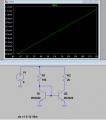
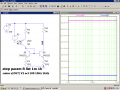
enclosed is a simulation and the green trace is the current through R1, vs. supply voltage V1. As you can see, once Q1 starts to conduct, the current changes in R1 is proportional to change in supply voltage. That's how you set the current through a current mirror.

This property actually comes handy in certain applications, like a 4-20ma driver, or the amplification stage in a CFB opamp. etc.

The way to reduce / eliminate that is to put a CCS there in place of R1: its high (ac) impedance solves the problem.

You can also switch out Q2 to a different transistor to see how the mirroring works.

current mirror.PNG
 

crutschow

Joined Mar 14, 2008
38,537
But why does Ohm's Law work? It's negative feedback on a scale deeper than we usually consider it. Consider that there's always noise present that moves the voltages/currents away from the values predicted by Ohm's Law. So why don't the voltages and currents just keep wandering further and further away? Because negative feedback effects drive them back toward the predicted values.
Noise doesn't move the the voltages/currents away from their predicted values.
You use Ohm's law to determine the predicted perturbation in the current caused by any noise.
Saying that two resistors in series have negative feedback is stretching the definition far beyond what anyone else does (that definitely is a scale deeper) :rolleyes:.
If someone else agrees with your definition, I'd like to hear from them.
 
Top