Need suggestions for debugging 240V AC to 5V 2A DC SMPS Circuit

Thread Starter

Priyanshu Gupta

Joined Dec 10, 2024
7
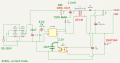
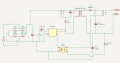
I am currently working on a project to build a 240V AC to 5V 2A DC SMPS circuit. I have designed the circuit based on the standard flyback converter topology, but I’m facing some issues that I can't resolve. I hope someone here can guide me through troubleshooting this.


View attachment 195872 Screenshot 2024-12-10 173011.png
 

Pyrex

Joined Feb 16, 2022
501
Hi,
for flyback topology converters, it is necessary to make the transformer exactly according to the calculated parameters.
Is the primary winding is shared in two equal parts?
Is the air gap provided in the transformer?
 

ronsimpson

Joined Oct 7, 2019
4,646
What is the primary inductance of T1?
D5=5.6V + 1.5V for the LED + ? for R4= about 7V But you want 5V.
1733926215317.png
It is dangerous to work on the power line.
I use a DC power supply with current limit for the AC input. 0-400V

No AC input! Add 5Vdc to pin2. Across 47uF cap. This will wake up the IC.
Add different power supply to 4.7uF cap. Start out at 12V or small voltage.
Pins 7&8 of IC should show maximum on time of 75%.
Add power to output. Start out at 0V and increase to 8V. LED current should start to flow at about 7V and the duty cycle should reduce to 0% or very small. When U1 is working correctly you can remove the output power supply.

Increase the voltage on 4.7uF cap. You should see some power voltage on the output.
Bing Videos This video might help you.
The circuit is getting short
Test D1-D4. Please say more about the short. What have you done so fare?
 

Thread Starter

Priyanshu Gupta

Joined Dec 10, 2024
7
What is the primary inductance of T1?
D5=5.6V + 1.5V for the LED + ? for R4= about 7V But you want 5V.
View attachment 337729
It is dangerous to work on the power line.
I use a DC power supply with current limit for the AC input. 0-400V

No AC input! Add 5Vdc to pin2. Across 47uF cap. This will wake up the IC.
Add different power supply to 4.7uF cap. Start out at 12V or small voltage.
Pins 7&8 of IC should show maximum on time of 75%.
Add power to output. Start out at 0V and increase to 8V. LED current should start to flow at about 7V and the duty cycle should reduce to 0% or very small. When U1 is working correctly you can remove the output power supply.

Increase the voltage on 4.7uF cap. You should see some power voltage on the output.
Bing Videos This video might help you.

Test D1-D4. Please say more about the short. What have you done so fare?
The circuit got shorted from the bridge rectifier, I double-checked the connections before but still happened same.
 

Thread Starter

Priyanshu Gupta

Joined Dec 10, 2024
7
What is the primary inductance of T1?
D5=5.6V + 1.5V for the LED + ? for R4= about 7V But you want 5V.
View attachment 337729
It is dangerous to work on the power line.
I use a DC power supply with current limit for the AC input. 0-400V

No AC input! Add 5Vdc to pin2. Across 47uF cap. This will wake up the IC.
Add different power supply to 4.7uF cap. Start out at 12V or small voltage.
Pins 7&8 of IC should show maximum on time of 75%.
Add power to output. Start out at 0V and increase to 8V. LED current should start to flow at about 7V and the duty cycle should reduce to 0% or very small. When U1 is working correctly you can remove the output power supply.

Increase the voltage on 4.7uF cap. You should see some power voltage on the output.
Bing Videos This video might help you.

Test D1-D4. Please say more about the short. What have you done so fare?

did some changes but DK1203 is not getting voltage at vcc and gnd , and the overall output is 0.06v
@ronsimpson
 

ChasNC

Joined Jul 14, 2020
5
With a high AC input voltage (up to 265VAC), this kind of circuit tends to need a soft start / pre-charge circuit. An NTC in series with the bridge rectifier works well, and if the SMPS efficiency is needed after it gets started, a pre-charge relay can be used to wrap around the pre-charge ressitance. I am assuming that you are saying that the input rectifier diode bridge is going short when you try to start. Those are 1A diodes with some level of transient current capability, but it would be easy for this kind of circuit to get into the 60-100A peak range during a start if the bulk cap ESR is small.

TI has several application notes that explain this kind of design, as well as On Semi, Analog Devices, and some other vendors.
 

paulktreg

Joined Jun 2, 2008
851
What is the actual voltage rating of the indicated 22uF 50V electolytic capacitor after the bridge rectifier. It needs to be at least 400VDC.
 

ronsimpson

Joined Oct 7, 2019
4,646
The circuit got shorted from the bridge rectifier, I double-checked the connections before but still happened same.
Have you tested the diodes in the bridge?

Do you have a bench power supply? With current limit?
Remove the 220Vac and input something small like 12V current limited. Is there voltage on 4.7uF 450V cap? (10VDC) Now reverse the 12V power. +<--->- Do you have voltage on 4.7uF? This is another way to test the bridge.

Maybe the short is inside the IC.
 
First problem the scope ground needs to be floating (isolated) or you short out the diodes in the bridge.
Something like a digikey CT4066-ND.

Second problem: You have to know what your doing.

You have to add start winding dots to the transformer and have to select a core and wind it to meet dielectric beak down requirements .

Third: Don't use Chinese IC's.

Try buying a power supply. Mean Well MFM-10-5.
 

agsuresh

Joined Dec 28, 2023
64
The circuit is getting short
T1 - 203T Primary 0.1mm, 4T Secondary 0.5mm
D5 - 1N4734A
R1 - 100k ohm
C5 - 103/1KV

Have you connected a 60watt filament bulb in series with the circuit ac line ? That is the best way to save a lot of pain. Make a switch board and keep your fingure on the switch. If the bulb lights up , means there is some issue, and you can immediately switch it off. As the circuit draws more and more current, the bulb shall glow brighter and brighter.

If the circuit is not well made, It can damage a lot of components even on the secondary side. So do not assume that they might be good.

With some these ic's (pwm + mosfet) , they could get damaged even by putting the multimeter on certain points. The internal capacitance of the meter may affect the performance inducing oscillations , damaging the components.

The snubber capacitor should be above 1kv type.
 
Top