Need recommendations for a used scope

Thread Starter

Hextejas

Joined Sep 29, 2017
187
I am a total beginner though I am getting to the point where I will need to start seeing the waveforms.
So, to that end, I want an inexpensive, analog, used scope.
A friend recommended a Tektronix 465.
Comments please.

Yikes ! The auto correct changed inexpensive to expensive and I didn't catch it.
 
Last edited:

recklessrog

Joined May 23, 2013
985
I have seen that there are a lot of Gov.surplus Phillips/Fluke PM 3082, 3092, 3394a analogue 'scopes available on E.bay etc. There is a whole series of these and ranging from 100-200 mHz and some with digital storage. Some are 2+2 channel, some full 4 channel.
I have several of these that I used in my business for many years before I retired and kept a few for hobby use now.
One which was used 8 hours every working day for over 10 years is still as sharp as it ever was, the tubes seem to go on forever, not something that I can say for some of the Tektronics scopes we owned.
Check out the specs on Flukes U.S website. (not U.K)
http://media.fluke.com/documents/PM3082__umeng0000.pdf
 

dl324

Joined Mar 30, 2015
18,328
What types of circuits do you plan to work with? Frequency and number of waveforms you want to view simultaneously are important factors.

What is your budget?

Do you want the scope to be portable, luggable, bench only? How much space do you have available for it?
 

Thread Starter

Hextejas

Joined Sep 29, 2017
187
What types of circuits do you plan to work with? Frequency and number of waveforms you want to view simultaneously are important factors.

What is your budget?

Do you want the scope to be portable, luggable, bench only? How much space do you have available for it?
I was afraid that you would ask me that dl324 and unfortunately I don't know, except for the space. I didn't know that they made them so small. As an aside, the 465 that was previously recommended to me looks exactly like the device that the IBM tech would bring into the office when he needed to work on our main frame. And it would be far and away too big.


Back to the topic. Considering space and the wifely factor, a handheld would be ideal.

As to waveform and frequency, I don't know enough to be able to answer you. Something basic.
As to budget, does $250.00 sound reasonable ?

I also have a DIY kit on the way but I am guessing that it might be limited though maybe it will be enough for a while.
https://www.amazon.com/JYE-DSO-138-Open-Source/dp/B00WAQGGZA

I don't know where this hobby will lead me. I got into it indirectly from an idea to build a circuit to interface with Arduino, Raspberry Pi, etc. So as to be able to do "stuff" electrically, controlled by the Arduino. I had build a few Heath kits about 40 years ago and wanted to try and learn what the pieces did, rather than just solder them into a board. I am pretty sure that I could buy off the shelf stuff to do what I need, but where's the fun in that.

Thanks again
 

dl324

Joined Mar 30, 2015
18,328
As to budget, does $250.00 sound reasonable ?
Google handheld scope and be prepared for a shock. That type of convenience is priced at a premium.

If I was your Wife, I'd demand matching funds.

Sometimes you can pick up a used Tek 465 type scope for less than $50; I have. We used them in college and put them on the floor when we didn't have bench space; or we put them on a rolling cart.. That scope has 4 posts on the bottom to wrap the power cord around. Those posts also serve as feet for standing it vertically.
 

philba

Joined Aug 17, 2017
959
Be aware that older scopes (which is what a decent quality used scope will be) all have electrolytic capacitor issues. This is not cause for alarm as the problem is usually very easy to fix if there is decent service info available. It's really a question when will it die, not if. I'd pick a mainstream scope where the issues and fixes are pretty much known.

My late 80s Tek 2225 is a case in point. It recently died. At first look it was frighteningly complex. But I found a service manual and the Yahoo Tek Scopes group had some pretty helpful folks. I was able to find the problem (dead cap which took out 2 transistors) and replace the bad components. It now works fine. Not sure how easy it would have been if I didn't have the service manual.
 

MrChips

Joined Oct 2, 2009
34,812
It would help us if we knew your location.

I wouldn't be afraid to repair any older Tektronix oscilloscope since you are almost certain to be able to find a copy of the service manual on the internet.

I would look for a used Tektronix 2213, 2215, or 2225.

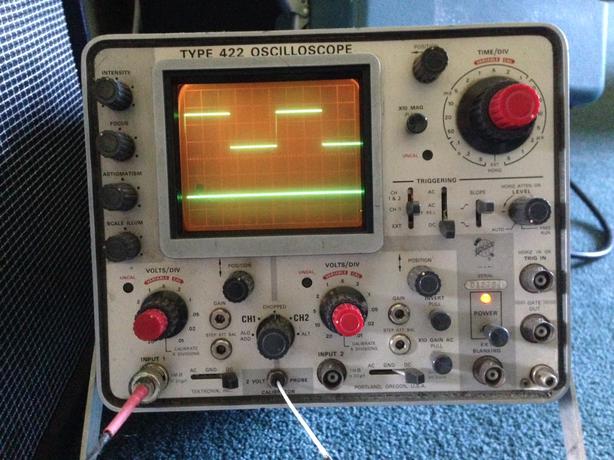
I am still using a Tektronix 422 and that thing is built like a tank to last forever. This is at least 50 years old and I have never replaced any capacitors.


philba

Joined Aug 17, 2017
959
I am still using a Tektronix 422 and that thing is built like a tank to last forever. This is at least 50 years old and I have never replaced any capacitors.
Trudat. And Tek used super high quality parts unlike more recent & lesser brands. But, those caps are still ticking away...
 

Thread Starter

Hextejas

Joined Sep 29, 2017
187
Dl324, matching funds is hilarious.
I was just looking around when I realized that screen size and clarity might be significant.
I think it was Bertus or Mr Chips or another that posted a screenshot from a scope ( I cant find it ). It looked like a perfect sine wave to me and he was using it to make a point. Well he also remarked that there was a problem with it.
Huh, well other than the shape, maybe it had some fuzzy spots or thingies, or blurred lines, that were the issue.
So, if there are those types of imperfections, other than shape, to be looked for, i am thinking that the screen size
clarity, and resolution for a gentleman of my advanced years and failing vision.
Hence, I think a 3.5 screen might be too small.
After browsing, I have boosted my budget and space considerations cause i saw the reviews on these 2 models.
Siglent SHS 806,,,5.7 screen
Siglent SDS 1102x
And am still looking at the recommendations here

These are both probably overkill as to my career but they seem like they would last a long time.
Plus they are new, so limited risk from EBay.

Sorry for the confusion
 

philba

Joined Aug 17, 2017
959
I have to say, a modern DSO is an incredible tool. I'm eyeing the Siglent SDS1104XE (4 ch, 100 mhz) scope. There are a couple of sellers that offer hobbyists discounts but you have to go to a different forum to get the code...

The SDS1202X-E has a really nice display. It's $380-ish with maybe another $20-30 off with the above discount.
 

MrChips

Joined Oct 2, 2009
34,812
Houston Texas, and do you have any problems with that size of screen, and how is your vision ?
Most of us lose our eyesight, among other things, as we get older.

I have to use four different magnification reading glasses to go from distance vision, computer screen, reading books, looking at IC markings, PCB assembly.

So what? You do what ya gotta do!

More than worrying about the size and sharpness of the screen, I would be considering firstly what do I intend to do with the oscilloscope.
 

dl324

Joined Mar 30, 2015
18,328
Hence, I think a 3.5 screen might be too small.
It depends on how many signals you're viewing simultaneously. You can always use glasses. I'm nearsighted and use computer glasses (or no glasses), depending on the working distance involved.

I have a scope with a 3.5" screen and I have no difficulty reading it. Top screen is 3.5", bottom is 5". The 7704A is setup for 4 channels, but can have 8 for analog. With a logic analyzer plug-in, it can display 16 channels. Though I prefer to use a scope with a 6" screen in that case.
upload_2017-12-23_10-14-27.png
 

Thread Starter

Hextejas

Joined Sep 29, 2017
187
Most of us lose our eyesight, among other things, as we get older.

I have to use four different magnification reading glasses to go from distance vision, computer screen, reading books, looking at IC markings, PCB assembly.

So what? You do what ya gotta do!

More than worrying about the size and sharpness of the screen, I would be considering firstly what do I intend to do with the oscilloscope.
Mr. Chips, I truly meant no disrespect. It was that the screen size on the 2213 was 3.5 x 4.0 I think. I too need about 4 different pairs of glasses and I have a hard time with my IPhone. Uncorrected vision is 20/400 with astigmatism. And as to what I intend to do with the scope, I am too ignorant to know, but I do know that firstly, i want to be able to read it with some degree of ease.
Again apologies if I misspoke and seemed disrespectful.

It depends on how many signals you're viewing simultaneously. You can always use glasses. I'm nearsighted and use computer glasses (or no glasses), depending on the working distance involved.

I have a scope with a 3.5" screen and I have no difficulty reading it. Top screen is 3.5", bottom is 5". The 7704A is setup for 4 channels, but can have 8 for analog. With a logic analyzer plug-in, it can display 16 channels. Though I prefer to use a scope with a 6" screen in that case.
DL, those pictures are very helpful. Thank you.
I think that I might go by a local store and take a look at some different screen sizes.
 
Last edited by a moderator:

MrChips

Joined Oct 2, 2009
34,812
Here are my practical tips for what you should look for in purchasing your first used or new oscilloscope, assuming you have never used one before.

Unless you are a professional with professional needs, put aside any discussion on screen size, sharpness, fuzziness, blurring, distortion, etc., for the moment. I am not saying that these are not important. What I am saying is that there are more important things to consider first, such as what you plan to do with the oscilloscope.

Firstly, the primary purpose of an oscilloscope is for viewing changing voltages, especially rapidly fluctuation voltages. If your voltage is steady or changing slowly over periods longer than a few seconds, then a standard analog or digital voltmeter will work fine.

Oscilloscope usage as an important diagnostic tool can be lumped into two classes, audio work and computer work.

The audio spectrum runs from 20Hz to 20kHz. An inexpensive analog oscilloscope with a bandwidth to 1MHz will do fine. It would be very difficult to find an oscilloscope with a bandwidth less than 20MHz. Max bandwidths of 20MHz to 100MHz are more common.

When you view an audio signal such as music signal on an oscilloscope screen you will be watching a lot of random shapes on the screen. Hence blurring or distortion on the part of the oscilloscope will not impact significantly on what you observe. It would be like watching a movie at 100 times the normal viewing speed.

In order to observe a stationary trace on the screen, the input signal must be repetitious, such as 60Hz AC waveform. This is an important fact to remember.

If you are going to be experimenting with digital circuitry or anything to do with computers, your best bet would be a digital oscilloscope. This has nothing to do with examining digital waveforms with a digital scope nor analog waveforms on an analog scope. This has to do with the fact that a digital scope can store and freeze a single shot event. For example, if you hit a single key on a computer keyboard and the computer were to transmit that data, this would be a single shot event. On an analog oscilloscope, this would be a blip on the screen and it would disappear. On a digital scope, the trace of the event would remain on the screen for viewing long after the event was over.

The bottom line

If you are a hobbyist just getting to analog circuits, get a used analog scope (about 50MHz bandwidth) for under $100.

If you are a hobbyist and intend to dabble in digital circuitry, get a new or used digital scope (about 100MHz bandwidth) for under $400. Of course, the digital scope will serve you well for both analog and digital applications, assuming that you can spend four times the money.

If you do not fit in either category, e.g., you are a professional, RF engineer, with deep pockets, then the sky is the limit, and you probably already have an oscilloscope that fills your needs.
 

philba

Joined Aug 17, 2017
959
That's good advice. I'd like to add one more thing.

If you are doing a lot of digital stuff, consider getting a logic analyzer. You can get lower speed (10s of MHz) ones for well less than $20 and really good high speed ones for <$100. Using free traceview you can analyze all sorts of digital things. I use my LA far more than my scope. It's great for looking at the various inputs and outputs to see if your circuit is working right. You can even look at (and read) protocols like SPI, I2C, serial. For working with Arduinos and RasPis, you would probably use one a lot.
 

Thread Starter

Hextejas

Joined Sep 29, 2017
187
Here are my practical tips for what you should look for in purchasing your first used or new oscilloscope, assuming you have never used one before.

The bottom line

If you are a hobbyist and intend to dabble in digital circuitry, get a new or used digital scope (about 100MHz bandwidth) for under $400. Of course, the digital scope will serve you well for both analog and digital applications, assuming that you can spend four times the money.
Thank you for making this simpler.
I have never used one before and plan to do computer interfaces.
You have narrowed this down a lot.
Now, a lot of the discussions that I have been reading have centered on 2 channels vs 4.
What do you recommend ? It seems to make about a $100.00 difference.
 

MrChips

Joined Oct 2, 2009
34,812
The discussion going on right now is about the choice between

Siglent SDS1052DL 50MHz 2-Channel US$279
Siglent SDS1102CML+ 100MHz 2-Channel US$319
Siglent SDS 1202X-E 200MHz 2-Channel US$379

or waiting for a
Siglent SDS 1104X-E 100MHz 4-Channel US$499
Siglent SDS 1204x-E 200MHz 4-Channel US$649

Personally, I would go with the lowest priced (given your situation) unless you have the money to spend.

https://forum.allaboutcircuits.com/...about-upgrade-siglent-1202xe-thoughts.141452/
 
Top