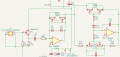
Need help with tl072

Thread Starter

ad8chd

Joined Apr 28, 2023
17
What confuses guitarists is when they play on a bigger stage, use a longer lead and get a completely different sound, because that treble peak is an octave lower. Then they think their amplifier has gone wrong.
Lol as a guitarist I can attest to this, also that that is far from the only thing that confuses us. Well me anyway.
 

Thread Starter

ad8chd

Joined Apr 28, 2023
17
I agree about the buffer and the bias. I presume that the diodes are a distortion network and as they will conduct quite some current connecting them to the 4.5V bias will make a real mess of the 4.5V bias. They should go to earth as you point out.
Although it seems to be the defacto standard, 1MΩ is too high a load impedance for a guitar pickup. 220k works much better, because it doesn't produce a huge peak in the treble region cause by the resonance between the inductance of the pickup and the capacitance of the cable. (Obviously, the pitch of the resonance varies with the cable length)
I like my 1M distortion pot. The best part of it is the last few degrees too. (It's not linear so it goes nothing nothing nothing our amps all go to 11) plus my pickups are seymore Duncan invaders. No posts, all screws with big hex heads. The neck is 7k but the bridge is 16.8k, a fender pickup is around 3. But they are super dark to any brightness they can get is a good thing
 

Ian0

Joined Aug 7, 2020
13,131
I've actually got the half Vcc going into the same pin as my signal, I didn't draw it because I was in a hurry and just drew it from the datasheet without thinking about the cap and the rest of it. On the original design (the IC came from a boss ds1 pedal) there is a jfet buffer that I would have much rather went with but transistors are giving me a really hard time. The circuit that does work (the op-amp section of the ds1) actually sounds pretty good, but I'd like to get all that distortion from a few stages a little at a time rather than all from one chip so I was going to try to run the buffer into another couple tl072's I have them into that then into a lm386. I was hoping by the time I got there I will have figured out how to hook it up to a transformer and have a little homemade amp. The voltage divider on the circuit that works is 2 1k resistors, the coupling cap is I think .47u. on the tl074 I've been trying all different values.
If you are using an old bipolar op-amp like the M5223 or an LM358 or 741 then you might need a JFET source-follower to drive it to get a decent high impedance input, but the TL072 doesn't need a buffer because it already has a high impedance input.
LM386 is rubbish.
 

Thread Starter

ad8chd

Joined Apr 28, 2023
17
If you are using an old bipolar op-amp like the M5223 or an LM358 or 741 then you might need a JFET source-follower to drive it to get a decent high impedance input, but the TL072 doesn't need a buffer because it already has a high impedance input.
LM386 is rubbish.
What's wrong with the 386? Also I have two guitars, one with avarage output pickups, and one with big dumb 16k pickups. For some reason the higher impedance pickups seem to drive it less. Is that a thing?
 

Ian0

Joined Aug 7, 2020
13,131
What's wrong with the 386? Also I have two guitars, one with avarage output pickups, and one with big dumb 16k pickups. For some reason the higher impedance pickups seem to drive it less. Is that a thing?
LM386 is an ancient headphone amplifier for pocket radios and personal cassette tape players. Things have moved on. Its distortion is poor - mainly crossover distortion, which is not the sort of distortion that makes guitars sound good!
Pickups vary - the signal varies with:
the diameter of the string
the distance between the string and the pickup
the alignment between string and magnet
the strength of the magnet
the number of turns in the pickup
the inductance of the pickup
the length of the cable between pickup and amplifier
how badly internal tone-controls are implemented
and probably a few more things I've overlooked
 

Thread Starter

ad8chd

Joined Apr 28, 2023
17
LM386 is an ancient headphone amplifier for pocket radios and personal cassette tape players. Things have moved on. Its distortion is poor - mainly crossover distortion, which is not the sort of distortion that makes guitars sound good!
Pickups vary - the signal varies with:
the diameter of the string
the distance between the string and the pickup
the alignment between string and magnet
the strength of the magnet
the number of turns in the pickup
the inductance of the pickup
the length of the cable between pickup and amplifier
how badly internal tone-controls are implemented
and probably a few more things I've overlooked
Is crossover distortion like the signal bleeding inside the chip? I'm looking for like nasty odd order harmonic early 90's metal distortion (think dimebag x Hetfield) what route would you recommend I go (I know, tubes... but I need to figure out this solid state stuff first cause it's way cheaper)
 

Ian0

Joined Aug 7, 2020
13,131
Is crossover distortion like the signal bleeding inside the chip? I'm looking for like nasty odd order harmonic early 90's metal distortion (think dimebag x Hetfield) what route would you recommend I go (I know, tubes... but I need to figure out this solid state stuff first cause it's way cheaper)
No - crossover distortion is a gap between the top half of the waveform and the bottom half. It gets worse as the signal level gets smaller, because the gap stays the same size as the signal gets larger and smaller.
Valves are better for even harmonics, my favourites for odd-harmonics are low-voltage zeners. The lowest voltage zeners (BZX55C2V4) have a more gradual breakdown than higher voltage devices so are a bit more subtle getting higher harmonics as the overdrive increases.
This is the front-end of a practice combo I made for the bassist in the Lene Lovich band. It shows the preamp and the Baxendall tone control (which is centred an octave lower than it would be for lead guitar).
(The pots look peculiar because I used a stereo pot with the two tracks in parallel, because a stereo pot has six pins to anchor it to the pcb intead of 3 where I have used two 220k tracks one 100k track will do)
Screenshot from 2023-04-30 11-22-05.png
 
Last edited:

Thread Starter

ad8chd

Joined Apr 28, 2023
17
No - crossover distortion is a gap between the top half of the waveform and the bottom half. It gets worse as the signal level gets smaller, because the gap stays the same size as the signal gets larger and smaller.
Valves are better for even harmonics, my favourites for odd-harmonics are low-voltage zeners. The lowest voltage zeners (BZX55C2V4) have a more gradual breakdown than higher voltage devices so are a bit more subtle getting higher harmonics as the overdrive increases.
This is the front-end of a practice combo I made for the bassist in the Lene Lovich band. It shows the preamp and the Baxendall tone control (which is centred an octave lower than it would be for lead guitar).
(The pots look peculiar because I used a stereo pot with the two tracks in parallel, because a stereo pot has six pins to anchor it to the pcb intead of 3 where I have used two 220k tracks one 100k track will do)
View attachment 293149
Don't zeners let current flow both ways at a certain voltage? Is that why it's more gradual? Or cause it's soft clipping rather than straight to ground?
 

MrChips

Joined Oct 2, 2009
34,809
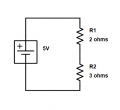
So maybe the current is r1=2.5 & r2=1.6666 because v\r =A ? I think there will be 3 volts between them but I'm shaky on going across each, maybe 5 across each? But that can't be right or else it wouldn't be a math problem cause it would be a trick question huh. So I've been trying to find info online but Google ain't really what it used to be, most sites are ai written ads and worthless. I would love to be pointed I. The direction of some study material I can read (I'd rather not watch videos) I would appreciate it, or if anyone is feeling super generous and in the mood to spoon feed this baby bird I wouldnt turn down the help but I completely respect making me do the work.
Learning electronics is not a weekend affair. In fact, it is a lifetime rewarding journey. You have not even cracked open the door as yet. You have a very long road ahead of you.

You say that you know Ohm's Law. You also said that you know algebra. That is a very good place to start.
However, I am not going to spoon feed you.

Given this exercise:

1682862356381.png

Ohm's Law is stated as

I = V / R

There are two variants of Ohm's Law

V = I x R
R = V / I

Applying Ohm's Law to the above exercise using algebra gives:

(1) V1 = I1 x R1
(2) V2 = I2 x R2

Circuit theory tells us that:

(3) V = V1 + V2
(4) I1 = I2

Now we have 4 equations and 4 unknowns, V1, V2, I1, and I2.
Can you solve for I if we make I = I1 = I2 (thus eliminating equation 4)?
This gives us 3 equations and 3 unknowns, V1, V2, and I.

If you know V and I, determine R where R is known as the effective resistance of R1 and R2 combined and where

R = V / I
 

Ian0

Joined Aug 7, 2020
13,131
Don't zeners let current flow both ways at a certain voltage? Is that why it's more gradual? Or cause it's soft clipping rather than straight to ground?
Low voltage zeners work by the zener effect, higher voltage zeners work by the avalanche effect. In the middle at about 6V work by both - they are the best zeners. Low voltage zeners are rubbish by comparison the breakdown voltage varies quite a lot with current. It makes a dreadful voltage regulator, but for soft clipping for guitar effects it is excellent.
I don't even know why they still make 2.4V zeners because there are some really excellent 2.5V references. Perhaps all the 2.4V zeners go into guitar distortion pedals?
 

Audioguru again

Joined Oct 21, 2019
6,826
The 3 Jfets in the pedal are not a buffers, instead they are level controllers maybe for wah, wah, wah or vibrato.
The low power LM386 does not produce audible crossover distortion from its class-AB output stage biased with 2 diodes.
At an output power a little less than clipping and at lower levels its mid-frequencies distortion is only 0.2%.
 

MrChips

Joined Oct 2, 2009
34,809
LM386 is an audio power amplifier meant for driving a loudspeaker. I would use a different opamp for signal amplification.
 

djsfantasi

Joined Apr 11, 2010
9,237
(It's not linear so it goes nothing nothing nothing our amps all go to 11)
You do realize that “11” is a marketing ploy that is not based in any reality?

For illustrative purposes only, assuming a linear 10db difference between 0 and 10 on some amp. These numbers are for illustration only. If you get hung up on this, assume there is a difference if 10 “plitzky”s. Now, the manufacturer labels their knobs 0-11. In the first case of 0-10, there is a difference of 1plitzky per number. In the second case of 0-11, there is a difference of 0.9 plitzkys per number - but in both cases, the total difference is 10 plitzkys or db. This logic applies to both linear and logarithmic scales.
 

Thread Starter

ad8chd

Joined Apr 28, 2023
17
Learning electronics is not a weekend affair. In fact, it is a lifetime rewarding journey. You have not even cracked open the door as yet. You have a very long road ahead of you.

You say that you know Ohm's Law. You also said that you know algebra. That is a very good place to start.
However, I am not going to spoon feed you.

Given this exercise:

View attachment 293164

Ohm's Law is stated as

I = V / R

There are two variants of Ohm's Law

V = I x R
R = V / I

Applying Ohm's Law to the above exercise using algebra gives:

(1) V1 = I1 x R1
(2) V2 = I2 x R2

Circuit theory tells us that:

(3) V = V1 + V2
(4) I1 = I2

Now we have 4 equations and 4 unknowns, V1, V2, I1, and I2.
Can you solve for I if we make I = I1 = I2 (thus eliminating equation 4)?
This gives us 3 equations and 3 unknowns, V1, V2, and I.

If you know V and I, determine R where R is known as the effective resistance of R1 and R2 combined and where

R = V / I
Yes, I'm fully aware of the rabbit hole into which I've fallen, I always do this. I pick a hobby that ends up being way more intricate then I expected. This is the scratch build rc planes all over again only less fun and more math. But way more rewarding so it will be my existence until I figure it out and get bored with it and try something else. I've been harvesting more old sterios and vcr's and whatever surface mount stuff I can get for free and looking up data sheets, getting stuff to sometimes work melting my table with the stupid soldering iron... But trust and believe the work is being put in. But with all that being said, I got the thing to work. One of my little feats on the chip wasn't long enough to make it to the metal part of the breadboard. I just soldered some of the breadboard tip wire things right onto the little feets and it works fine. So one other question and I'll leave you guys alone for now, if I'm trying to buy us a transistor all I need to know is where do I come up with my emitter current, because that's really the first thing that I have to know to get through all those other equations, and I can't figure out where people pull the number from. It's like between 1 milliamp and 10 milliamps and I can't ever figure out how they pick that number.
 

MrChips

Joined Oct 2, 2009
34,809
If you want an audio power amp for your boom box, get a Class-D ready built module readily available from multiple sources.
 
Top