Need help with this voltage amplitude circuit.

Status
Not open for further replies.

Wendy

Joined Mar 24, 2008
23,797
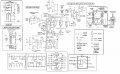
It might work, the invertor oscillator is not where the stress will be. That MOSFET is going to get hot, very hot, so heatsinking will be required. It is also drawn in such a way as which lead is which is ambigous, which is usually a way to connect it backwards and blow it out. The invertors are outside the norms for drawing schematics, but close enough for most people to figure them out.

You will also need a resistor between the gate and the output of the 40106, say 100Ω to allow the MOSFET to switch cleanly.

Given all the foriegn language around that schematic I'm betting you didn't draw that sucker. Care to share the source?

There is a good chance the 40106 is a bit weak on the drive, but like I said the MOSFET and the coil it is driving is what is going take most of the stress, followed by the power supply. That coil will be drawing many amps, probably in excess of 10 amps, thought the exact number is hard to predict.

BeenThere is right about that high voltage. You are in the realm of one minor mistake and you will fry, these kind of voltages are not to be messed with.

BTW, a 555 can output up to 200ma (0.2A), while one output of the 40106 is rated for several µa (0.000002A).
 

Thread Starter

h2opower

Joined Aug 30, 2009
45
Just so you are aware of how Meyer stated the effect on his patent...

He indicated a source voltage of 26 VDC. His VIC (we would call it a step up transformer) had a 1:5 turns ratio, so his claimed results were at around 130 volts. His diode and "bifilar" coils were not in circuit in a manner that makes sense electronically. No further voltage multiplication would have been possible, despite his claims.

So far, the resonance effect is to enable the water molecules to come apart with no input energy. The claimed frequencies - and those possible with the components stated - are simply too low. The water molecule has a set of resonant frequencies, but way up in the IR region. Not at the 950 nm emission of most IRLED's, by the way.

If you plan on following the scheme in your latest post, be aware that Meyer had no part of it. You are also going to be dealing with a dangerously high voltage that can create arcs to your body, as well as generating soft X-rays. Be more than careful - this can be lethal.

The salient question I would raise - why the high voltage? Way back in 1820, Michael Faraday showed that electrolysis takes place at a much lower voltage - just over 1.23 volts. You might find the material interesting - http://www.nmsea.org/Curriculum/7_12/electrolysis/electrolysis.htm

My point is this - if Meyer claimed to have his stuff running at 130 volts and some frequency (the claims on the net go from 6 KHz to 143 KHz), why are the circuits supposedly based on his work needing impossibly high voltages? But, if you have taken the time to read through the material I linked you to, you are aware of this already.
That is one way to break down the water molecule here is another:
 

Thread Starter

h2opower

Joined Aug 30, 2009
45
It might work, the invertor oscillator is not where the stress will be. That MOSFET is going to get hot, very hot, so heatsinking will be required. It is also drawn in such a way as which lead is which is ambigous, which is usually a way to connect it backwards and blow it out. The invertors are outside the norms for drawing schematics, but close enough for most people to figure them out.

You will also need a resistor between the gate and the output of the 40106, say 100Ω to allow the MOSFET to switch cleanly.

Given all the foriegn language around that schematic I'm betting you didn't draw that sucker. Care to share the source?

There is a good chance the 40106 is a bit weak on the drive, but like I said the MOSFET and the coil it is driving is what is going take most of the stress, followed by the power supply. That coil will be drawing many amps, probably in excess of 10 amps, thought the exact number is hard to predict.

BeenThere is right about that high voltage. You are in the realm of one minor mistake and you will fry, these kind of voltages are not to be messed with.

BTW, a 555 can output up to 200ma (0.2A), while one output of the 40106 is rated for several µa (0.000002A).
You guys are the greatest I will definately make the changes. The circuit is from Dr. Dingel, it's all he was willing to share.

On the transformer it is more like a police tazor in how it works, it is not a typical step up transformer. I took a lot of trail and error to figure out how it really works. Now the VIC transformer creates its high voltages by way of reactive capacitance, XC1 • XC2 • XC3,…, • XC42. These type of transformer do not make their high voltages like a typical step-up transformer does. All of the bobbin cavities have to match in inductance with the primary coil’s inductance for the desired frequency the user is aiming for. This way makes sure that all coils hit resonance at the same time. Since the primary has the strongest magnetic field it leads the way for all other magnetic fields to add to its magnetic field strength. Again I don't follow Stanley Meyers words I follow the science behind the technology.
 
Last edited:

Wendy

Joined Mar 24, 2008
23,797
Now the VIC transformer creates its high voltages by way of reactive capacitance, XC1 • XC2 • XC3,…, • XC42. These type of transformer do not make their high voltages like a typical step-up transformer does.
Uh, no. We know this circuit very well, it is called a voltage multiplier, derived from voltage doubler.

http://www.allaboutcircuits.com/vol_3/chpt_3/8.html

It starts with step up transformer (which with 6 turns of wire will soak a huge number of amps, and be inefficient as hades), then uses the basic voltage doubler to finish the job. To most of us this is basic electronics.

There are other ways of generating high voltage, this is just one way to do it.

The (relatively) high frequency will allow the slight inductance to prevent a total burnout. It may be enough, but there is no resonance involved here.

Question for the other electronics types, I think a swamping diode is needed for this circuit to prevent damage to the MOSFET from inductive kickback. Anyone else disagree?

I mentioned it, but that is not a true schematic, too many holes. There is a reason we have specific symbols for components, so that there is not ambiguity in how to connect the parts together. That symbol in your schematic is for a JFET, and is dated pretty badly (the symbol has changed to clear up which is drain and which is source). JFETs were never power components, their cousins MOSFETs are for much higher power levels, and I'm making the assumption that the schematic is actually referring to a MOSFET because of this.

Edit: I just looked at that schematic again, that symbol is so far off it has no information. You can't tell if it is a N Channel or P channel, though it can be figured out easily enough. I have grave doubts this was ever built, it is so far off. In addition to the FET, and the oscillator driver, the transformer is lacking some key information. This is why I asked for the source, so I could look at the real parts list.

 
Last edited:

beenthere

Joined Apr 20, 2004
15,819
If you troll the alternative energy sites, these things are relatively common. I think that they are meant to impress, as nobody has put in component ID's or much of anything useful. To have high power FET's running off what just about has to be 4000 series CMOS is a bit less than convincing, too. Most of the circuitry appears to be some hobby circuit with additions.
 

Thread Starter

h2opower

Joined Aug 30, 2009
45
I am not using the voltage multiplyer just the 40106 chip in the place of the 555's. In order to reach the corona discharge in air I have to get it to around 11k volts to start off with, and I designed the Gas Processor to take 60k volts before the air breakdown voltage is reached. This is a see through showing of what the Gas Processor is doing: http://www.youtube.com/watch?v=NQvXrxrqshk. At first I tried to make one just like this one but I found it impossible to find anyone that could put the conductive oxide on the inside of the 2 inch diameter tube, so I redesigned it to the one I have now.

When I did my research on the VIC transformer I found that this type of transformer is not comonly used due to run away voltage problems they can have. As the voltage is shut off the capacitive reactance of the individual bobbin cavities ramps up the voltage.
In this transformer Meyer shows I took the stance as he was trying to hind something for he was a business man, capable of eating his young for a profit. In his use of words I found this on just what bi-directional wrap ment:
It's just a fancy word for something that is cross wrapped. So breaking down what he said I use bifilar wire for dual primaries, cross wrapped about the bobbin two layers or forwards and back again. It's just my translation of his words to the real world of the living. If you haven't noticed by now I am not a fan of Stanley Meyer. Which is why the hho'ers hate me.

I looked to Albert Bowe, Dr. Dingel, and many others for the answers to the questions I had, and not just Stanley Meyer. The hho'ers also hate me for posting this:

How far can a car go on 1 mole of gasoline if the car gets 30 mpg given the gasoline used has an energy content of 5080 kJ/mol?

And the same question for just hho @ 286 kJ/mol( how much water will be need to be broken down to go the same distance)?

And the same question for just oxygen stripped to the 4th energy level with atomized water mist( how much water will be need to be broken down to go the same distance)?


This is what I get for gasoline:
(5080kJ/mol)(1gram/44.6kJ)(1L/800grams)(gal/3.785L)(30miles/gal)= 1.13 miles/mol.
It is only .0376gal. Also note I changed the energy content of gasoline to its real value 5300 kJ/mol was kinda on the high side. That 5080 kJ/mol is for 91 octane gasoline or in our case in the US supper unleaded.

Now for hho:
(286 kJ/mol)(1g/15.89 kJ)(1L/1000g)(1gal/3.785L)= 0.00476gal/mol but we need 17.76 moles of hho to equal the energy content of gasoline so then 17.76(.00476gal/mol)= .0845 gallons of water that will need to be converted to travel the same distance.

Now with the GP/EEC plus atomized water:
(6505.2 kJ/mol)(1g/361.4 kJ)(1/1000)(1/3.785)= 0.00476gal/mol but now only .781 moles of the mixture is need to equal the energy content of gasoline so then .781(.00476gal/mol)= 0.00371 gallons of water needs to be atomized to go the same distance.

This is the power of the GP/EEC and note this is the worste case assuming no hydrogen is produced by the injectors. If you produce hydrogen then add in 1836 kJ/mol minus the energy used to create the gas. Also the numbers should be less for the energy to strip the oxygen atoms was not factored in nor was the energy to run the injectors, but it does give a good ballpark figure we can work with.
Telling them that hho alone was worthless really upset them and I was excomunicated, lol. That's the power of science as it got Galileo locked up so many years ago, if they could they would lock me up to shut me up the hho'ers.
 
Last edited:

Wendy

Joined Mar 24, 2008
23,797
Transformers are well understood, both in magnetic effects and counter EMF. I understood the transformer is meant to boost the voltage to around 7-8KV. The voltage multiplier is a X4 unit, which is were the 30KV is coming from. To the best of my knowledge they don't tend to run away voltage wise, but are extremely straight forward in operation. I'm not too sure what you're trying to show for your transformer configuration, but transformers in general are pretty simple devices, and haven't changed too much since Tesla invented them.

I've used kapton, it is pretty good stuff. It is strong, has very high insulation, and can withstand very high temperatures. It is used a lot for solder processes.

In terms of efficiency there really isn't any difference between a 555 and any other oscillator. The transformer and step up circuitry is where your losses are going to be.
 
Last edited:

Thread Starter

h2opower

Joined Aug 30, 2009
45
Transformers are well understood, both in magnetic effects and counter EMF. I understood the transformer is meant to boost the voltage to around 7-8KV. The voltage multiplier is a X4 unit, which is were the 30KV is coming from. To the best of my knowledge they don't tend to run away voltage wise, but are extremely straight forward in operation. I'm not too sure what you're trying to show for your transformer configuration, but transformers in general are pretty simple devices, and haven't changed too much since Tesla invented them.

I've used kapton, it is pretty good stuff. It is strong, has very high insulation, and can withstand very high temperatures. It is used a lot for solder processes.

In terms of efficiency there really isn't any difference between a 555 and any other oscillator. The transformer and step up circuitry is where your losses are going to be.
Then you would also know that putting the de-Q-ing diode, Meyer calls a blocking diode, doubles the voltage in the capacitor. Which is what the Gas Processor and fuel injectors' voltage zones really are.

Like I said you guys are the greatest. It's nice to finally talk to people that understand me.
 

Wendy

Joined Mar 24, 2008
23,797
<sigh>

What you have there is a power supply filter, not a voltage booster. Even with resonance, it doesn't boost voltage, at that point it is DC voltages only. That diode does nothing for the circuit except drop .7V, and there is no AC where resonance has any meaning.

There are ways to boost voltages by switching DC to a coil on and off (a flyback transformer), but this is not what you have. The electronics you are showing is going past questionable territory.

What is the switch labeled spark gap supposed to be (or do)? What turns it on or off?
 

Thread Starter

h2opower

Joined Aug 30, 2009
45
<sigh>

What you have there is a power supply filter, not a voltage booster. Even with resonance, it doesn't boost voltage, at that point it is DC voltages only. That diode does nothing for the circuit except drop .7V, and there is no AC where resonance has any meaning.

There are ways to boost voltages by switching DC to a coil on and off (a flyback transformer), but this is not what you have. The electronics you are showing is going past questionable territory.

What is the switch labeled spark gap supposed to be (or do)? What turns it on or off?
I learned that from here: DC Tesla Coil design

DC Tesla Coil design

And I got a lot of good formulas that I use from here also.​
 

Wendy

Joined Mar 24, 2008
23,797
The part you missed, which is why I asked about it, was the switch. It switches very fast, it is usually a transistor, or a set of contacts on a motor (Tesla coil's eat current, but the conversion is pretty good, so the voltages are fantastically high). The coil and capacitor are to isolate the DC power supply from the massive discharge of the second cap. Basically they are trying to prevent the diodes in the bridge from blowing out.

The inductor shown doesn't like to change it's current, so with the switch open no current flows. The capacitor doesn't like to change it's voltage, so with the switch closed it dumps it's charge as current through the load, a small inductor. Since the switch action is very fast before the coil can completely start conducting the switch is open again, leaving the capacitor as the only device taking current, in the form of a charge.

The diode you have in your circuit doesn't really do anything. There are cases that a diode in the right place for a flyback circuit can make a difference, but that is a different story.

Edit: I reviewed the section you were referring to on Tesla Coils, the diode can help some, but I suspect it's usefullness is overstated. Experimentation will help. What is more important is the switching rate of the switch, it is what will induce resonance.

With the switch opening and closing at a fast rate, it is possbile to have resonance, since the open/close acts like a form of AC. The real resonance in a Tesla coil is in the part not shown, the small inductor (shown) feeds the big inductor, that has a self resonance the switch aims for.

Another good source of info is Wikipedia. It's not the only one, there have been sites some of the other guys show for thinks like flyback transformers, which use inductive kickback to generate high voltages.
 
Last edited:

Thread Starter

h2opower

Joined Aug 30, 2009
45
Okay, now to get back to the circuit at hand.

Q4&5 will be a TRANS NPN DARL 100V 10A TO-247 for me and A22 a 7808, anything come to mind of the veryable resistor and the capacitors needed? Plus I will be using the other op amps to replace the 741's in the whole circuit:


Not sure if I will replace the 555's with 40106's yet, but it sounds like a good idea so far.

The power supply I have in mind is 24volts at 3 amps, but that is subject to change when the testing begins. Being that the medium for the Gas Processor is typical air with a dielectric constant of 1 I don't think much current will be used. The current will be the greatest when the system is first turned on and the capacitor charges up. Since the dielectric value of air doesn't change much perhapes I don't need a pll or resonance scaning circuit, what do you guys think? But maybe for safty reasons and/or circuit protection.

On the bulb I really want to use a set up like an amplifier power bars showing me more energy consumed any sugestions?

Thanks everyone for you help I am very greatfull.
 

Wendy

Joined Mar 24, 2008
23,797
A25 is a simple buffer, voltage in, voltage out, with the main load for the input being the resistor going to VDD.

The second state, A24, is where most of the action is. It does several things simultaneously, it inverts the voltage, as the input goes up, it goes down. This is referenced to the offset, if the input is 1V above offset, the output is 1V below the offset. However, this gain is variable (as is the offset), so the 1V description is basically just an analogy. It also tends to reject high frequencies (as a low pass filter).

A23 is another simple buffer, no gain there, which drives the Darlington.

BTW, the name "Summing Circuit" is off. It's not. A summing circuit is something distinctive and relatively simple in the world of op amps.

Q1/Q2 is also a simple buffer, a current amplifier. It is called a common collector configuration. The voltage at the base is followed at the emitter minus 1.4V (base emitter drop, X2). The input impedance of the transistors are very high, while the output impedance is very low.

As the signal at "J" goes up in voltage the DC component is used to reduce the voltage coming out of Q1/Q2. The AC component is basically rejected, used to help average to a DC level.

As for the components needed, it is a guess at best, we would need to know what the signal out needs to look like (in volts) and what the signal in looks like. It is designed to turn a noisey DC signal into a relatively quiet DC, and as the input goes up, the output goes down. This much we can read into it.
 

SgtWookie

Joined Jul 17, 2007
22,230
A few items:
1) A standard power MOSFET needs it's Vgs (gate voltage measured in relation to the source terminal) near 0v to be fully OFF and at least 10V to be fully ON.

2) As already mentioned, the 40106 CMOS Schmitt-trigger inverters have very low current source/sink capability. They'd be OK for driving a low-power MOSFET at low frequencies (1kHz perhaps), but anything beyond would be quite a stretch.

3) Standard (bjt) 555 timers can source/sink up to 200mA when their Vcc is 15v. However, the output (pin 3) of the bjt 555 has a Darlington voltage follower. This means that under even light load conditions, you won't see more than about Vcc-1.3v on the output. So in order to get the MOSFETs' gate up to 10v, you'll need to supply the 555 timer with at least 11.3v.

CMOS 555 timers have much lower current source/sink capability, so they would not be suitable.
4) 555 timers require a pair of capacitors across their Vcc/ground pins, one 0.1uF and one around 220uF or higher. This is because as the 555 output changes states, there is a brief amount of time where both the upper and lower transistors of the output cause a short across the supply. The capacitors will smooth out this transient.
 

beenthere

Joined Apr 20, 2004
15,819
Before proceeding too much further, it might do to look at some strange things about the schematic.

Notice Q4 and Q5 off the battery supply. There is not limiting resistor on the base of either transistor. Imagine how long they will function after A23 goes positive?

Look at the op amp driving the "electron extraction grid". Really - a 741 running with the negative voltage terminal and the inverting input to ground? And driving all that load?

The "analog voltage" input fighting a 100 ohms to Vdd (anybody's guess there) and then the "summing" amp driving the inverting input of another 741 - but with no negative voltage? And a positive offset voltage control?

I have found another circuit on a water power site that makes as much sense. Please enjoy the Infinity Circuit.
 

Attachments

beenthere

Joined Apr 20, 2004
15,819
In case anybody is interested - here is an earlier iteration of the circuit. It's less obfuscated, but no more likely to work. This is what happens when the scammers get busy scamming each other.

Please also note that the inset "voltage intensifier circuit" is the only part of this circuit that actually comes from Stan. Someone made up the rest at a later date.
 

Attachments

Last edited:

Thread Starter

h2opower

Joined Aug 30, 2009
45
Thanks everyone for your help. It might surprize you to know I haven't drawn any of these circuits. I ask a friend to modify the circuit for use with the Gas Processor(GP) in that the GP has LEDs and an electron extraction circuit(EEC) pulsing 180 degrees from the GP pulsing.

I was just going to hook up a PNP FET to the primary and add the RPM and other controling voltages to the gate of that FET, but then I ran across figure 4. Figure 4 was doing what I wanted to do, but I didn't know how to build it, so I was told to seek help from people here.

Sure I have talked to Dr. Dingel one on one, as well as many others but I have never designed a single circuit. I look at the circuits for there intended use and go from there. I know what the circuirt needs to do, but lack the skills nessasary to design one to do the job.

I had my friend draw that circuit at my request asking him to put the LED driver and the EEC on the nor side of the switch for that was 180 degree off of the pulsing for that was what I was looking for, plus I had him add figure 4 to the circuit at the primary. Now I didn't want the little small pulses but just the large one, but I don't know how to do that with this circuit. Heck I don't even know what the box is under the words DC Voltage. But following diagrams like these I can build them, and built some I have. All have worked thus far with only the first one I ever built that had to be trouble shooted, and I found I was sold a defective 555 timer chip from Digi-key.
 

Thread Starter

h2opower

Joined Aug 30, 2009
45

Now Q4 & Q5 I will use: 497-2541-5-ND from Digit-Key.
A22 a 7808
Not sure if A23, A24, and A25 are to be the same.
And need help filling in the other items.

The power supply might be a 24v 3amp or just 13.5v auto's power system supply.

Thanks for everyones help:)

h2opower.
 

JoeJester

Joined Apr 26, 2005
4,390
h2opower ...

Do a google search for Tina-TI. That is a simulation program. Download it and you can design all you want, but you will find out, all you are doing with the last circuit is feeding the battery voltage as measured at the test signal except when the switch is in the OFF position.

The only thing you will do is lose weight ... from the loss of cash out of your wallet.

Have fun.
 

Thread Starter

h2opower

Joined Aug 30, 2009
45


R1= 10k
R2= 25K
R3= 1M
R4= 47K
R5= 4.7k
R6= 4.7k

P3= 25k pot
P4= 6k pot

A22= 7808
A23, 24, 25= LM1558, LM324

C1= 100uf and 0.1uf in parallel
C2= 1000uf
C3= 10-100uf
C4= test 10uf, 1uf, 100uf, 1nf, 100pf

Q 4,5= Tran NPN DARL 100v 10A TO-247 or for short a Darlington transistor.

That's it, circuit complete, have fun becoming energy independent everyone:).

h2opower.
 
Status
Not open for further replies.
Top