@#12: I don't know if the TS will be able to understand the point you are making here (I'm pretty sure I understand the point you are making, but admit to having a hard time following how this post makes that point), so perhaps a bit more explanation might go a long way. My #.02.
I cannot believe this thread has gone on for 65 posts now when it should have ended with one or two posts. In my opinion you need to be a major fool for wanting to build such a heater for a living space. Anyone risking valuable property, their life and / or the lives to save a few bucks on a heater needs to seriously reexamine the whole idea of value.
I bought one of these heaters to provide emergency heat if we lost power or we had furnace problems. The furnace went out a couple years ago and I used the heater for a couple weeks until the furnace guy could come out. It kept about 1000 sq feet around the living room sufficiently warm so we didn't have to wear coats; but we only ran it long enough to get to the mid 50's. You'd be surprised how quickly you can adapt to lower temperatures...
I cannot believe this thread has gone on for 65 posts now when it should have ended with one or two posts. In my opinion you need to be a major fool for wanting to build such a heater for a living space. Anyone risking valuable property, their life and / or the lives to save a few bucks on a heater needs to seriously reexamine the whole idea of value.
These things tell me you are not in a modern house with dual voltage kitchen outlets and those outlets wouldn't be in the attic anyway, they would be in the kitchen. You can not expect to find this service inside the available outlet in the attic. You can not expect this service to be in ANY room in that house because it is not less than 40 years old. Trying to do the modification in the video you posted is not an option.
These things tell me you are not in a modern house with dual voltage kitchen outlets and those outlets wouldn't be in the attic anyway, they would be in the kitchen. You can not expect to find this service inside the available outlet in the attic. You can not expect this service to be in ANY room in that house because it is not less than 40 years old. Trying to do the modification in the video you posted is not an option.
Ok, I confess! I'm confused! -- What's all this talk of 220V service? -- In my experience, single phase residential service supplies 240V (120V each side of a center tap) whereas (low EMF) 3-Phase service supplies a line-to-line potential of Sin(120°)*240V=120*√3V≈208V (as expected given the 120° [i.e. 2π/3] line-to-line phase differential) --- How are you arriving at 220V???
Old age, whippersnapper. When I was a pup a good day had 115 volts per phase. More often it was 110/220. The fact that schools teach one voltage doesn't mean it was always thus.
These things tell me you are not in a modern house with dual voltage kitchen outlets and those outlets wouldn't be in the attic anyway, they would be in the kitchen. You can not expect to find this service inside the available outlet in the attic. You can not expect this service to be in ANY room in that house because it is not less than 40 years old. Trying to do the modification in the video you posted is not an option.
Ok, I confess! I'm confused! -- What's all this talk of 220V service? -- In my experience, single phase residential service supplies 240V (120V each side of a center tap) whereas (low EMF) 3-Phase service supplies a line-to-line potential of Sin(120°)*240V=120*√3V≈208V (as expected given the 120° [i.e. 2π/3] line-to-line phase differential) --- How are you arriving at 220V???
It depends when and where you grew up, but yes, 120/240 is now the standard.
From Wikipedia:
In the United States[8] and Canada,[9] national standards specify that the nominal voltage at the source should be 120 V and allow a range of 114 V to 126 V (RMS) (−5% to +5%). Historically 110 V, 115 V and 117 V have been used at different times and places in North America. Mains power is sometimes spoken of as 110 V; however, 120 V is the nominal voltage.
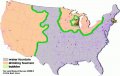
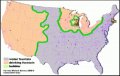
Salamander! I just googled and, in fact, Google does understand local dialects. I think most of the country that needs a Torpedo heater, calls them a torpedo heater. Now, I must search to see what small part of the map calls them Salamanders.
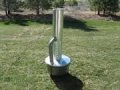
Back to the salamander... GT you don't live that far from me but, funny how things have different names. A salamander heater in this area is a "pot heater", a pot with a flue that burns the kero/fueloil fumes in the flue. No electric needed.
Like this one -
@Hypatia's Protege
I remember a couple of years ago somebody posted a, "voltage through the decades" chart. I think it was Gopher or Shortbus? The information is on this site...somewhere. My personal experience includes measuring 112 VAC in 1963 Indianapolis. Then a job designing power supplies in California (still before HP was born!) and I had to use 105VAC to 125VAC as the limits for my input voltage, so that suggests the standard was 115VAC at that time and place. Now, 2016 Florida, my actual voltage is 124.9 per phase. I had to install a Calrod heating element in my 1979 clothes dryer because the nichrome coils weren't designed for 250 VAC and the original heater elements burn out in about 3 weeks.
Edit: About 20 years ago the local utility company told me, "240 volts +/- 5%" so I wrote it in the circuit breaker box. 250 volts is within that range, but it seems as unexpected to me as it was unexpected by the clothes dryer! So, standards-schmandards. Reality intrudes.

 Facebook
 Google
 GitHub
 Linkedin





 -- What's all this talk of 220V service? -- In my experience, single phase residential service supplies 240V (120V each side of a center tap) whereas (low EMF) 3-Phase service supplies a line-to-line potential of Sin(120°)*240V=120*√3V