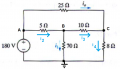
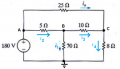
Need help with a Circuit Analysis problem

Thread Starter

waterboyjoshy

Joined Aug 11, 2017
4
Maybe you could also help me with this one?
As far as I can tell I can't use the same method to find Req.

I've written equations such as V5+V70 = 180, V5+V10=4*25 and i25+i5=iS
As far as I can tell I need to use simultaneous equations to find any variables.
However I can't seem to work out where to start in solving them.
I know (from the answers) the current at the 5 ohm resistor is 8A but can't understand how to get that value.

Can anyone point me where to start or is there an easier method for solving this?
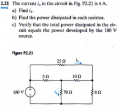


Untitled.png
 

WBahn

Joined Mar 31, 2012
32,829
MOD NOTE: Split from thread:

https://forum.allaboutcircuits.com/threads/complex-circuit-analysis.138874/#post-1165659

It is best to keep one problem per thread. Otherwise chaos will ensue as responses to the different problems get intermixed.

Also, the term "Complex Circuit Analysis" has a pretty specific meaning (but you aren't there yet and so wouldn't know about it). Pretty soon you will learn how to analyze non-DC circuits using complex numbers and that is what is almost always meant when talking about complex analysis.
 

WBahn

Joined Mar 31, 2012
32,829
Maybe you could also help me with this one?
As far as I can tell I can't use the same method to find Req.

I've written equations such as V5+V70 = 180, V5+V10=4*25 and i25+i5=iS
Both voltages and currents are signed quantities, which requires that you specify not only the magnitude, but the polarity.

Notice that the problem says that i0 is 4 A but the diagram shows that i0 is flowing left to right. You need BOTH of those pieces of information to know what the current in that branch is.

The best practice is to explicitly label all currents and voltages that you refer to in your work on the diagram, being sure to show the polarity.
 

WBahn

Joined Mar 31, 2012
32,829
Consider the following annotated diagram.
Edit_2017-08-11_1.png

Note the choice of the bottom node as the common reference node (usually called "ground", even though this is not the best name or symbol to use).

You are give that io = 4 A.

What is the voltage at Node A?

Given these two pieces of information, can you find the voltage at Node C?

If you know the voltage at Node C, can you find i4?

If you know i0 and i4, can you find i3?

Do you see how you can walk yourself around the circuit using what you already know in order to find one more piece of information that you didn't know?
 

LesJones

Joined Jan 8, 2017
4,511
Can you calculate the voltage at node C ? (You know the voltage at node A and you have been told the value of i0)
You can solve the problem without being given the value of i0. I did it using Thevenins theorem.

Les.
 

WBahn

Joined Mar 31, 2012
32,829
Can you calculate the voltage at node C ? (You know the voltage at node A and you have been told the value of i0)
You can solve the problem without being given the value of i0. I did it using Thevenins theorem.

Les.
Of course you can, but the TS isn't at that point yet. Considering the level of the problem and the approaches being used so far, it's unlikely that the TS has yet been introduced to Thevenin. The fact that the problem gives the value of i0 strongly suggests that they are just getting introduced to KVL/KCL applied to loops and branches.
 

Motanache

Joined Mar 2, 2015
652
imag1.png
We apply Kirchhoff laws
1. For current intensity
Since the intensity of the electric current is the same with the electric charge passing through the wire in unit of time --It's normal that the electric charge that goes into a junction is the same that out

Junction B
I2=I3+I1

Junction C
I3+I0=I4

Junction where is the symbol GND
I4+I1=I source(=Is)

For electrical voltages -Attention to the sign or at the sense of current through the resistor.
180V=5R*I2+70R*I1+r*Is .............r - If the source has internal resistance
https://en.wikipedia.org/wiki/Kirchhoff's_circuit_laws
10R*I3+8R*I4-70R*I1=0

24R*I0-10R*I3-5R*I2=0
 
Last edited:

Motanache

Joined Mar 2, 2015
652
b)Power dissipation = all power on the resistor is dissipated (transform in heat
P=U*I=U*U/R=I*I*R=...........
For example for the resistor 25ohm I0=4A. so P=4A*4A*25ohm=400W

c)Add the power dissipated on each resistor
Verify if I4+I1=I2+I0.
If 10A+2A =8A+4A is true
If they are not equal, the source has internal resistance and the answer to point c) is not, else is yes.

The source's internal resistance should appear in equation if it is different from 0.
 
Last edited:
Top