Need help understanding inductive Kick

nsaspook

Joined Aug 27, 2009
16,325
What is almost always ignored is that the current delivering the power of the spike, is greatly reduced by the resistance of the coil in the changing magnetic field.
Speaking of awkward phrasing, "current delivering the power", heavy sigh. ;)

A 1A electric current can support a greater or lesser electrical energy value, say 1 kW or 10 W, depending upon the value of the generated potential.
 
Last edited:

MisterBill2

Joined Jan 23, 2018
27,524
The simplest way to reduce the inductive impulse is to slow the rate of change of the current. This is sometimes achieved by having a capacitor across the device that interrupts the current. As the capacitor charges when the direct connection is opened, the current drops much more slowly than when contacts open "instantly", and so the rate of the magnetic field collapse is much less. That method was almost universally applied in vibrator high voltage supplies back in the days of vacuum tube mobile electronics. So there is a method that seems to be totally ignored by the majority these days.
 

crutschow

Joined Mar 14, 2008
38,508
So there is a method that seems to be totally ignored by the majority these days.
I see two possible reasons for that.
One is that it requires both a resistor and a capacitor to limit the turn-on current spike and minimize ringing of the the tank circuit formed by the capacitor and inductor.
The other is that you need to know the inductance of the device to properly size the capacitor for the desired voltage spike suppression, and that's not always available for common inductive devices like solenoids and relays.
 

nsaspook

Joined Aug 27, 2009
16,325
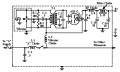
I don't see the method as being ignored, RC snubber devices are a popular product today to reduce inductive 'kicks' or other circuit effects from opening/closing 'connections'. The old vibrator arc damping buffer (inductive kick energy storage) cap was usually on the secondary side of the HV transformers circuit with usually resistors across the contacts, this made them a horrendous EMI/RFI generator under the right conditions.

https://www.radioremembered.org/vpwrsup.htm

1649961464202.png
Vibrator Hash - The making and breaking of current at the vibrator contacts are accompanied by sparking. The sparking decreases the life of the contacts and causes RF interference in the receiver. This interference is know as hash. Circuits must be provided for spark suppression and hash filtering.

C-3 in the diagram above is the buffer capacitor. It takes up the high-voltage surges that would otherwise result from the rapid magnetic changes taking place during the time the vibrator contacts are traveling between contacts. It also is effective in reducing sparking at the contacts. The capacitor and inductance of the transformer form an oscillating circuit, and for this reason it is important that this capacitor be replaced with one of the same value and voltage rating. Common values vary from .005 to .03 mfd.

Resistors R-1 and R-2 are connected across the vibrator contacts and are also effective in reducing sparking and hash. They form a discharge path for back electromotive force in the primary which would otherwise cause a heavier spark at the contact break. These resistors rarely give problems. Sometimes capacitors are used in place of the resistors.
https://worldradiohistory.com/Archi...s/Cornell-Dublier/Cornell-Dublier-1949-08.pdf
Another change shown in the circuit of Figure 8 is the moving of the Capacitor "C" from its former location across the primary terminals to a new location across the secondary terminals of the transformer.
...
The waveform resulting from the circuit shown in Figure 8 is illustrated in the accompanying graph. The vi- brator characteristics of frequency and time efficiency can be so matched to the transformer characteristics and the capacitance of "C" that the contacts open before the transformer core be- gins to saturate and close with the tuned -circuit oscillation voltage practically equal to the battery voltage. This circuit characteristic protects the vibrator contacts from excessive sparking and electrical wear.
 
Last edited:

MisterBill2

Joined Jan 23, 2018
27,524
A spike reduction capacitor does not need to be optomized to have an adequate effect. And there are enough low-Q coils that do not produce a lot of ringing, also. Besides that, a small amount of ring is usually not an issue. And the low capacitance devices do not cause problems when connected backwards, nor do they increase relay dropout times enough to matter.
 

crutschow

Joined Mar 14, 2008
38,508
A spike reduction capacitor does not need to be optomized to have an adequate effect.
Perhaps.
But you need know the inductance if you want to calculate a capacitor size that will keep the peak spike voltage below a given limit, such as a transistor driver would need.
 

k1ng 1337

Joined Sep 11, 2020
1,038
A spike reduction capacitor does not need to be optomized to have an adequate effect. And there are enough low-Q coils that do not produce a lot of ringing, also. Besides that, a small amount of ring is usually not an issue. And the low capacitance devices do not cause problems when connected backwards, nor do they increase relay dropout times enough to matter.
Any rules of thumb for spike reduction capacitors?
 

crutschow

Joined Mar 14, 2008
38,508
Any rules of thumb for spike reduction capacitors?
If you know the coils inductance than calculate its inductive stored energy using E=1/2 LI² where L is the inductance, I is the inductor current and E is the stored energy in Joules.
Then use the formula C= 2E/ V² to calculate the capacitor value for the maximum desired voltage spike that occurs when all the inductive energy has been transferred to the capacitor (the actual spike will be some less than this due to the coil resistance).
To reduce ringing, add a small resistor (e.g. 50-100Ω) in series with the capacitor.
 
Last edited:

MisterBill2

Joined Jan 23, 2018
27,524
It is also possible to use a lower speed transistor for switching. Slowing down from instant to fast is all it takes in many instances. Switching off in two milliseconds instead of two microseconds is a thousand times slower, So there is a 60 dB reduction in the impulse just from that.
 

nsaspook

Joined Aug 27, 2009
16,325
There is always a trade-off.
Some extra net power will be dissipated by the SS switch during the slow cross-over.
When the transistor is in the active resistive region during 'slow' switching, it's dissipating extra power.
 

crutschow

Joined Mar 14, 2008
38,508
It is also possible to use a lower speed transistor for switching. Slowing down from instant to fast is all it takes in many instances. Switching off in two milliseconds instead of two microseconds is a thousand times slower,
So would you do that by adding a capacitor between the transistor output and input?
 

vu2nan

Joined Sep 11, 2014
357
Need help understanding inductive kick
In simple terms....

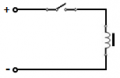
When the switch is closed, current flows through the inductor and energy is stored in the resulting magnetic field.

123.png

At the instant of switch opening, the magnetic field collapses and the induced high reverse voltage enables the energy to spark across the air gap back to its source.

The direction of applied and induced current is the same.

The behaviour would be the same irrespective of the location of the switch.

Nandu.
 
Last edited:

MisterBill2

Joined Jan 23, 2018
27,524
The voltage pulse is produced when the switch opens and current is interrupted. Because the opening of the switch produces a very rapid reduction in current, the change in voltage is quite large. The basic equation is: E= L dI/dt, where L=the inductance
and di/dt is the rate of change in the current.
The mechanism of the voltage generation is the collapsing of the magnetic field returning the energy to the circuit. So if the switch does somehow open "instantly", the di/dt term approaches infinity, which is a very large number, for practical purposes. So now you have the actual mechanism of the inductive voltage pulse described.

Note that I am using (a very large number) as an approximation for infinity, it is adequate for the explanation, but technically not correct. But for this application it is close enough.
 

shortbus

Joined Sep 30, 2009
10,050
That method was almost universally applied in vibrator high voltage supplies back in the days of vacuum tube mobile electronics.
I think your wrong about the vibrator producing the high voltage, that was done in the transformer the vibrator supplied. Vibrators only supplied pulsing DC so a step up transformer could work.
 

nsaspook

Joined Aug 27, 2009
16,325
I think your wrong about the vibrator producing the high voltage, that was done in the transformer the vibrator supplied. Vibrators only supplied pulsing DC so a step up transformer could work.
You would get a high value of EMF during switching on the DC primary side unless there was a method of storing or dissipating the energy from the collapsing magnetic field in the step up transformer. With the classic vibrator circuit this energy was usually stored (in the caps electric field) in the buffer capacitor on the secondary winding side (sometimes also on the primary) and supplied to the load instead of being dissipated in a snubber. The buffer resonates the transformer at approximately the frequency of the vibrator operation so it acts as a fly-wheel to store energy. This suppresses sparking at the contacts and reduces the idle load current.

http://messui.polygonal-moogle.com/valves/VR199905.pdf
In a no-load position, i.e., when the reed is oscillating between the contacts, the building up and collapsing of the magnetic field may in fact repeat itself and caused damped oscillations within the transformer. This can cause interference of its own accord, but more importantly, a situation can arise when a portion of the damped oscillation is opposite in polarity to the applied voltage when the contacts close, thus causing serious sparking, and greatly reducing the service life of the contacts. The situation can be corrected by placing the buffer capacitors in place as already described. The effect of these capacitors is to cause the transformer to resonate at the same frequency as the mechanical frequency of the vibrating reed. When properly adjusted, the induced. EMF has reversed in polarity again, and is approaching the terminal voltage of the battery when the points close. Variations in transformer characteristics, vibrator characteristics, primary and secondary voltages and loading can all affect the electrical resonance, and the values of buffer capacitors are best determined at the workbench with the aid of a CRO to study the waveforms. The unsuppressed spikes can reach quite high voltages, and ordinary paper capacitors are not recommended. Mica types of 1 nF or 2nF value and 1000V rating were preferred.
 
Last edited:

shortbus

Joined Sep 30, 2009
10,050
You would get a high value of EMF during switching on the DC primary side
I understand all of that, and not what I was talking about. He seemed to think a vibrator made the necessary high voltage internally. Or that's what I got from his post/answer.
 
Top