Need help understanding constant current circuit.

Jony130

Joined Feb 17, 2009
5,598
This is (currently) throwing a 404 Error.
Try Google " an-4137"
In this PDF show how you use TL431 + optocoupler in a SMPS feedback loop.
It works this way: when the output voltage is too low, the tl431 outputs a logic high and the led is off.
when the output voltage is too high, the comparators output is low, turning on the led, which typically controls the duty cycle thus reducing the output.
digital mode totally works here.
As several others have already commented, the use in the posted references with a KA431 shunt regulator are not using the optoisolator in a linear mode.
And I don't understand something. How can you say that TL431 + optocoupler in SMPS do not work in linear region ?
And this circuit is not a constant current source. Or maybe I misunderstood something
 

Jony130

Joined Feb 17, 2009
5,598
The feedback only depends on the emitter in the optocoupler being on or off.
It can't be true. How can diode in the optocoupler being on or off, if optocoupler IR diode is driven by a output voltage? Also SMPS controller change his duty cycle based on the voltage at the feedback input.
 

Wendy

Joined Mar 24, 2008
23,798
Hijacking a thread is not allowed. Peter has been given a one day cooling off period, if this thread still revolves around him I will move his posts to his own thread.
 

WBahn

Joined Mar 31, 2012
32,883
Sorry. It is linear. At least for the short time it transitions from off to on.
To say that something is linear means that one thing is directly proportional to another. What is it in this circuit that you are claiming is proportional to something else?

Sorry about the language.
Turrets. ?
Unlike Turrets, I hope you have the ability to choose NOT to hit Post. So just stop.
 

dl324

Joined Mar 30, 2015
18,339
It can't be true. How can diode in the optocoupler being on or off, if optocoupler IR diode is driven by a output voltage? Also SMPS controller change his duty cycle based on the voltage at the feedback input.
The first clue that the optocoupler wasn't being used in linear mode is that it's detector is a phototransistor. Any application using an optocoupler in it's linear mode would not use a phototransistor because the collector base junction is the detector and needs to be large with a high capacitance that will affect transistor switching speed due to Miller effect. Additionally, the collector current of the transistor flows through the detector which contributes to non-linearity. A photodiode+transistor is more appropriate for linear applications.
 

Thread Starter

dsharp02

Joined Aug 8, 2015
17
A stupid question is one not asked.

Where are you dsharp02, you started the thread.
I've been working on my day job.

Reading the responses, at times I feel more confused now than when I started. There are posts from people saying that there is very little math needed to analyze the circuit, followed immediately by posts that fill the screen with tons of equations. There are people arguing about whether someone did the calculations correctly. If very little math is needed to understand the circuit, then why are people arguing? How the heck is a newbie supposed to know who is right and who is wrong?

At this point I have just accepted that the voltage across R2 and Q2 is between 0.6 and 0.8 volts. I still don't fully understand why it must be so, but hopefully as I read, and re-read the posts, and the coverage of the circuit in "The Art of Electronics", I'll eventually come to an understanding.

Thanks.
 

WBahn

Joined Mar 31, 2012
32,883
I've been working on my day job.

Reading the responses, at times I feel more confused now than when I started. There are posts from people saying that there is very little math needed to analyze the circuit, followed immediately by posts that fill the screen with tons of equations. There are people arguing about whether someone did the calculations correctly. If very little math is needed to understand the circuit, then why are people arguing? How the heck is a newbie supposed to know who is right and who is wrong?

At this point I have just accepted that the voltage across R2 and Q2 is between 0.6 and 0.8 volts. I still don't fully understand why it must be so, but hopefully as I read, and re-read the posts, and the coverage of the circuit in "The Art of Electronics", I'll eventually come to an understanding.

Thanks.
Might I suggest that you go back and read my first couple posts (Posts #13 and #14) again in light of what you have learned in the meantime.

The reason that the voltage across R2 and the base-emitter junction of Q2 will be locked to about 0.6 V and 0.8 V (assuming the circuit is set up so that both transistors can remain in the active region -- that's important) is that a tiny increase in the current through R2 will result in a tiny increase in the voltage across R2 will the same a tiny increase in the Vbe of Q2. That tiny increase in Vbe of Q2 will result in a significant increase in the collector current in Q2 (changing Vbe by about 60 mV will result in a factor of ten increase in the collector current). That increase in collector current will result in a larger voltage drop across R1, which will result in the voltage on the base of Q1 dropping. That means that the Vbe voltage on Q1 will decrease, which will decrease the collector current, which in turn decreases the emitter current which results in the current through R2 dropping back down. The same process happens in reverse if the current in R2 were to decrease -- the same feedback path would result in a response that increases the base-emitter voltage on Q1 causing the current in R2 to increase.

As for why it's specifically between those two voltage ranges, that's due to the nature of silicon PN junctions used in practical semiconductors. The relationship between the voltage across the junction and the current through the junction is exponential. As mentioned above, for every 60 mV increase in voltage, you get a tenfold increase in current. So let's say that the range of collector currents in the transistors when it is to be considered "on" goes from 1 uA to 1 A. That's six orders of magnitude, but it corresponds to a difference in Vbe of only 360 mV. In practice, you are probably talking more about a range from somewhere around 10 uA to 100 mA, which is four orders of magnitude and corresponds to a range of Vbe that spans about 240 mV. As for why that 240 mV is centered somewhere in the vicinity of 0.7 V and not 0.2 V or 1.9 V, that has to do with sizing the P-N junction so that it has a desirable current density and doing that parks the normal operating range in that 0.7 V arena.

As for the screens of equations and the people arguing about what was done right or wrong -- welcome to an Internet forum. You have people here who are very experienced and skilled, you have people here that have a rough grasp of many, but not all, of the relevant issues, you have people that are at about your level of comprehension, and you have people that have far less than that. More to the point, you have people in each group (but particularly the middle two) that know far less than they think they know yet are very confident that they know everything about it -- there's even a name for it: the sophomore syndrome (sophos and moros -- sophisticated moron). Most people that gain any level of competence in any area go through that phase when they have learned enough to think they know everything but have not yet learned that what they don't yet know is far more voluminous. So they tend to speak very forcefully about things at levels that far exceed their true level of ability. It's human nature and it has free-reign in an open forum like this. So YOU have to decide for yourself who to pay attention to closely, who to read with a grain of salt, and who to completely ignore. This thread has contributions from people in all three camps.
 

dl324

Joined Mar 30, 2015
18,339
There are posts from people saying that there is very little math needed to analyze the circuit, followed immediately by posts that fill the screen with tons of equations.
There are a lot of equations that describe the circuit you posted, but there are only a few that are significant for determining the effect of varying R1 and R2.
There are people arguing about whether someone did the calculations correctly.
This is a peer reviewed forum. If someone thinks something is incorrect, they're free to post their correction; even if it's actually wrong or complicates the discussion unnecessarily.
If very little math is needed to understand the circuit, then why are people arguing? How the heck is a newbie supposed to know who is right and who is wrong?
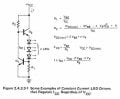
Below is a circuit from HP's Optoelectronics Applications Manual that is very similar to yours; just rearrange the LEDs and change component designators. Being in a manual doesn't mean it's correct, but if you study the equations you'll see they're correct.
ledConstCurrentSource.jpg
As with most things in life, you need to filter information with your knowledge and experience to decide what you want to believe.
At this point I have just accepted that the voltage across R2 and Q2 is between 0.6 and 0.8 volts.
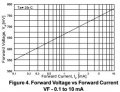
The voltage across R2 is the base-emitter voltage of Q2. The forward voltage characteristics of the BE junction will be similar to those of a silicon diode. Below is a graph of forward voltage vs current for an MMBD1501 silicon signal diode. From 0.1mA to 10mA, forward voltage varies from 0.55V to 0.78V.
diodeVoltage0v1-10mA.jpg

It has already been mentioned that small changes in LED current will result in brightness changes that will be unnoticeable.
 

dannyf

Joined Sep 13, 2015
2,197
How the heck is a newbie supposed to know who is right and who is wrong?
By studying hard.

You are essentially asking that others guarantee that whatever they say is truth. Given that you are receiving such advises free of charge, that's probably quite difficult a demand to be satisfied.
 

Thread Starter

dsharp02

Joined Aug 8, 2015
17
By studying hard.

You are essentially asking that others guarantee that whatever they say is truth. Given that you are receiving such advises free of charge, that's probably quite difficult a demand to be satisfied.
I'm not sure how you leaped from me asking how I can distinguish between those who know and those who only think they know, to me asking for guarantees from people who post. I'm aware that people can be wrong. For a circuit that was described multiple times as extremely simple, requiring very little math to analyze, it's kind of shocking the amount of discussion that was generated.

It's kind of like a newbie programmer asking about recursion (a well-settled subject in software development), and getting a hundred contradictory answers. Recursion is not a ground-breaking development in software engineering, so I would not expect there a huge amount of discussion.

In any case, I wasn't trying to be accusatory toward anyone, I was just making an observation about the state of the thread and how it's a bit bewildering to see so much discussion over what I had (perhaps incorrectly) assumed to be a well-settled subject.

Thanks
Dave
 

dannyf

Joined Sep 13, 2015
2,197
assumed to be a well-settled subject.
Just because something is well settled doesn't mean every person understands its correctly, or comprehends it the same. Different people have different levels of comprehension and different ways of comprehending the same thing, not necessarily incorrectly.

You have to understand that end of the day, free advises are free for a reason. You have to separate the falsehood from the truth. Others can help you (or hinder you in the process of trying to help you) but it is up to you to learn to figure out which is false and which isn't.
 
Top