Now consider this method:
We know that Width = Height because the end not involving Length is square -- hence we’ll express the dimension of said end merely as “W”:
Thus: Equation 1) L=2W --- As per stipulation: ”length twice the side of its square end”
--AND-- Equation 2)2W+L=72 -- As per stipulation: “W+H+L” = 72 Inches
Thus we have: 2W+2W=72 --- Via substitution of L (in Eq 2) with the 'right side' of Eq 1
Hence: W=18
H=18
L=36
Note: Later on in your studies we’ll explore more sophisticated methods of solving such ‘simultaneous equations’ (which being especially useful where multiple ‘unknowns’ are at issue -- For now please consider this approach -- It'll make life much easier!
I ask you to please seriously consider the technique illustrated in post #342! --- It will save a good deal of time and annoyance as well as get you "on track" for higher mathematics...
A bottle and a cork sell for $1.10 together. The bottle, however, costs at least a dollar more than the cork. What is the possible price range of each item if purchased separately?
A bottle and a cork sell for $1.10 together. The bottle, however, costs at least a dollar more than the cork. What is the possible price range of each item if purchased separately?
A bottle and a cork sell for $1.10 together. The bottle, however, costs at least a dollar more than the cork. What is the possible price range of each item if purchased separately?
i dnt know how to solve...sorry
I do not expect your skills to include manipulation of inequalities yet -- Howbeit, in this case, merely formulating the problem as such will render the solution obvious
HINT:
Write an equation consistent with this stipulation: A bottle and a cork sell for $1.10 together...
Write an inequality consistent with this stipulation: The bottle, however, costs at least a dollar more than the cork...
A bottle and a cork sell for $1.10 together. The bottle, however, costs at least a dollar more than the cork. What is the possible price range of each item if purchased separately?
One way to deal with inequalities is to pretend it is an equality and solve it as such. Then, with that solution in hand, ask whether values above the solution are still solutions or whether values below the solution are still solutions. It's not as elegant or as rigorous as working with the inequalities directly, but it can help you make the transition from working with one to working with the other.
---Edit @ 18:47 (UTC - 6:00) 10 Dec 2015 --- All typos 'eradicated'!---
As I understand post #357 you want a more 'interesting' exercise? -- Inasmuch you did well yesterday - I offer this fun exercise -- As incentive I will grant you 10 "likes" if you solve it!
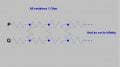
What is the resistance apparent 'across' Nodes P and Q for the network pictured below? Note: Please do not resort to analysis! -- Perhaps counterintuitively, this exercise is readily solved via purely algebraic techniques! I promise!!!
Hint 1: Note that the resistance of the semi-infinite 'section' is not altered via removal of preceding 'stages'... Hint 2: Hint #1 is very important! -- Please consider it!
Hint 3: This is actually a very simple problem! -- Don't be distracted by 'infinity'...
You probably already know this -- however for completeness sake:
Resistors in series: Reffective = The sum of resistances (i.e. Reffective = R1+R2+R3...)
Resistors in parallel Reffective = The reciprocal of the sum of the reciprocals of the resistances (i.e. Reffective = (1/R1+1/R2+1/R3...)^-1
Again, do not use analysis (i.e. Calculus, etc)!!! -- Doing so will disqualify your answer!
OBTW Don't bother searching the web for the 'answer' - most sites offer incorrect solutions!
As HP says, the solution to this problem is trivially simple -- and profoundly important in many fields of study (think RF engineering and transmission lines).
Before attempting the solution, however, bound the results by asking yourself what the absolute smallest value the total resistance could possibly be and also what is the absolute largest value the total resistance could possibly be. Then you know that the actual answer has to be between those two limits.

 Facebook
 Google
 GitHub
 Linkedin