Need help in Aptitude Question

Hello,
Yesterday, i was at home.
as R is 1 ohm.
so, P & Q as you said Hint 1: Note that the resistance of the semi-infinite 'section' is not altered via removal of preceding 'stages'
it should 3 ohm
1+1+1=3
That is indeed the resistance of a single 'stage' just as two 'stages' have a resistance = 2.75Ω and three stages a resistance = 2.6Ω, etc... But the point is that the semi-infinite network remains infinite in extent (towards the 'right') hence its resistance is not changed via 'removal' of any number of 'stages' from the left -- as I said, that first hint is 'huge':):):)

PS --- Thanks for returning!:)
 
Last edited:

Thread Starter

RRITESH KAKKAR

Joined Jun 29, 2010
2,829
That is indeed the resistance of a single 'stage' just as two 'stages' have a resistance = 2.75Ω and three stages = 2.6Ω, etc... But the point is that the semi-infinite network is remains infinite (towards the 'right') hence its resistance is not changed via 'removal' of any number of 'stages' from the left as I said that first hint is 'huge':):):)
Sorry i don't get it.
 

WBahn

Joined Mar 31, 2012
32,852
then,
1+1.3+1=3.3
So putting a 3 Ω resistor in parallel with a 1 Ω resistor would yield a 1.3 Ω resistor?

Please show your calculations.

Any time two resistors are placed in parallel, the combined resistance must be less than the smaller of the two (it must also be less than half of larger of the two).

That, in and of itself, is a good problem for you. So to state it formally:

The equivalent resistance, Req, of two resistors R1 and R2, placed in parallel is given by

\(
R_{eq} \: = \: \frac{R_1 \cdot R_2}{R_1 \: + \: R_2}
\)

Show that, if R1 ≤ R2, then

Req ≤ R1

and that

Req ≤ R2/2
 

WBahn

Joined Mar 31, 2012
32,852
what is PS
It's stands for "post script", a reference to a note added to a letter after it has been signed (think back to the days before word processors when letters were hand-written or, at best, hand typed). The "post" means "after" and the "script" refers to the handwritten signature. Or, an equivalent view, is that it literally means "script (i.e., writing) that comes after." If you closed a letter and signed it and then wanted to add something to it, you wrote "PS" before additional material. If that happened again, you wrote "PPS" for "post post-script".
 

WBahn

Joined Mar 31, 2012
32,852
Sorry i don't get it.
I figured this would be a point of confusion. Perhaps this will help:

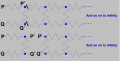
R_ladder.png

Take the original circuit and name nodes P' and Q' and then break the circuit into two portions at the black hash marks. This gives you the two circuits directly below it.

The key is to recognize that the resistance between P' and Q' must be the same as between P and Q. Do you see that this must be the case and why?
 

WBahn

Joined Mar 31, 2012
32,852
So putting a 3 Ω resistor in parallel with a 1 Ω resistor
R1=3 ohm
R2=1 ohm
Req=R1xR2/R1+R2
Req= 3/4=.75ohm
Yes. So that is the equivalent resistance of the middle 1 Ω and the everything to the right of it (assuming your answer of 3 Ω total was correct). So what would that give you for the total resistance of the whole thing?
 

WBahn

Joined Mar 31, 2012
32,852
That is indeed the resistance of a single 'stage' just as two 'stages' have a resistance = 2.75Ω and three stages a resistance = 2.6Ω, etc.
PQ = 1+.75+1=2.75


Yes!

But now you need to ask the "does it make sense" question.

IF the resistance between PQ is 3 Ω, then if follows that the resistance between PQ is 2.75 Ω.

What does this conclusion tell you about the claim that the resistance between PQ is 3 Ω?
 
Top