need help get rid of main hum

Thread Starter

bug13

Joined Feb 13, 2012
2,002
Hi guys

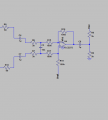
I got this circuit here, it work great if I power the circuit with a 9V battery, but I got main hum if I power it with 12V switch mode power supply. I have a voltage regulator to regulate to voltage to 5V in both case. The balance signal is transmit through a 20m cat6 cable.

I am using ZSR500 5V regulator, with 1u and 100n cap as close to the input and output.

How can I get rid off the main hum??

Thanks guys!
Capture.PNG
 

AnalogKid

Joined Aug 1, 2013
12,164
Most switching power supplies require a minimum load to regulate well, and you circuit might not be enough. This can cause excessive noise and power-line artifacts on the supply output. Note that with an input stage gain of over 42 dB, it will not take much hum on the power rail to appear at the output.

Also, at 3 kHz the chip has less than 20 dB of negative feedback, making the circuit much more susceptible to external noise sources. At 20 kHz the chip has only 40 dB of forward gain, so the circuit is running with no negative feedback at all at the higher audio frequencies.

ak
 

#12

Joined Nov 30, 2010
18,224
With that much gain, you better start with a metal box for it. And AK is right. You ran out of gain-bandwidth product. Looks like you need two stages of amplifier.
 

Thread Starter

bug13

Joined Feb 13, 2012
2,002
Also, at 3 kHz the chip has less than 20 dB of negative feedback, making the circuit much more susceptible to external noise sources. At 20 kHz the chip has only 40 dB of forward gain, so the circuit is running with no negative feedback at all at the higher audio frequencies.
ak
It looks like I don't understand this part of a opamp well enough, can you point me to some reading material, or some keywords that I can google and learn more about this. Thanks.
 

Thread Starter

bug13

Joined Feb 13, 2012
2,002
Low Pass Filter?
There
What is the rest of the circuit, and what is the overall circuit function?

ak
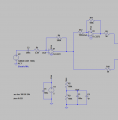
Note: this part is powered by a separated switch mode power supply.

Test with good sound: Tx power with 9V battery, Rx power by a separated 12V switch mode power supply.

Test with hum: Tx power with 12V switch mode, Rx power by separated 12V switch mode power supply

Capture.PNG
 

MrAl

Joined Jun 17, 2014
13,720
Hi guys

I got this circuit here, it work great if I power the circuit with a 9V battery, but I got main hum if I power it with 12V switch mode power supply. I have a voltage regulator to regulate to voltage to 5V in both case. The balance signal is transmit through a 20m cat6 cable.

I am using ZSR500 5V regulator, with 1u and 100n cap as close to the input and output.

How can I get rid off the main hum??

Thanks guys!

View attachment 107157
Hello there,

When you say "main hum" do you mean the hum from the 'mains' power in your home or office, like 50Hz or 60Hz hum that is often a problem in audio circuits?

If so then you might look up ways to do this in tube amplifiers, which used to use a potentiometer to inject part of the mains line voltage into the audio circuit (a very small part of course). I dont remember it well enough to post a schematic though. The 'mains' line voltage however does not come from the mains itself, but from a transformer secondary, which in the old days they used one of the filament heater transformers that were already present for the tubes.

Alternately, a band stop filter, also called a 'notch' filter, works very well sometimes. I once made a 60Hz version that took out most of the 60Hz hum in my circuit, and it was a passive notch filter no op amps, called a "Twin Tee" notch filter.

If the 'hum' is from the power supply though, then you need to filter the power supply better, probably with one small inductor and at least one nice size filter cap.
 

Sensacell

Joined Jun 19, 2012
3,786
It sounds like your differential amp has poor CMRR. (common mode rejection ratio)

The ability to reject common-mode voltages (hum, typically) requires a high CMRR differential amp.

An alternate concept would be a simple audio transformer, these have great CMRR.
 

Thread Starter

bug13

Joined Feb 13, 2012
2,002
When power with a 12V switch mode power supply:
From my scope, there are spikes at the output of R10, while it's reasonably clean at the output of R5. And those noise are in sync with the spike from the power supply.

When power with 9V battery:
Output of R5 and R10 is reasonably clean.

So I guess I need to filter the power supply.

Then I tried add 100uH inductor in series and 220u, 100n, 10n, 100p in parallel, spike are reduced (as see in a scope), but hum/noise is still very lound (same as no filter before)

NOTE:
also tried multi stage gain, noise still there.
 

Sensacell

Joined Jun 19, 2012
3,786
Try connecting the battery AND the Ground from the AC power supply. (leave the + unconnected)
Power from battery, but still grounded to the same way.

That will tell you what's up
 

Thread Starter

bug13

Joined Feb 13, 2012
2,002
Try connecting the battery AND the Ground from the AC power supply. (leave the + unconnected)
Power from battery, but still grounded to the same way.

That will tell you what's up
I am home now so I can't test it. What does it tell me if I only connect the AC power supply ground, and it produce noise?
 

merts

Joined Apr 1, 2016
8
Essentially you have a mic. amplifier which is prone to noise.
Shield the amp.in a metal case after filtering as suggested.
Position your supply as far as possible away from the amp.
This will prevent the transformer from inducing any hum into the circuit.
Good luck.
 

ian field

Joined Oct 27, 2012
6,536
With that much gain, you better start with a metal box for it. And AK is right. You ran out of gain-bandwidth product. Looks like you need two stages of amplifier.
According to the TS's schematic; the electret mic has no supply - might not need so much gain if it had.
 

AnalogKid

Joined Aug 1, 2013
12,164
Since both inputs to U4 are derived from a single point (the output of U1), I see no reason for a fully differential amplifier there. All of the signal damage already has been done. If you want to use a differential amplifier to improve signal quality, it has to be at U1.

And, from post #7, what is the overall circuit function?

ak
 

Thread Starter

bug13

Joined Feb 13, 2012
2,002
Tells you that it's common mode ground noise, not noise on the power supply.
Cool thanks for replying and I will test it next week.

Essentially you have a mic. amplifier which is prone to noise.
Shield the amp.in a metal case after filtering as suggested.
Position your supply as far as possible away from the amp.
This will prevent the transformer from inducing any hum into the circuit.
Good luck.
Not that I don't want to shield the amp, but I shielding it might be very difficult in my case, but I will discuss with others and look into the possibility of doing it. Or at least try it out in a metal box next week. Thanks for your input.

According to the TS's schematic; the electret mic has no supply - might not need so much gain if it had.
The electret mic has a 5V regulated supply through 2 1k resistors, 100n and 1u decoupling cap between two 1k resistor. Sorry I didn't draw in my circuit(hense the confusion), instead I just use an voltage source to simulate the mic.

Since both inputs to U4 are derived from a single point (the output of U1), I see no reason for a fully differential amplifier there. All of the signal damage already has been done. If you want to use a differential amplifier to improve signal quality, it has to be at U1.

And, from post #7, what is the overall circuit function?

ak
I am not sure how to get an differential signal out from a electric mic, that's why I start with something I can understand.

I started as single ended signal, it work well if I use a separated twisted pairs. But we want to carry all the signal in a cat6 cable. Along with my audio signal, the cat6 also carry two digital line, 12V power, and another two analog signal. And it picked a lot of noise from the two digital line and two analog lines.

That's why I move to a differential pairs. My differential Rx can reject all the common mode noise from the other 6 wires in my cat6, only if I power my mic preamp from a 9v batter.

And we don't want to power our preamp with 9v battery permenantly, that's why I I tested it with 12V plug pack, that leads to the noise problem from my 12 plug pack.

It's the same project I have been working on (I already have two posts asking about how to select electric mic, and switching between electric mic with relays, which you and others have already helped). The requirements has changed, now we want to be able to run the mic up to 20meters (was 5-10m) with a cat6.

We have a VoIP module, we want to make an adaptor/add on board, which can provide up to 6 sets of mic, speaker and other control signals. A user at the far can can control which mic and speaker can be active. And only one set of mic and speaker can be active at one time.

I may have a lot of assumptions here, so if anything is not clear, feel free to ask.

Thanks.
 

AnalogKid

Joined Aug 1, 2013
12,164
My differential Rx can reject all the common mode noise from the other 6 wires in my cat6, only if I power my mic preamp from a 9v battery.
Only if it is the first thing in the door. Your pseudo-differential signal, made by inverting the single-ended mic signal, inverts both the audio and the noise, so there is no cancellation in the diff amp stage.

For a 2-pin electret microphone element, consider this: +5V > 1K > mic + terminal > mic - terminal > 1K > GND. The mic element is terminated in 2K, a very common value, and the 2 terminals have a true differential signal (plus some DC). This can drive the diff amp stage U4 directly:
Delete R5, R6, R7, R8, C3. Keep C4, C7. Change R15 and $17 to 10K. This gets you differential cancellation and some gain.
Output drives a single resistor-capacitor 2.6 kHz lowpass filter, replacing the effect of R5-R8 and C3.
Next comes re-using U1 as a single-ended, non-inverting stage. This makes up the rest of your gain. Sharing the system gain across two opamps will greatly improve bandwidth, so you don't run out of gain-bandwidth product.

ak
 
Top