Need advice on audio mixer/volume control

Thread Starter

ElectricSpidey

Joined Dec 2, 2017
3,336
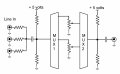
I'm looking at the 4066 data sheet, it also does not allow voltages below VSS.

From the data sheet I have.

"The signals via the switch can be either digital or analog, may
never exceed the voltage on pin 14 or lower the voltage from
pin 7." (yes it has a typo)
 

Thread Starter

ElectricSpidey

Joined Dec 2, 2017
3,336
So I need to look into a digital pot, or mechanical relays, or offsetting that signal...sheesh

Well, that is why I came here.

Thanks for all of the info so far...I need something to eat...I feel low sugar coming on.
 

Thread Starter

ElectricSpidey

Joined Dec 2, 2017
3,336
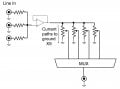
I first thought about using a single MUX, but the disconnected ones are going to interact with the others because of the grounds.

And setting up as VRs instead of dividers is not going to work.
 

Audioguru again

Joined Oct 21, 2019
6,826
A series coupling capacitor passes the audio signal but blocks any DC on it. Then two resistors can bias the DC on the signal to the voltage range of the MUX.
 

Thread Starter

ElectricSpidey

Joined Dec 2, 2017
3,336
So, I'm probably going to use relays instead of the MUXs, there won't be any problem because the source is not present during switching.

So can somebody please answer questions 2 thru 4 in the OP.

Thanks
 
Last edited:

AnalogKid

Joined Aug 1, 2013
12,155
2. What are the resistance values needed?
3. Wattage ratings of the pots?
4. Do I need to enclose and shield?
4. Yes and yes.

3. Just about anything. 1 Vrms audio across a 10 K pot is 100 uW of power dissipation.

2. With a summing gain/buffer circuit, 10K to 50K should work well. Nine 10 K pots in parallel equals 1.1 K, something most opamps can drive. Some purists might think that too low, and want something like 20 K as a minimum value. Fine.

Without a buffer, the three-resistor summing network is now loaded by the 9 pots in parallel. Without the pots, each audio source will see a load of 1.5 times the summing resistor value. Again, for folks who thing an opamp never should be loaded by fewer than 2 K ohms, the summing resistors are in the 3 K to 10 K range. For 10 K summers, the output node is at 3.3 K. Ten times that (for minimal loading) makes for a minimum pot value of 30 K. That's not a very common value, so I'd bump it up to 50 K.

ak
 

AnalogKid

Joined Aug 1, 2013
12,155
Nine paths to ground thru the disconnected pots = way too much signal loss. (IMHO)
Nope. The whole idea of the buffer amp is that its output capabilities exceed whatever the pots bring to the party. Think of the buffer as a 1 volt signal coming through a 1 ohm resistor. Now calculate the *change* in voltage drop with 1 pot connected to GND and with 9 pots connected in parallel. That is a very small number.

ak
 

Thread Starter

ElectricSpidey

Joined Dec 2, 2017
3,336
Yea, when I originally planed on only one MUX the buffer wasn't part of the deal. (and still isn't really)

So, thanks everyone for the information...appreciate it.
 

AnalogKid

Joined Aug 1, 2013
12,155
With no buffer circuit ...

If you scale the pot value such that it is greater than 10 times the Thevenin impedance of the summing node, the signal loss for 9 pots in parallel will be less than 1 dB. The math is that of a 2-resistor voltage divider.

ak
 

KeithWalker

Joined Jul 10, 2017
3,608
As I mentioned in post #11: It would be much simpler if you use one digital potentiometer, and set that with your digital input, rather than 9 physical pots.
dIG.jpg
 

Thread Starter

ElectricSpidey

Joined Dec 2, 2017
3,336
Thanks for the tip Keith, but after you mentioned digital pots in your first post I had a look into them.

I think I could probably figure out how to use one with the PSoC, but I'm pretty much locked into using 4 bit binary for this project.

I will be using the first 9 channels for volume control and the rest to control a sound chip. (switching channels for 200mS from the volume control to selecting inputs on the sound board, then back to volume control, this will work ok because no sound will be playing during the switching)

But, thanks anyway, it certainly is a good idea.

I'm going to be updating my original idea and posting something a little later.
 

Thread Starter

ElectricSpidey

Joined Dec 2, 2017
3,336
@crutschow

So ignoring the possibility of doing this in a better way (buffer, single MUX, digi pot etc.) will this do the trick?

A_MUX_4.jpg

I added the voltage divider and caps to the input and output as this is the way it's done with most of the digital volume controls using the 4067 I have seen on the net.
 

Thread Starter

ElectricSpidey

Joined Dec 2, 2017
3,336
@KeithWalker

I was looking at the DS1669 Digi pot, there is some promise there, I do have "one" GPIO pin open in this design, and control looks brain dead simple using some loops, but of course the chip is obsolete.
 

KeithWalker

Joined Jul 10, 2017
3,608
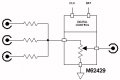
Have a look at the M62429P. It's a dual control; for stereo but you can use just one channel if you want. It is really simple to program with a serial input and clock. I have used this one very successfully. Just make sure that your audio signal stays between 0 and 5VDC or it will be clipped. Use a coupling capacitor on it's input to do that.
 

Thread Starter

ElectricSpidey

Joined Dec 2, 2017
3,336
@KeithWalker Interesting.

So after having a better look at the amp I will be using, I see it actually has built in digital volume control over I2C.

So I'm thinking about using another PSoC to decode the 4 bit binary and convert to 9 of the 64 volume levels over I2C which this platform has implemented in hardware.

But, of course I haven't got a clue how to use I2C...:(

I'll have to look into serial data transfer using the PSoC or C++ code.

Thanks again for the tip.
 
Top