Looking for a schematic of a led chaser circuit.

Thread Starter

Icanmakeit67

Joined Sep 23, 2018
216
Been looking for a schematic of a led chaser circuit. I only need the first 4 outputs of a 4017 IC but I want outputs to stack on. 1 on, 1&2 on, 1,2 &3 on,1 2 3 & 4 on then all off. Then atart again.
5 volts powered. Loads are 4 2n2222 transistors each running a dozen or so LEDs.
I can make the. Chaser with a 555 timer but I have tried many signal diode combinations that don’t give me the. Pattern.
please help
please, any help is appreciated
 

WBahn

Joined Mar 31, 2012
32,917
This simplest way to do this is with a cheap 8-pin MCU. The program would be pretty trivial. But, unless you already have the programming hardware and software tools, the up front investment in time (modest) and money (very little) might not be worth it if you have no interest in doing other projects.

The most obvious way to do it with a 4017 (to me, I've never actually had occasion to use the 4017, so there might be a trick someone else can point to) is to use a wired-OR configuration. Connect the first output to the base of each transistor using a separate resistor. Do the same for the second input, but only to the last three. So on for the remaining two. The use the sixth output to reset the chip (the fifth output, which is connected to nothing, gives you the one period with all of the LEDs off).

Are you really set on using the 4017? There are bar graph driver ICs, such as the LM3914, that might be simpler and quicker to use.
 

SamR

Joined Mar 19, 2019
5,494
Try searching images for LED Chaser Circuits/Schematics. I agree with Bahn, the most elegant way is with programming an ATTiny to do it (good learning experience) but the 4017 is a possibility.
 
Did you need "off" between the sequence?

You could do something with a LM3914 in bar mode and the voltage from the ramp of a 555 timing cap to drive the input, then using the "fifth" output to reset the 555.
 
I only need the first 4 outputs of a 4017 IC but I want outputs to stack on. 1 on, 1&2 on, 1,2 &3 on,1 2 3 & 4 on then all off. Then atart again.
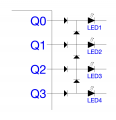
Here's a basic direction for lighting LED 1, LED 1 & 2, LED 1, 2 & 3, LED 1, 2, 3 & 4. Since you wish to run more than one LED, such as a string of 12 per output, substitute the LED's pictured below with transistors.
Screenshot 2026-06-18 at 8.06.39 AM.png
When Q0 is active only LED1 will light. When Q1 is active LED's 1 & 2. Q2 - LED's 1, 2 & 3. Q3 - LED's 1, 2, 3 & 4. Use Q4 to reset the counter.

edit: You may want to use Q5 for a very brief period where NO LED's are lit. For a longer delay; Q6 or 7 or 8 or even 9. For the longest period between starts don't use any reset signals. And use of transistors is highly recommended. A CD4017 can't provide enough current for more than one LED at a time.
 
Last edited:

Thread Starter

Icanmakeit67

Joined Sep 23, 2018
216
Here's a basic direction for lighting LED 1, LED 1 & 2, LED 1, 2 & 3, LED 1, 2, 3 & 4. Since you wish to run more than one LED, such as a string of 12 per output, substitute the LED's pictured below with transistors.
View attachment 368502
When Q0 is active only LED1 will light. When Q1 is active LED's 1 & 2. Q2 - LED's 1, 2 & 3. Q3 - LED's 1, 2, 3 & 4. Use Q4 to reset the counter.

edit: You may want to use Q5 for a very brief period where NO LED's are lit. For a longer delay; Q6 or 7 or 8 or even 9. For the longest period between starts don't use any reset signals. And use of transistors is highly recommended. A CD4017 can't provide enough current for more than one LED at a time.
This is very helpful. I have wanted to do a stack type chase to look like filling up whatever then a dump or empty with a loop situation.
THANKS
 

WBahn

Joined Mar 31, 2012
32,917
Here's a basic direction for lighting LED 1, LED 1 & 2, LED 1, 2 & 3, LED 1, 2, 3 & 4. Since you wish to run more than one LED, such as a string of 12 per output, substitute the LED's pictured below with transistors.
View attachment 368502
When Q0 is active only LED1 will light. When Q1 is active LED's 1 & 2. Q2 - LED's 1, 2 & 3. Q3 - LED's 1, 2, 3 & 4. Use Q4 to reset the counter.

edit: You may want to use Q5 for a very brief period where NO LED's are lit. For a longer delay; Q6 or 7 or 8 or even 9. For the longest period between starts don't use any reset signals. And use of transistors is highly recommended. A CD4017 can't provide enough current for more than one LED at a time.
The problem with the approach, as shown (and I'm assuming that you have current limiting resistors to the right of each LED is that the voltage drop across the diodes changes as different pins dominate. For instance, when Q1 is driving LED1, you have only one diode drop, but when Q3 is driving it, you have four diode drops. That's an additional 2+ V that is not being dropped across the current limiting resistor, which will reduce the LED current. Depending on the voltage that the system is running at, that could have a significant impact on the LED current.

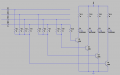
If you use switching transistors, you still need current limiting resistors in the bases, so you would have seven diodes and four resistors (eleven components) in your switching logic before the transistors. Using the approach I recommended in the first response, you need ten resistors and four diodes (to suppress voltage-divider interaction between the output. Using bussed resistor arrays, you would only need eight components (four diodes, three bussed SIP arrays and a single resistor), making the interconnect extremely easy.

1781814439863.png
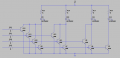
Another alternative, since switching transistors already need to be used, is to use them to also implement the wired-OR logic directly at the LEDs.

1781815590830.png

This requires more transistors, but is simpler overall, especially if not using resistor arrays in the prior approach.
 

AnalogKid

Joined Aug 1, 2013
12,155
Why can't it be done with a 4017?
It can, but it takes a bunch of parts to sum the outputs. See post #7 and post #11.

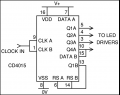
Better to go with either an 8-bit SIPO (serial-in, parallel-out) shift register or a dual 4-bit shift register. Either way, you need 4 output states plus one reset state. As with the 4017, the (n+1)th state resets the part. Because the CD4015 has a true zero output state where all of the outputs are low (unlike the 4017), you don't need a fifth output state for the all-LEDs-off state. Once both shifters are reset, they sit there for almost all of one clock cycle. Posts #4 and #10.

Fun Fact: Internally, the 4017 is in fact a shift register with a bunch of gates to decode the outputs. For this application, you have to add the equivalent of a bunch of external gates to re-encode the outputs back into the shift pattern. It is the wrong part for the job.

ak
 
Last edited:
To the TS;
As you can see there are many ways to achieve your goal with discrete logic. Analog circuits also. Each will have its advantages or disadvantages.
You decide which approach is best for you.
 

WBahn

Joined Mar 31, 2012
32,917
It can, but it takes a bunch of parts to sum the outputs. See post #7 and post #11.

Better to go with either an 8-bit SIPO (serial-in, parallel-out) shift register or a dual 4-bit shift register. Either way, you need 4 output states plus one reset state. As with the 4017, the (n+1)th state resets the part. Because the CD4015 has a true zero output state where all of the outputs are low (unlike the 4017), you don't need a fifth output state for the all-LEDs-off state. Once both shifters are reset, they sit there for almost all of one clock cycle. Posts #4 and #10.

Fun Fact: Internally, the 4017 is in fact a shift register with a bunch of gates to decode the outputs. For this application, you have to add the equivalent of a bunch of external gates to re-encode the outputs back into the shift pattern. It is the wrong part for the job.

ak
I agree it's not the best part, hence why I proposed two alternatives in Post #2 and specifically asked if the TS was set on using a 4017.
 
The scheme shown in post #7 will work, HOWEVER, you will need to use driver transistors like shown in post #11. Probably the driver transistors will need to be darlington types, possibly MPSA13's I think.
It can, but it takes a bunch of parts to sum the outputs. See post #7 and post #11.

Better to go with either an 8-bit SIPO (serial-in, parallel-out) shift register or a dual 4-bit shift register. Either way, you need 4 output states plus one reset state. As with the 4017, the (n+1)th state resets the part. Because the CD4015 has a true zero output state where all of the outputs are low (unlike the 4017), you don't need a fifth output state for the all-LEDs-off state. Once both shifters are reset, they sit there for almost all of one clock cycle. Posts #4 and #10.

Fun Fact: Internally, the 4017 is in fact a shift register with a bunch of gates to decode the outputs. For this application, you have to add the equivalent of a bunch of external gates to re-encode the outputs back into the shift pattern. It is the wrong part for the job.

ak
It CAN be done with a CD4018, up to 5 LEDs, because that device has count outputs thyat stay high. It is much less common, but the very simplest scheme. You will need to look in your data book. You will need driver transistors, just like for the 4017.
An IC data book is a very good asset for finding ways to achieve the less common functions. The books from the manufacturers were the very best resource in that regard.
 

AnalogKid

Joined Aug 1, 2013
12,155
As you can see there are many ways to achieve your goal with discrete logic. Analog circuits also.
Yup.

1. An R-C ramp driving four logarithmically-spaced voltage comparators.

2. A constant-current linear ramp driving four equally-spaced voltage comparators.

3. A constant-current linear ramp driving an LM3914 dot/bar display driver in bar mode, as in post #5.

ak
 
Last edited:

WBahn

Joined Mar 31, 2012
32,917
You can also do it with the 555 as the only IC along with the five transistors and eight resistors (not counting the current-limiting resistors for the LEDs themselves or the bypass capacitors and timing resistors for the 555).

Configure the 555 an astable multivibrator with a high duty cycle. The buffer the voltage on the timing capacitor with an emitter-follower and have that drive four resistive voltage dividers, each of which drives the base of one of the switching transistors. Select the voltage divider ratios to give the desired turn-on times. If component selection is done carefully, you can even eliminate the buffer transistor.

This is crude, but unless a level of accuracy/precision is needed that is not apparent from the description the TS gave, it should work fine.
 
Top