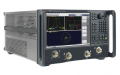
Hello, I would like to perform Automatic Fixture Removal in N5224B PNA Microwave Network Analyzer .
Is there a manual I could use so he will show how to do it in this device?
Thanks.
My first Network Analyzer was very hard to learn how to use it. (HP) and came with a 100-page manual.
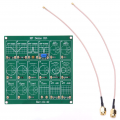
My second analyzer had a one-page manual. It came with this board. $13 on Amazon.
Rectangle 1 is a low pass filter. 2 is a high pass filter. 3 is a bandpass filter. 4 is band reject filter. 5 is 33 ohms or a SWR of 1.5.
Connect your analyzer to each and test. You will learn how to use the analyzer very fast.
This is the technical support page for the AFR option for that PNA. If you follow the AFR wizard (assuming you have the AFR option, that is), it'll guide you through the process. Effectively, you define what you already know about the fixture, do a back-to-back measurement of the connectors/fixtures, then use the resulting measurement files from the THRU and the fixture measurement files that the PNA calculates from the THRU measurement it did with a measurement of the entire DUT (including fixtures) in the last step of the wizard to generate a measurement file with the fixtures removed.
I don't think there's a good way to use the AFR files as stand-ins for calibration; you use AFR to do post-measurement corrections on a measurement that has the fixtures embedded.
Addendum: This is a link to the application note PDF. You need to sign into Keysight's webpage to download it, but to make an account and download files is free aside from the few minutes it takes to make an account if you don't already have one.
Addendum 2: This webpage has instructions/information as well.
Fixture removal removes the effects of the fixture (or attempts to do so) from a measurement that's already been taken. There's two primary ways this is done: TDR and cascaded S-parameters. The latter is done by Keysight, and how it works is that the PNA takes a TDR measurement of the back-to-back fixture setup, determines the midpoint, and splits the TDR signal in two. Then, during the AFR algorithm, it converts the S-parameter measurement of the entire system (DUT and fixtures both) to an equivalent TDR response (the math is more complex than just "inverse Fourier transform," but that's the heart of it), does what amounts to a pattern match for the fixtures in the total TDR measurement, and moves the start and endpoints of the TDR response to between those two parts. It then converts the remaining TDR signal back to S-parameters. This resulting set of S-parameters is the de-embedded DUT, more-or-less.
Back-to-back cascaded S-parameters, as is done in other VNAs, is simpler, but not guaranteed as accurate. It works similarly, getting S-parameters for both the full system and the back-to-back fixture by itself. It then uses a bit of math to take the S-parameter block from the back-to-back fixtures and split them in half (S-parameters are converted to ABCD or T parameters, the matrix square root taken, and the result swapped back to S-parameters, with phases corrected as necessary). It then converts the bisected fixture S-parameters and the full system S-parameters back to transmission parameters (ABCD or T), does a little matrix math to get the transmission matrix of just the DUT, and converts that back to S-parameters.
Both AFR methods mentioned are approximates and aren't perfect. They also require the DUT to be de-embedded after every measurement, assuming the fixture hasn't changed between.
Calibration itself eliminates this process. Through one of several standards (SOLT, TRL, TRRL, multi-line TLR, and many others), the PNA is able to actually calculate the "error terms" - the actual matrix elements of all the fixtures and whatnot. This moves the "reference plane" of the PNA from the port of the PNA to the end of the fixture. Then, any device (that uses the same fixture) can be measured, and all the connectors and fixtures are already acocunted for in the measurement, pre-removed. It's a tedious process, and only works if you have a proper calibration kit (you can make one yourself, but it's not easy, especially for wideband calibrations). Supposedly there are one-port calibration techniques, but I haven't looked into them.
Tl;dr: AFR is a post-hoc de-embedding process that's only a "good approximate," while proper calibration pre-emptively eliminates the fixtures from the measurement from the get-go. The former is easier to set up and do but has to be done with every measurement, the latter is more robust and you sacrifice initial time to do the calibration to save a lot of time later.

 Facebook
 Google
 GitHub
 Linkedin