Facebook
 Google
 GitHub
 Linkedin
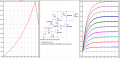
thank you for your reply really thank youLets play SPICE.
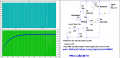
Never let a transistor turn on with a capacitor load. If you have to have a capacitor then this is how.
I added L1 so M1 will turn on into a inductor not a capacitor. C1 is across the motor like you want.
I speed up the PWM by 10:1 from your circuit to keep L1 small.
View attachment 223311
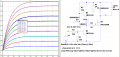
When C1 connects to M1 you had 24A and 20V at the same time on M1. HOT
Now with L1 added M1 turns on with very little current.
i think it's kind of too faraway from my thought.
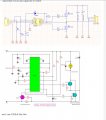
my circuit is about motor control speed circuit (24v 3a 3800rpm)
i found a lot of circuits, and i tried most of all.
i read datasheets and i learn to calculate NPN base, FET gate resistors
finally i made circuit and through the "RPM to Hz calculation" 3800rpm motor PWM signal start with 120hz.
60khz working good. but fet gets too hot (over 50 degree)
20khz working good. but still fet gets too hot (over 45 degree)
300hz workng good. but there is a ripple.(turn on/off speed like "Car turn indicators")
i tried decrease gate resistor and base resistor.
according to my calculation
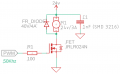
2n2222a base R -> 460<R<1K
IRLR024N gate R -> 46<R<460
(time for fully turn off)
so i used heatsink, but everyone says that 24v 3A is not a high voltage so i can do this without heatsink
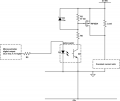
so i tried add C1 in my circuit, it works good
(not fully off problem was in my code)
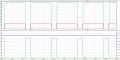
i know pwm signal in graph is like rectangle(bolcks)
"make that graph smooth using cap will good" this was my idea.
(between turn on and turn off fill to capacitor)
this is why i'm using C1 in my motor.
it works good but, now i know cap is over charging(20A).
i thought decrease cap value -> decrease cap charging
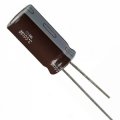
so i just buy to cap (100uF/50V)