My Lamp won't light?

MrChips

Joined Oct 2, 2009
34,807
Go back and read what I have posted.

If the lamp (load) is on the emitter, this is COMMON COLLECTOR configuration.

If the load is on the collector, this is COMMON EMITTER configuration.

The two are very different and behave very differently. If you were to analyse the behaviour of COMMON COLLECTOR circuit, you will notice that the base-emitter voltage is affected by the emitter current. Every time you increase the current through the load, the base-emitter voltage is reduced. This is huge negative feedback which suppresses any voltage gain. The base bias has to play catch up in order to keep the transistor conducting.
 

MisterBill2

Joined Jan 23, 2018
27,501
For a PNP transistor to conduct, the emitter must be more positive than the collector. At least, until it is forced into reverse breakdown. Also, the base-emitter junction must be forward biased.
 

Thread Starter

Homebrew1964

Joined Nov 22, 2024
188
I have my circuit doing what I needed via the suck it and see technique....I have ADHD and am no good with math.

Thanks for all the replies.
 

panic mode

Joined Oct 10, 2011
4,974
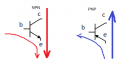
using conventional current flow (from positive to negative) it looks like this:
1775926987741.png
The only difference between PNP and NPN is current direction.
Notes:

base current direction and symbol arrow for BJT match (both are in the same direction).

For NPN ("P" is in the middle, which is base), you need "P"ositive current into base.

For PNP ("N" is in the middle, which is base), you need "N"egative current into base (or current flowing out of base).

Base current and Collector current combine and become Emitter current.

In general base current is much smaller than collector or emitter current - usually it is so much smaller that difference between emitter and collector current is also insignificant... (usually).

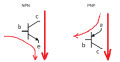
since convention is to read from left to right and top to bottom, even in schematics. PNP transistor is usually shown in flipped orientation, at least today (old circuits used Germanium transistors and PNP used to be more common back then):

1775927487748.png

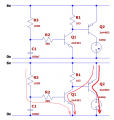
using this it is easy to see why mixed circuits (using both PNP and NPN) look like this:
1775927926887.png

above is consistent since all currents flow from higher potential (6V) towards lower potential (0V).

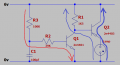
it should be obvious that you cannot have currents go both ways like this (this is a wrong circuit):
1775929090126.png
 
Last edited:

Thread Starter

Homebrew1964

Joined Nov 22, 2024
188
using conventional current flow (from positive to negative) it looks like this:
View attachment 365835
The only difference between PNP and NPN is current direction.
Notes:

base current direction and symbol arrow for BJT are in same direction.

For NPN ("P" is in the middle, which is base), you need "P"ositive current into base.

For PNP ("N" is in the middle, which is base), you need "N"egative current into base (or current flowing out of base).

Base current and Collector current combine and become Emitter current.

In general base current is much smaller than collector or emitter current - usually it is so much smaller that difference between emitter and collector current is also insignificant... (usually).

since convention is to read from left to right and top to bottom, even in schematics. PNP transistor is usually shown in flipped orientation, at least today (old circuits used Germanium transistors and PNP used to be more common back then):

View attachment 365836

using this it is easy to see why mixed circuits (using both PNP and NPN) look like this:
View attachment 365837

above is consistent since all currents flow from higher potential (6V) towards lower potential (0V).

it should be obvious that you cannot have currents go both ways like this (this is a wrong circuit):
View attachment 365839
Thank you for that explanation..... Very easy to understand.
 

panic mode

Joined Oct 10, 2011
4,974
the next milestone in understanding BJTs is different connections....
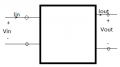
normally, any circuit with input and output can be generalised as a black box.... when input and output are separate.

1775931193858.png

but... transistor is a 3-terminal device... so regardless how the transistor is cnnected, one of those three terminals will need to be part of both input circuit... and output circuit.

this leads us to three scenarions:
common emitter,
common base,
common collector.

if you look at first image in previous post, you will notice that input current is what we marked as base current... but this small current is present both at Base and Emitter. so both base and emitter can be inputs.
the much larger current is the present at Collector and Emitter. so both of those terminals can be an output.

this determines how the terminals are used:

in "common emitter" circuit, base is the input, collector is output.
in "common base" circuit, emitter is input and collector is output.
in "common collector" circuit, base is an input and emitter is the output terminal.

each of the connections have certain characteristics... input impedance, output impedance, voltage gain, current gain....
knowing those characterises one can choose circuit that is most suitable for the application at hand.
 
Top