Facebook
 Google
 GitHub
 Linkedin

Go back and read what I have posted.
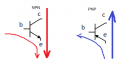
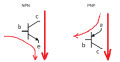
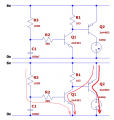
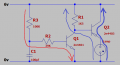
If the lamp (load) is on the emitter, this is COMMON COLLECTOR configuration.
If the load is on the collector, this is COMMON EMITTER configuration.
The two are very different and behave very differently. If you were to analyse the behaviour of COMMON COLLECTOR circuit, you will notice that the base-emitter voltage is affected by the emitter current. Every time you increase the current through the load, the base-emitter voltage is reduced. This is huge negative feedback which suppresses any voltage gain. The base bias has to play catch up in order to keep the transistor conducting.
If the lamp (load) is on the emitter, this is COMMON COLLECTOR configuration.
If the load is on the collector, this is COMMON EMITTER configuration.
The two are very different and behave very differently. If you were to analyse the behaviour of COMMON COLLECTOR circuit, you will notice that the base-emitter voltage is affected by the emitter current. Every time you increase the current through the load, the base-emitter voltage is reduced. This is huge negative feedback which suppresses any voltage gain. The base bias has to play catch up in order to keep the transistor conducting.