Multiple independent slotted optical switches

Thread Starter

brodonh1

Joined Sep 15, 2008
13
slotted-optical-switches.png

Hi All,
I'm using 4 reed switches to independently switch DC and I want to do the same task with
slotted optical switches and mosfets.
My question is what is required to make the opto switches independent.
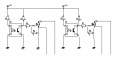
I breaded boarded two and and one switches both mosfets on.
I used common power supply for optos and common power supply through Drain and Source of fets.
All with common ground.
Could I use the slotted optos as optocouplers along with their switching or should I add couplers.
Direction for "normal" solution is needed.
Haven't been able to find any examples.
Thanks for any advice,
Donald

Moderators note : Please cut away all white space next time
 
Last edited by a moderator:

dl324

Joined Mar 30, 2015
18,221
My question is what is required to make the opto switches independent.
I breaded boarded two and and one switches both mosfets on.
The opto emitters are both on continuously; connect to separate controls.

Please clip most of the whitespace from your images.
 

AnalogKid

Joined Aug 1, 2013
12,050
There is a lot of information missing from your question (resistor values, logic polarity, FET voltage and current), so all answer will be guesses. Still, for the schematic in post #1, a few observations:

1. You don't state what logic polarity you are trying to achieve. When the opto is on, do you want the FET to be on or off? For what you have drawn, opto ON equals FET OFF.

2. You can eliminate half of the resistors. For the left circuit, you can remove R3 an R4, and connect the FET gate directly to the opto collector.

3. As drawn, there is no control of anything. Both LEDs are on all the time, which means both opto transistors are on all the time, which means both FETs should be off.

BUT

4. A MOSFET is different from a bipolar transistor in many ways, and one of them is the way it behaves with low voltages and currents. Even with the gate shorted to the source, the FET is not completely off; a very low current still can move through the channel. If Vgs is slightly above zero V, this current increases. Depending on the current the FET is controlling, this might be enough to appear partly on when it should be off.

In your circuit the gate voltage Vgs is set by the current through the opto transistor and its collector pullup resistance. The goal is for the opto transistor to be saturated, but optocoupler transistors are not like normal transistors; they frequently do not have super low saturation voltages. The transistor current is set by the LED current and the current transfer ratio (CTR) of the optocoupler. So it is possible that the FETs are on all the time because your control circuit never turns them off even though the schematic looks like it should. Without all resistor values, no one knows.

ak
 
Last edited:

Thread Starter

brodonh1

Joined Sep 15, 2008
13
There is a lot of information missing from your question (resistor values, logic polarity, FET voltage and current), so all answer will be guesses. Still, for the schematic in post #1, a few obwervations:

1. You don't state what logic polarity you are trying to achieve. When the opto is on, do you want the FET to be on or off? For what you have drawn, opto ON equals FET OFF.

2. You can eliminate half of the resistors. For the left circuit, you can remove R3 an R4, and connect the FET gate directly to the opto collector.

3. As drawn, there is no control of anything. Both LEDs are on all the time, which means both opto transistors are on all the time, which means both FETs should be off.

BUT

4. A MOSFET is different from a bipolar transistor in many ways, and one of them is the way it behaves with low voltages and currents. Even with the gate shorted to the source, the FET is not completely off; a very low current still can move through the channel. If Vgs is slightly above zero V, this current increases. Depending on the current the FET is controlling, this might be enough to appear partly on when it should be off.

In your circuit the gate voltage Vgs is set by the current through the opto transistor and its collector pullup resistance. The goal is for the opto transistor to be saturated, but optocoupler transistors are not like normal transistors; they frequently do not have super low saturation voltages. The transistor current is set by the LED current and the current transfer ratio (CTR) of the optocoupler. So it is possible that the FETs are on all the time because your control circuit never turns them off even though the schematic looks like it should. Without all resistor values, no one knows.

ak
Thanks ak for responding,
I have what I need regarding 12v supply into opto sw and R values to switch one mosfet as desired.
Can I use same 12v supply to 4 sw with independent operation?
If so how?
Thanks,
Donald
 

Thread Starter

brodonh1

Joined Sep 15, 2008
13
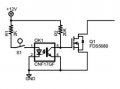
Something like this times 4:
View attachment 90429
MOSFET is normally on and turned off by closing S1.
Hi Dennis,
Thanks for responding. If I have slotted opto sw plus you s1 then the slotted opto sw would have to be set to function as a
opto coupler or just use an opto coupler and not slotted. It would work. I could use reeds to switch the couplers on.

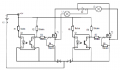
I thought of another possibility and brd borded it and it works with 2 large led's (matched load through the mosfets).
Schematic attached. Don't know how this will be with unmatched larger loads. I need to switch up to 400V, .3A.
independent_opto_swtich.png

Dear Moderator,
I don't know how to take the white space out and keep the image.
Thanks,
Donald

Moderators note : again removed white space from picture
 
Last edited by a moderator:

dl324

Joined Mar 30, 2015
18,221
Dear Moderator,
I don't know how to take the white space out and keep the image.
There are many ways to do it.

You can load the image in your favorite photo editor, select and cut the desired portion, and paste the selection into another image file.
 

Sensacell

Joined Jun 19, 2012
3,769
R3,R4,R7,R8 are not doing anything beneficial, eliminate them.

You want the gate voltage to be 0-12 V to ensure your FETs are turned on fully, R4 and R8 cut the gate voltage to 6V.
R3 and R7 would only serve to slightly slow the FET turn off time, not necessary.
 
Top